
- 10 Mbps: Previous average speed of cellular-based systems, often unreliable. - **Starlink's
Experts agree that Landline's integration of Starlink internet into its fleet represents a significant advancement in ground transportation connectivity, setting a new industry standard for passenger comfort and productivity during airport commutes.
Landline Buses Get Starlink, Erasing the Airport Commute Dead Zone
FORT COLLINS, Colo. – March 04, 2026 – The often-unproductive commute to a major airport hub is being transformed into a fully connected, premium travel experience. The Landline Company, a firm specializing in ground transportation for airline partners, announced today that its entire fleet of motorcoaches is now equipped with high-speed Starlink satellite internet, offered free to all passengers.
This upgrade aims to eliminate the connectivity "dead zones" frequently encountered on highways and in rural areas, providing a seamless gate-to-gate digital experience for travelers connecting through major hubs like Chicago O'Hare (ORD), Philadelphia (PHL), and Toronto Pearson (YYZ).
A First-Class Experience on the Ground
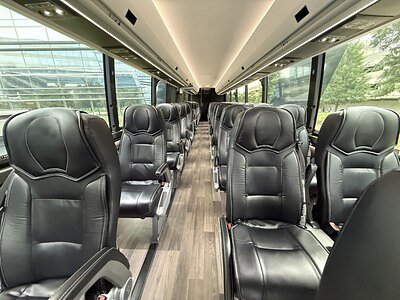
For many travelers, the journey to the airport is a necessary but disconnected part of the travel day. Landline is working to change that perception by creating an environment that mirrors the comfort and productivity of a premium airline cabin. The company's Prevost H3-45 motorcoaches are already outfitted with spacious 2x1 leather seating, generous legroom, individual power outlets, and large tray tables. The addition of streaming-quality Wi-Fi is the final piece of the puzzle.
Previously, the company relied on cellular-based systems, which could be unreliable. Research indicates that such systems often delivered sluggish speeds averaging just 10 Mbps, leading to inconsistent coverage and passenger frustration. The switch to Starlink, engineered by SpaceX, promises a radical improvement. Starlink's "Land Mobility" service is specifically designed for vehicles in motion, leveraging a massive constellation of low-Earth orbit satellites to provide consistent, high-speed internet access, even in areas where cellular service is weak or nonexistent.
"At Landline, we're redefining airport travel by delivering a premium onboard experience that our customers love," said David Sunde, Chief Executive Officer of Landline, in a statement. "By equipping our entire fleet with Starlink, we're giving passengers fast, free Wi-Fi that works gate to gate. This investment in best-in-class connectivity underscores our commitment to a seamless, airline-integrated connecting experience from ground to air."
Passengers can now reliably stream movies, participate in video calls, and work on cloud-based documents without interruption, effectively turning travel time into productive time or leisure time.
The Strategic Value of a Connected Coach
Beyond enhancing passenger comfort, the Starlink integration represents a significant strategic move for Landline and its airline partners, which include American Airlines, Air Canada, and Sun Country Airlines. The company's business model is built on creating "multi-modal" travel networks, allowing airlines to affordably extend their reach into smaller markets without the operational costs and complexities of adding short-haul flights.
Customers book a single ticket through the airline, which includes the Landline segment. They check their bags and even clear TSA security at their local Landline station, then arrive airside at the major airport hub, ready to walk to their connecting flight. This process, combined with protected connections, is designed to make the bus journey feel like an extension of the flight itself.
The upgrade to a robust Wi-Fi network strengthens this value proposition considerably. Airline partners like Air Canada have already renewed and expanded their agreements with Landline, citing the innovative approach and positive customer feedback. By ensuring the ground experience is as connected and comfortable as the air experience, Landline makes these bus-to-plane routes more attractive to passengers, encouraging adoption and enabling further network growth for its airline partners.
Pushing the Boundaries of Travel Tech
The decision to deploy Starlink fleet-wide is more than just a customer amenity; it signals a broader shift in the travel industry's approach to ground transportation. For years, services like buses and trains have lagged behind airlines in technological adoption, particularly concerning connectivity. Landline's investment sets a new benchmark, challenging the status quo and raising passenger expectations for all forms of transit.
The technology itself is built for the rigors of the road. The Starlink Performance Kit used for such deployments is engineered for durability, capable of withstanding harsh weather and constant vibration. While the service requires a clear view of the sky and can be affected by urban canyons or dense tree cover, its performance in open-road conditions far surpasses traditional mobile internet solutions.
This move also highlights the growing demand for ubiquitous connectivity. As remote work and flexible lifestyles become more common, travelers increasingly expect to be able to work, communicate, and be entertained from anywhere, including during the journey itself. By addressing this demand head-on, Landline positions itself not just as a transportation provider, but as a facilitator of a modern, mobile lifestyle. This initiative could pressure other ground transport operators to reconsider their own digital offerings, potentially sparking a wave of similar upgrades across the industry. The era of the disconnected commute may be drawing to a close, replaced by a new standard where every leg of the journey is a fully connected experience.