
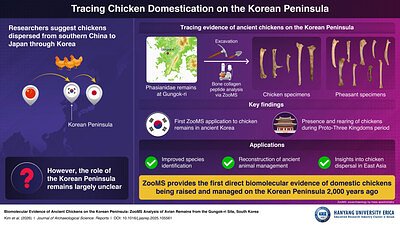
- 2,000 years ago: Domesticated chickens were managed by humans in Korea.
- 5 out of 14 bone fragments: Identified as domestic chickens using ZooMS.
- Elevated nitrogen isotopes: Evidence of human-managed diets for ancient Korean chickens.
Experts conclude that this study provides definitive evidence of early chicken domestication and management in Korea, rewriting the history of human-animal relationships in East Asia.
Korea's Ancient Chickens: Science Rewrites 2,000-Year-Old History
GYUNGGI-DO, South Korea – April 22, 2026 – For millennia, the chicken has been a cornerstone of Korean culture and cuisine, but its origins on the peninsula have remained a mystery shrouded in fragmented history. Now, a groundbreaking study by researchers at Hanyang University ERICA is providing the first definitive, science-based answers, proving that domesticated chickens were being managed by humans in Korea as far back as 2,000 years ago.
The discovery, published in the Journal of Archaeological Science: Reports, not only confirms the ancient presence of this vital livestock but also introduces a revolutionary scientific approach that is set to rewrite the history of human-animal relationships across East Asia. By analyzing tiny bone fragments from an archaeological site, the team has filled a crucial gap in our understanding of the chicken's journey from its wild origins to tables across the world.
A New Toolkit for an Ancient Puzzle
For decades, archaeologists in Korea have faced a persistent challenge: the bird bones recovered from ancient sites are often too small and broken to be identified with certainty. It has been nearly impossible to distinguish the remains of domestic chickens (Gallus gallus) from those of their wild relatives, such as the common pheasant (Phasianus colchicus), using traditional visual analysis alone. This has left the role of the Korean Peninsula in the broader story of chicken dispersal—long assumed to be a simple transit route from China to Japan—largely as a matter of academic debate.
The Hanyang University team, led by Professor Kyungcheol Choy of the Department of Cultural Anthropology, overcame this obstacle by employing a cutting-edge technique known as Zooarchaeology by Mass Spectrometry (ZooMS). This biomolecular method analyzes the protein collagen, which survives in bone for thousands of years. By examining the unique amino acid sequences within collagen peptides, ZooMS can act as a "protein barcode," identifying a species from a sample as small as two milligrams.
"The most important contribution of this work is the first application of ZooMS to avian remains in Korean archaeology, which opens several practical applications," stated Professor Choy in the university's press release.
At the Gungok-ri archaeological site in South Korea, the team applied this technique to 14 bird bone specimens from the Proto-Three Kingdoms period (approx. 80 CE to 361 CE). The results were unambiguous: five of the fragments belonged to domestic chickens, while eight were identified as pheasants. This provided the first concrete, biomolecular evidence of chickens on the peninsula during this era.
More Than Just Bones: Proof of Ancient Farming
Confirming the presence of chickens was only the first step. The researchers sought to answer a more profound question: were these birds simply hunted, or were they an integrated part of human society? To find out, they deployed a powerful multi-proxy approach, combining ZooMS with radiocarbon dating and stable isotope analysis.
The isotope analysis of the bone collagen yielded the most revealing insights into the human-animal relationship. By measuring the nitrogen isotope values in the chicken bones, the team found them to be significantly elevated. This chemical signature indicates a diet rich in protein, likely from C4 plants like millet or from kitchen scraps—a diet that could only be provided through direct human intervention. In short, these weren't wild birds foraging for themselves; they were being actively fed and managed by people.
"In our study, we confirmed not only the presence of chickens but also their management during the Proto-Three Kingdoms period," Professor Choy remarked. "We applied the stable isotope analysis to bone collagen and confirmed that ancient chickens were managed in Korea during this era."
This finding transforms our understanding of early Korean agriculture and livestock husbandry. It provides tangible proof that, two millennia ago, chickens were already a managed resource, likely valued for their eggs, meat, and perhaps even for cultural or ritualistic purposes, echoing their prominent role in Korean founding myths. This deep-rooted connection helps explain the bird's enduring place in the nation's culinary identity, from traditional dishes to the modern obsession with chimaek (chicken and beer).
Redrawing the Map of East Asian Domestication
The implications of the Hanyang University study ripple far beyond the Gungok-ri site. For years, the prevailing theory held that chickens, first domesticated from the Red Junglefowl in Southeast Asia around 1,500 BCE, spread northward into China and then onward to Japan, with Korea serving as a passive land bridge. While the earliest evidence of chickens in Japan dates to the Yayoi period (4th-3rd century BCE), the lack of corresponding proof from Korea left a significant void in the narrative.
This research fills that void, positioning the Korean Peninsula as an active participant in the dispersal and development of one of the world's most important domestic animals. It suggests a more complex and direct history of animal husbandry in the region than previously assumed.
"The significance of this study goes well beyond a single archaeological site. It lays the methodological groundwork for rewriting the history of human-animal relationships in East Asia," highlighted Professor Choy.
The robust methodological framework—combining ZooMS, dating, and isotopes—is now a proven model for future research. The team plans to apply this approach to avian remains from other Korean archaeological sites over the next decade. This will allow them to reconstruct, with unprecedented accuracy, the specific routes and timelines by which chickens entered the peninsula and were subsequently transmitted to Japan.
This new scientific lens is not limited to chickens. The same techniques can be applied to the fragmented remains of other key domesticated animals, such as pigs, cattle, and horses, to illuminate the development of livestock economies. Furthermore, this biomolecular toolkit holds the potential to answer broader questions about ancient human diet, disease, migration patterns, and even environmental change, heralding a new era for the investigation of the human past in Korea and the wider region. This research provides a solid, science-based foundation for museum exhibitions and educational programs, finally connecting the tangible past to the living culture of today.