
- 370,000 visitors attended Salone del Mobile 2026 in Milan, where Knoll showcased its vision.
- Dozie Kanu's debut furniture collection earned praise from leading design publications.
- Knoll's pavilion was constructed entirely from repurposed, recycled, and fully recyclable materials.
Experts would likely conclude that Knoll successfully balanced its modernist heritage with contemporary innovation and sustainability, setting a benchmark for responsible design leadership in the industry.
Knoll's Future Vision: Art, Heritage, and Sustainability in Milan
MILAN, April 21, 2026 – Amid the vibrant energy of Salone del Mobile 2026, which drew over 370,000 visitors to the global capital of design, Knoll articulated a powerful and multi-layered vision for its future. Under the creative direction of Jonathan Olivares, the iconic brand masterfully balanced its deep-rooted modernist heritage with a bold embrace of contemporary artistic expression and a tangible commitment to sustainability. The presentation was not merely a product launch but a cohesive statement on the evolving nature of design, demonstrating how a legacy brand can lead conversations about materiality, culture, and responsible manufacturing.
Knoll's showcase featured pioneering collaborations with artists and architects, extensions to successful collections, the revival of a beloved classic, and a significant partnership celebrating its own history, all housed within a pavilion that was itself a testament to circular design principles.
The Art of Living: Furniture as Sculpture
The centerpiece of Knoll's debut was the arresting collection of tables by Dozie Kanu, a US-born, Portugal-based sculptural artist. Marking his first commercial furniture line, the console, coffee, and side tables immediately became a highlight of the fair, earning praise from leading design publications. Kanu's work transforms the static nature of a table into an animated, performative object. The designs juxtapose rigid steel rods with taut leather tops and flowing fringe tassels that sway with the slightest movement, creating fleeting glimpses of the space around them.
These pieces are deeply personal, weaving a narrative of Kanu's “personal geography.” The leather top is a nod to an African drum from his collection, while the dramatic fringe merges the visual language of African ceremonial dress with the flair of Texas cowboy culture. “It's not decoration,” says Kanu. “It's a formal expression of exploration and desire.” Knoll Creative Director Jonathan Olivares praised the collection's unique perspective, stating, “By approaching design through a sculptural lens, his pieces for Knoll animate space with a distinct attitude, while remaining direct in structure and function.”
This theme of furniture transcending function to become art continued with extensions to other acclaimed collections. Architect and sculptor Jonathan Muecke expanded his Muecke Wood collection with a new lounge chair, ottoman, coffee table, and side table. Building on the principles of his art practice—that “material is elemental, repetition is clarity, and logic is freedom”—the new pieces explore the rhythmic interplay of clean, repeating forms, emphasizing the organic beauty of the wood itself.
Similarly, the architecture firm Johnston Marklee, led by Sharon Johnston and Mark Lee, grew their Biboni seating collection. Following the introduction of the sofa in 2025, the collection now includes a lounge chair and ottoman, plus new sectional elements and a deep-seat option for the sofa. The designs are defined by their sculptural, anthropomorphic qualities, using plush scallops and soft folds to shape space through volume and curves, creating an inviting form that feels both formal and supremely comfortable.
A Legacy Reimagined: Honoring the Past, Shaping the Future
While pushing the boundaries of contemporary form, Knoll simultaneously reinforced its profound connection to its own history. In a major cultural partnership, parent company MillerKnoll served as Main Partner for the Triennale Milano exhibition, Lella and Massimo Vignelli. A Language of Clarity. The major retrospective, running through September, examines the immense impact the Vignellis had across graphic systems, product design, and interiors.
MillerKnoll lent key historical works from its archives, including monumental posters from the 1972 Knoll au Louvre exhibition and iconic products like the Handkerchief Chair. This move highlights the Vignellis' central role in defining Knoll’s corporate and graphic identity during a period of critical international growth. “The Vignellis brought extraordinary clarity to Knoll at a pivotal moment in its international expansion,” said Amy Auscherman, Director of Archives & Brand Heritage at MillerKnoll. This strategic celebration of heritage serves not just as a history lesson, but as a foundation upon which the brand’s contemporary innovations are built.
This dialogue between past and present was perfectly embodied in the European reintroduction of the Morrison Hannah Chair. Originally designed in 1973 by Andrew Morrison and Bruce Hannah, the chair was conceived to be “easy to manufacture, easy to reupholster, easy to live with, and easy to love.” The 2026 revival maintains this spirit while incorporating updated ergonomics, more comfortable foam, and a wider range of tilt, making it ideal for the fluid demands of modern hybrid work. It delivers discreet office performance with residential comfort, proving that great design can be thoughtfully evolved to remain relevant for generations.
Designing with Conscience: A Pavilion of Principle
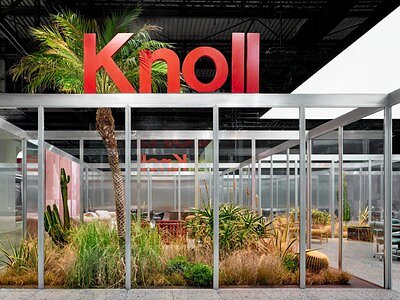
Knoll's commitment to forward-thinking design extended beyond the products to the very space they were presented in. For the fourth consecutive year, the exhibition pavilion was designed by the Belgian architectural duo OFFICE, led by Kersten Geers and David Van Severen. Advancing a powerful sustainability-driven vision, the entire structure was constructed from repurposed, recycled, and fully recyclable materials.
This principled approach to temporary architecture aligns with the broader mission of Salone del Mobile, which has intensified its focus on circularity and achieved ISO 20121 certification for sustainable event management. By creating an environment that is as thoughtfully considered as the objects within it, Knoll demonstrated a holistic “total design” philosophy, where material choices, environmental impact, and aesthetic form work in complete harmony.
This dedication to responsible design, whether through the sustainable pavilion or the human-centric ergonomics of the revitalized Morrison Hannah Chair, underscores a deep-seated corporate conscience. By weaving together the threads of avant-garde artistic collaboration, reverent archival celebration, and a clear commitment to sustainable and practical innovation, Knoll's presence in Milan was a definitive statement. It showcased a brand that is not just participating in the future of design, but actively and thoughtfully shaping it.