
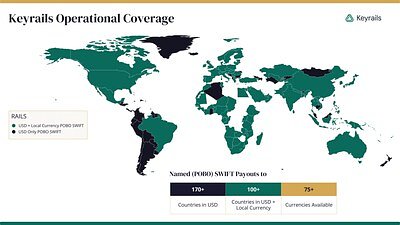
- 100+ markets and 75+ currencies supported by Stable OS 2.0
- $33 trillion in stablecoin transaction volumes in 2025
- 450+ nostro accounts in over 100 jurisdictions for direct settlement
Experts view Keyrails' Stable OS 2.0 as a significant step toward streamlining cross-border trade finance by integrating stablecoins with traditional banking systems, addressing long-standing inefficiencies in emerging markets.
Keyrails Bridges Stablecoins and SWIFT for Emerging Market Trade Finance
LONDON, UK – May 13, 2026 – Fintech firm Keyrails today announced the launch of Stable OS 2.0, a new institutional payment platform that aims to overhaul high-value cross-border trade payments by creating a direct link between stablecoins and traditional banking infrastructure. The system is designed to solve long-standing execution problems for financial institutions operating in complex emerging markets.
The platform enables banks, fintechs, and trade operators to execute payments across more than 100 markets and over 75 currencies using a single, unified wire instruction. This move addresses the fragmented and often unpredictable nature of international trade finance, which has long been plagued by multiple intermediaries and inconsistent processes.
Bridging Digital Assets and Traditional Rails
At the heart of Stable OS 2.0 is an innovative hybrid model that connects the burgeoning world of digital assets with the established global banking system. The platform allows institutions to initiate payments directly from stablecoin wallets, which are then routed through the conventional SWIFT network using Keyrails' unique Bank Identifier Code (BIC), KEYRCA62.
Instead of navigating the complex web of correspondent banks typically associated with SWIFT transfers, Keyrails leverages a network of over 450 nostro accounts—accounts held in foreign currencies at other banks—in more than 100 jurisdictions. This network, maintained with major correspondent banks like JPMorgan, BNY Mellon, and Citi, allows payments to be settled directly at the beneficiary's bank via the local Real-Time Gross Settlement (RTGS) system. RTGS is the fast, interbank payment rail used by central banks for high-value transactions, effectively bypassing the slower, multi-step international wire process.
"Trade payments still depend on a chain of intermediaries no one controls end-to-end," said Berhan Kongel, CEO of Keyrails, in the company's official announcement. "Stable OS 2.0 gives institutions a standardized execution path across complex markets: payments can be instructed directly from stablecoin wallets, move through one wire instruction and one flow, and settle at the beneficiary bank via local RTGS."
To ensure security and scalability, Keyrails has partnered with Dfns for its wallet infrastructure, enabling automated and secure management of digital assets. Furthermore, by maintaining direct banking relationships in the key financial hubs of New York, London, and Hong Kong, the company provides an extended processing window with an average of 12 hours of uptime daily.
Tackling the 'Execution Problem' in Global Trade
The launch targets what Keyrails calls the 'execution problem' in cross-border payments. For businesses involved in import, export, and commodity trading, the issue is not just the speed of a transaction but the lack of control and predictability. Traditional wires can take two to five business days, accrue opaque fees from intermediary banks, and offer little transparency once dispatched. This often forces companies to pre-fund accounts in foreign markets, trapping significant capital that could be used for growth.
Stable OS 2.0 is engineered to provide greater control and visibility. The platform automatically generates a Unique End-to-End Transaction Reference (UETR), allowing the sender to track the payment in real-time. It also employs a Payments On Behalf Of (POBO) scheme, which ensures the original sender is clearly identified in the SWIFT message, simplifying reconciliation and improving compliance transparency.
By standardizing the execution path, Keyrails aims to reduce the operational handoffs and manual interventions that often lead to delays and errors, especially when dealing with exotic currencies and complex trade corridors. This provides a level of predictability that has been elusive in high-value international trade.
Navigating the Complexities of Compliance
While the technology presents a clear path to efficiency, its success hinges on navigating the intricate regulatory landscape of global finance. Cross-border payments, particularly those involving digital assets and high-risk jurisdictions, face intense scrutiny from regulators focused on Anti-Money Laundering (AML) and Know Your Customer (KYC) protocols.
Industry insiders note that most international payment delays are not technical but are related to compliance checks. Keyrails is addressing this head-on with a proprietary risk assessment system called Fortify360. This tool is specifically designed to help fintechs and financial institutions in developing markets meet the stringent compliance standards of US and European correspondent banks, thereby facilitating their access to the global financial system.
This focus on compliance is critical as financial authorities worldwide, guided by frameworks like those from the Financial Action Task Force (FATF), develop rules for stablecoin integration. By building a system with compliance at its core, Keyrails is positioning itself as a trusted partner for institutions looking to innovate within the existing regulatory framework.
A Strategic Play for the Future of Finance
Keyrails' initiative is timed to capitalize on the surging institutional adoption of stablecoins for settlement. In 2025 alone, stablecoin transaction volumes soared to $33 trillion, signaling a clear market appetite for real-time, programmable financial infrastructure. By treating stablecoins as a programmable treasury layer, Stable OS 2.0 allows for dynamic routing and settlement based on cost, speed, and compliance.
This makes Keyrails a strategic player in the battle for the future of emerging market payments, competing not only with legacy systems but also with other blockchain-based solutions. The company is already making inroads, with enterprises in aviation, telecom, and energy using the platform for cross-border capital movement. A particular focus has been on democratizing trade for Sub-Saharan African fintechs, especially within the vital trade corridor with China.
With its API-driven platform and plans to expand its product offerings for African, Middle Eastern, and Latin American corridors, Keyrails is not just building a payment rail. It is assembling the components of a 'programmable CFO stack'—an integrated operating system for payments, treasury, and credit designed for the unique challenges and opportunities of global B2B finance in the 21st century.