
- Base Case NPV: US$-6 million (negative after-tax NPV under long-term consensus metal prices)
- Spot Case NPV: US$445 million (after-tax NPV under April 2026 spot prices)
- Initial CAPEX: US$609 million (upfront capital expenditure for mine construction)
Experts would likely conclude that the Kay Mine Project's economic viability hinges on sustained high metal prices, making it a high-risk, high-reward investment with significant financing and regulatory challenges.
Kay Mine PEA: A High-Stakes Bet on Soaring Metal Prices
TORONTO, ON – April 30, 2026 – Arizona Metals Corp. today released a long-awaited Preliminary Economic Assessment (PEA) for its Kay Mine Project, presenting a complex picture of a venture teetering between marginal viability and a potential windfall. The study, prepared by the reputable G Mining Services, outlines a project whose economic fate is almost entirely dependent on the future of volatile commodity markets, revealing a stark contrast between its conservative base case and a far more lucrative scenario based on recent spot prices.
While the company framed the report as establishing a "credible development opportunity," the initial financial models present a challenging path forward. The base case, using long-term consensus metal prices, projects a negative after-tax net present value (NPV) of US$-6 million with a meager internal rate of return (IRR) of 4.9%. These figures, falling short of typical investor thresholds for new mine development, underscore the project's economic headwinds under historical pricing models.
However, the report also paints a dramatically different picture. A "Spot Case" sensitivity analysis, using the high metal prices of April 22, 2026, transforms the project's outlook, projecting a robust after-tax NPV of US$445 million and a more compelling IRR of 14.9%. This chasm between the two scenarios lays bare the central gamble for Arizona Metals: the Kay Mine is a high-stakes bet that the current bull market for copper, gold, zinc, and silver is not a temporary peak but a new, sustainable reality.
The $609 Million Hurdle
Beyond the fluctuating commodity prices, the most significant challenge outlined in the PEA is the substantial upfront capital required to build the mine. The initial capital expenditure (CAPEX) is estimated at a hefty US$609 million, with total life-of-mine capital, including sustaining and closure costs, reaching US$731 million. For a junior exploration company, securing financing of this magnitude is a monumental task under any circumstances.
Raising over half a billion dollars for a project with a negative base-case NPV presents a formidable challenge. Financial analysts note that without a clear path to profitability based on more conservative price decks, attracting the necessary equity and debt financing will be difficult. The project's 7.5-year payback period under the base case further complicates the investment thesis.
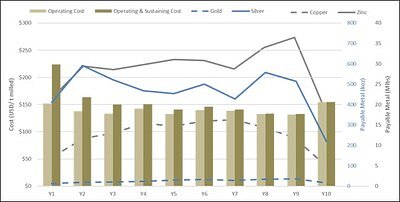
The PEA details a 10-year underground mining operation designed to process approximately 1,918 tonnes of material per day. Over its life, the mine is projected to produce 127 million pounds of copper, 293 million pounds of zinc, 258,000 ounces of gold, and 4.7 million ounces of silver. These production figures are significant, but achieving them requires successfully navigating the massive initial funding and construction phase, which is planned to span 30 months.
A Path Forward Through Expansion and Exploration
Despite the challenging base-case economics, Arizona Metals CEO Duncan Middlemiss highlighted a clear path to enhancing the project's value. In his comments, he emphasized that the PEA provides a "strong technical foundation" and that the study only captures a fraction of the potential at Kay Mine. The current mine plan utilizes only 6.55 million tonnes of the 9.28 million tonnes available in the higher-confidence "Indicated" mineral resource category. The remaining Indicated resource, along with an additional 0.86 million tonnes of "Inferred" resources, represents a significant volume of mineralized material that could be incorporated into future studies to extend the mine life and improve overall economics.
"The PEA captures only a portion of the broader opportunity we see at the Kay Mine Project," Middlemiss stated in the release. He pointed to the deposit remaining open for expansion along strike and at depth, a key characteristic of Volcanogenic Massive Sulphide (VMS) systems like Kay. Continued exploration and resource growth are central to the company's strategy.
Furthermore, the company is actively investigating alternative processing technologies and operational efficiencies. Any reduction in the estimated US$138.47 per tonne total operating cost could lower the cut-off grade, allowing more of the lower-grade material within the existing resource to be economically mined, thereby increasing the scale of the operation and potentially boosting returns.
Navigating the Environmental and Social Landscape
Situated just 43 miles north of Phoenix and immediately adjacent to the community of Black Canyon City, the Kay Mine Project's success depends not only on financing and geology but also on securing a social license to operate. The PEA acknowledges the project's proximity to residential areas and outlines a comprehensive and complex permitting process involving numerous federal, state, and county agencies, including the Bureau of Land Management (BLM) and the Arizona Department of Environmental Quality (ADEQ).
Baseline environmental studies have already identified sensitive factors that will require careful management. A cultural resources inventory documented 28 sites, six of which are recommended as eligible for the National Register of Historic Places. Biological evaluations confirmed the presence of the threatened yellow-billed cuckoo and two BLM-sensitive species—the lowland leopard frog and the Sonoran desert tortoise—within the project area.
Arizona Metals has initiated community engagement efforts, including local sponsorships and the development of an External Relations Plan to manage potential impacts related to traffic, noise, and visual changes. While Arizona has a mining-friendly reputation, navigating the regulatory hurdles and satisfying community and environmental concerns will be a critical, multi-year process. The successful development of Kay Mine will require a delicate balance between tapping into a valuable domestic source of metals and serving as a responsible steward of the local environment and community.
Topics & Related
Environmental Compliance
Geopolitics & Trade
Energy & Infrastructure
Corporate Finance
Copper
Gold
Related Company Pulse