
- $127.6 million: Kandi's 2024 revenue from electric vehicles, accounting for 91% of its total revenue.
- $256.7 million: Kandi's cash reserves as of mid-2025, funding its pivot to AI and robotics.
- $44 billion: Projected global market value for security robots by 2030, growing at 15% annually.
Experts view Kandi's strategic pivot into AI and robotics as a high-risk, high-reward move, leveraging its manufacturing expertise and academic partnerships to compete in a rapidly growing but highly competitive market.
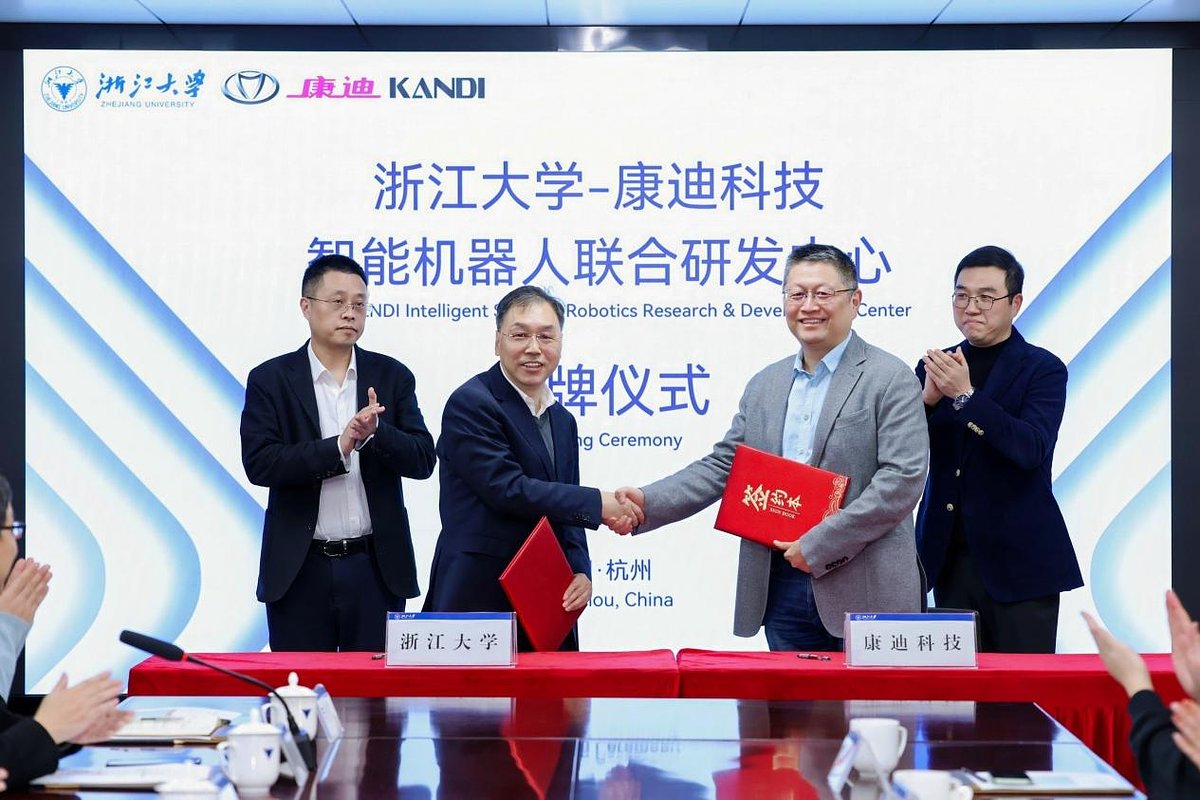
Kandi Technologies Pivots From EVs to AI With New Robotics Center
JINHUA, China – January 05, 2026 – Kandi Technologies Group, a company long known for its electric off-road vehicles, is making a significant strategic pivot into the high-growth field of artificial intelligence and robotics. The NASDAQ-listed firm has announced a partnership with the prestigious Zhejiang University to establish the Zhejiang University–Kandi Intelligent Robotics Joint Research Center, a move that signals a deliberate diversification beyond its core automotive business.
The new center, officially inaugurated on December 26, 2025, will focus on developing core AI technologies like intelligent perception and spatial computing. Its primary mission is to accelerate the creation and commercialization of quadruped robots—four-legged machines often likened to robotic dogs—specifically for the booming security and inspection market. This collaboration aims to fuse Kandi's industrial manufacturing prowess with the university's elite research capabilities, creating a direct pipeline from academic innovation to real-world deployment.
A Strategic Leap Beyond Electric Vehicles
For years, Kandi Technologies (NASDAQ: KNDI) has built its reputation on manufacturing all-electric personal transportation and utility vehicles, with a particular focus on off-road models for the North American market. This segment accounted for over 91% of the company's $127.6 million revenue in 2024. However, the company is now actively leveraging its substantial cash reserves—which stood at approximately $256.7 million in mid-2025—to branch into what it hopes will be higher-margin, proprietary technology sectors.
This is not Kandi's first foray into robotics. In June 2025, the company announced a partnership with Deep Robotics to develop intelligent golf caddy and security patrol robots. It also unveiled an "Intelligent Delivery Robot Dog Solution" in November 2025. The establishment of the new joint research center, however, represents a much deeper and more fundamental commitment to building in-house R&D capabilities in embodied intelligence.
"The launch of the Center underscores our unwavering commitment to strategic investment in technological differentiation," said Mr. Feng Chen, CEO of Kandi, in the official announcement. "By synergizing leading academic research with our deep industrial expertise, we are confident this partnership will generate sustainable momentum for product innovation and long-term value in the intelligent equipment space."
Tapping an Academic Powerhouse
The choice of Zhejiang University as a partner is a strategic masterstroke. The institution is one of China's premier universities and a recognized powerhouse in computer science and robotics. It is home to the State Key Laboratory of Computer-Aided Design and Computer Graphics, the only national-level lab in China dedicated to these technologies.
More importantly, the university has a proven track record in the specific field of quadruped robotics. Its researchers have been behind several high-profile projects, including the "Jueying" series of robot dogs. In August 2025, an affiliated institute unveiled "Black Panther 2.0," a quadruped robot that set a new speed record of 22 miles per hour, showcasing advanced biomimicry and dynamics. This history of cutting-edge development provides Kandi with access to a deep well of talent and established research, significantly de-risking its entry into a complex technological field.
The collaboration is designed for synergy: Zhejiang University will spearhead foundational research, while Kandi will apply its strengths in product engineering, intelligent manufacturing, and global market access to turn prototypes into scalable commercial products.
Targeting the Rise of Robotic Sentinels
The center's specific focus on quadruped robots for security inspection places Kandi squarely in one of the fastest-growing segments of the robotics industry. The global market for security robots was valued at over $16 billion in 2023 and is projected to surge to more than $44 billion by 2030, driven by a compound annual growth rate of nearly 15%.
This explosive growth is fueled by heightened safety concerns, the need to automate tasks in hazardous or inaccessible environments, and the increasing cost-effectiveness of autonomous solutions. Quadruped robots are particularly well-suited for these roles, offering stability and agility across difficult terrains where wheeled robots might fail. They are envisioned for patrolling critical infrastructure, performing surveillance in industrial plants, and detecting threats in high-risk areas.
However, Kandi is entering a competitive arena. The market is currently dominated by pioneers like Boston Dynamics with its famous "Spot" robot, as well as other key players such as ANYbotics and the increasingly popular Unitree Robotics, which offers more affordable solutions. Kandi's success will depend on its ability to differentiate its offerings through technological innovation, cost-effective manufacturing, and targeted applications.
A High-Stakes Bet Amidst Investor Scrutiny
While the strategic logic is clear, this pivot comes at a critical time for Kandi. Despite its strategic initiatives, the company's market capitalization declined significantly in 2024, and it reported a net loss of $51 million for the year. Analysts have expressed caution, questioning whether the company can meet its ambitious 2025-2029 strategic roadmap, which includes substantial revenue targets for smart mobility and battery-swapping technologies.
The move into robotics is therefore a high-stakes bet. It is an attempt to rewrite the company's narrative from that of a niche EV manufacturer to a diversified high-tech enterprise. For investors, this partnership is a tangible sign that Kandi is serious about its transformation, but they will be watching closely for concrete results and a clear path to profitability for these new ventures.
Fueling China's National Tech Ambitions
Kandi's partnership with Zhejiang University does not exist in a vacuum. It is a textbook example of the kind of industry-academia collaboration that the Chinese government has been aggressively promoting to achieve its national technology goals. This initiative aligns perfectly with strategic state-level plans like "Made in China 2025" and the "New Generation AI Development Plan," both of which identify robotics and artificial intelligence as critical sectors for achieving global leadership and technological self-reliance.
The Chinese government has created a highly supportive ecosystem for such ventures, offering financial incentives, state-backed venture capital funds, and policy frameworks like the "14th Five-Year Plan for Robot Industry Development," which explicitly aims for the mass production of advanced robots. By embedding its R&D efforts within this national strategy, Kandi not only gains access to top-tier academic talent but also positions itself to benefit from this broader wave of state-supported innovation, turning a corporate pivot into a move that resonates with the country's larger technological ambitions.