
- 90 major disputes over solar projects in Japan between 2012 and 2022
- 70% of Japan covered by mountains and forests, limiting flat land for solar farms
- Less than half the efficiency of traditional silicon solar cells for the new organic thin-film technology
Experts view Japan's 'jungle gym' solar concept as a promising innovation to mitigate deforestation from traditional solar farms, though significant technical challenges remain in efficiency and scalability.
Japan's 'Jungle Gym' Solar Aims to End Deforestation for Green Energy
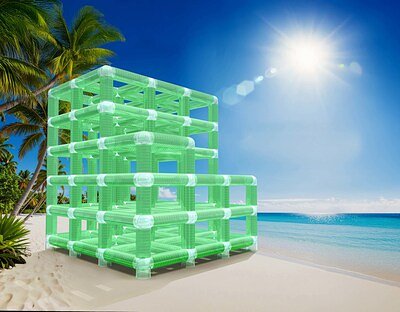
KAWANISHI-CITY, Japan – December 02, 2025 – In a nation where mountainous terrain has turned the quest for green energy into an environmental paradox, a Japanese research firm has proposed a radical new direction for solar power: upwards. Green Science Alliance Co., Ltd. recently unveiled a concept for a three-dimensional solar power generator modeled after a playground “jungle gym,” a design that promises to generate electricity without the vast, destructive land-clearing required by traditional solar farms.
Led by Dr. Ryohei Mori, the company plans to leverage the unique properties of flexible organic thin-film solar cells to create vertical, light-permeable structures. This innovation directly confronts the growing controversy surrounding “mega-solar” projects in Japan, offering a potential blueprint for deploying renewable energy in harmony with nature, not at its expense.
The Environmental Cost of Japan's Solar Boom
Japan’s ambitious push for decarbonization has run headfirst into its own geography. With over 70% of the country covered by mountains and forests, the flat, open land ideal for conventional solar installations is a scarce commodity. This scarcity has driven developers to clear vast tracts of forest, often on sloped terrain, to install sprawling arrays of traditional silicon solar panels.
The irony is stark: CO₂-absorbing forests are being razed to build carbon-reducing energy facilities. This practice has ignited fierce opposition across the country. Projects like a proposed 300-hectare solar farm in Kamogawa, Chiba Prefecture, which would have involved felling hundreds of thousands of trees, have become flashpoints for conflict. Between 2012 and 2022, nearly 90 major disputes over solar projects were reported, with the majority occurring in recent years as development has intensified.
Beyond deforestation, these installations degrade ecosystems and increase public safety risks. The removal of tree cover on mountainsides diminishes the soil's ability to retain water, heightening the danger of landslides and flooding in a country already prone to natural disasters. Concerns have also been raised over the impact on biodiversity, with mega-solar projects near sensitive areas like Hokkaido’s Kushiro Wetlands National Park threatening the habitats of endangered species.
The root of the problem lies in the technology. Conventional solar farms rely on rigid, opaque silicon-based cells. These panels are most efficient when aimed directly at the sun, cannot generate power from light passing through them, and can only be expanded in two dimensions. This technological constraint is the direct driver behind the need for massive, flat footprints and the resulting environmental and social strife that has given the term “mega-solar” a negative connotation throughout Japan.
A Vertical Leap for Photovoltaic Technology
Green Science Alliance’s proposed solution reimagines the fundamental structure of a solar farm. Instead of a flat plane, Dr. Mori envisions a multi-layered 3D array where flexible, semi-transparent organic thin-film solar cells are wrapped around the structure's pillars and supports. This “jungle gym” could be expanded both horizontally and vertically, capturing sunlight from multiple angles throughout the day—from the morning sun on its eastern face to the evening sun on its western face, and from above on its horizontal surfaces.
The enabling technology, organic photovoltaics (OPVs), is key to the concept. Unlike rigid silicon, OPVs are created from carbon-based materials that can be printed onto flexible substrates. This makes them lightweight and adaptable, perfect for conforming to the curved surfaces of a 3D frame. Critically, their chemical composition can be tuned to absorb specific wavelengths of light, allowing them to be made semi-transparent or even fully transparent. This property allows sunlight to pass through upper layers to reach cells below, a feat impossible with opaque silicon.
This approach could dramatically increase the power output per square meter of land, a crucial metric in a land-scarce country. While a full-scale prototype is still in development, the company, led by the Harvard-educated Dr. Mori, brings significant credibility to the project. Green Science Alliance has a deep portfolio of environmental technologies, from biodegradable plastics registered with the United Nations to next-generation batteries and advanced materials, underscoring its commitment to science-driven sustainability.
Harvesting Both Sunlight and Crops
The 3D structure’s most transformative potential may lie in agrophotovoltaics, or “solar sharing,” a practice that co-locates agricultural activity and solar energy generation. While current agrivoltaic systems place standard panels high above fields, they often create uniform blocks of heavy shade and can limit the movement of tall farm equipment.
The “jungle gym” design offers a more elegant and integrated solution. Its framework can be engineered to provide significant vertical clearance, allowing tractors and other machinery to operate freely underneath. More importantly, the use of semi-transparent solar cells could allow farmers to precisely manage the amount of sunlight reaching the crops below. This could create optimal growing conditions for shade-tolerant crops like tea or certain vegetables, potentially even increasing yields while simultaneously producing clean energy.
As the technology matures, improvements in cell transparency and efficiency could allow these 3D structures to deliver higher power yields than conventional 2D solar sharing setups. This would make the dual-use model more economically attractive for farmers and energy suppliers, contributing to both food security and energy independence in rural communities.
From Concept to Kilowatts: The Path Forward
Despite its promise, the 3D solar concept faces significant technical hurdles before it can be deployed at scale. Green Science Alliance acknowledges that the organic thin-film solar cells currently available have a photovoltaic conversion efficiency less than half that of their silicon counterparts and offer limited transparency. The trade-off between allowing visible light to pass through and capturing that light to generate electricity remains a core challenge.
To overcome this, the company is pursuing a dual strategy. It plans to invest in the long-term research and commercialization of advanced donor and acceptor materials to boost the performance of its OPVs. Concurrently, it is exploring perovskite solar cells (PSCs) as an alternative. PSCs have seen meteoric rises in efficiency, with lab-scale tandem cells now exceeding 34% efficiency, surpassing silicon. Companies like Oxford PV are already shipping early commercial panels. However, perovskites have their own challenges, primarily concerning long-term durability and stability when exposed to the elements.
Green Science Alliance plans to build a model prototype and begin proof-of-concept testing in early 2026. This phase will be critical for gathering real-world data. The company will also run complex simulations to model how the structure performs under varying conditions, including different times of day, weather patterns, and seasons, and to optimize the electrical configuration for maximum output. While the vision of transparent, skyscraper-like solar farms remains on the horizon, this innovative approach represents a crucial step toward a future where renewable energy can be generated without sacrificing the natural landscapes it is meant to protect.