
- Fintech Market Value: USD 18 billion (2025) with steep growth trajectory
- Digital Payment Transactions: Exceeded 20 trillion in January 2025
- Cyberattack Increase: Email-based attacks up 85% in Q3 2023
Experts agree that Indonesia's BFSI sector is at a critical inflection point, requiring urgent digital transformation to balance innovation, security, and financial inclusion amid rapid fintech growth and regulatory challenges.
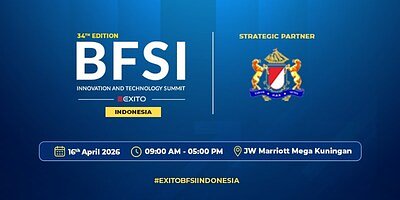
Jakarta Summit to Shape Future of Indonesia's Finance Technology
JAKARTA, INDONESIA – April 09, 2026 – Indonesia's top technology and financial leaders are set to convene in Jakarta next week for a high-stakes summit aimed at charting the course for the nation's rapidly evolving financial sector. Organized by Exito Media Concepts, the 34th Edition of the BFSI IT Summit Indonesia will take place on April 16 at the JW Marriott Mega Kuningan, gathering over 150 CIOs, CTOs, and digital transformation heads from the banking, financial services, and insurance (BFSI) industries.
The event, themed "Tech it to the Next Level: Shaping the Future of Indonesia's BFSI," arrives at a critical juncture. The country's financial landscape is being fundamentally reshaped by breakneck fintech innovation, surging consumer demand for digital services, and a complex regulatory environment, forcing institutions to either innovate or risk being left behind.
A Nation at a Digital Crossroads
Indonesia's BFSI sector is described by organizers and analysts as being at an "inflection point." This is not mere hyperbole. The nation's digital economy is booming, underpinned by a young, mobile-savvy population eager to embrace digital finance. The fintech market alone was valued at USD 18 billion and is on a steep growth trajectory, fueled by a surge in digital payment transactions that exceeded 20 trillion in January 2025, largely driven by the widespread adoption of the QRIS payment standard.
The number of fintech companies has multiplied six-fold in the last decade, intensifying competition for traditional banks and insurance firms. These new players are moving beyond payments into lending, wealth management, and insurtech, challenging incumbents to reimagine their entire operating models. This competitive pressure, coupled with customer expectations for seamless, mobile-first experiences, is driving unprecedented investment in modern technology infrastructure.
However, this digital gold rush is not without its obstacles. While technology offers a powerful tool for financial inclusion in a country where a significant portion of the population remains unbanked or underbanked, the path to modernization is fraught with challenges.
Navigating a Complex Regulatory and Security Landscape
As financial institutions race to digitize, they must navigate a formidable set of hurdles, chief among them being cybersecurity. The Indonesian banking sector has become a prime target for cybercriminals, with email-based attacks reportedly increasing by 85% in the third quarter of 2023. High-profile cyberattacks on capital market firms in 2025 served as a stark reminder of the systemic vulnerabilities that exist, prompting calls for stronger governance and oversight.
Regulators are responding. Both the Financial Services Authority (OJK) and Bank Indonesia (BI) have issued new mandates to bolster cyber resilience. OJK's Regulation No. 3 of 2024, for instance, expanded the scope of its regulatory sandbox to include risk management and crypto-related activities, while BI has enforced stricter cybersecurity requirements for payment system operators. For institutions, this means that strengthening security frameworks to safeguard sensitive financial data is not just a best practice but a critical compliance mandate.
Beyond security, firms grapple with integrating next-generation digital platforms with aging legacy systems—a complex and costly endeavor. Furthermore, challenges such as widespread digital fraud, gaps in digital infrastructure in remote areas, and low financial literacy among parts of the population represent significant headwinds that technology alone cannot solve.
The Summit's Agenda: Charting a Course for Modernization
The agenda for the BFSI IT Summit is a direct reflection of these pressing industry challenges. The sessions are designed to move beyond theoretical discussions and delve into practical, real-world solutions. Key technology priorities to be addressed include:
Cloud & Hybrid Infrastructure: Experts will discuss strategies for building scalable digital core systems while navigating Indonesia's specific regulatory frameworks and data residency requirements.
AI and Machine Learning: Sessions will explore how AI/ML can be leveraged not only for revenue growth and personalized customer experiences but also for enhanced risk management and more sophisticated fraud detection.
Core Banking Modernization: A central theme will be the transition from monolithic legacy systems to agile, cloud-native platforms that can support rapid innovation.
Open Banking & API Economy: The focus is on moving from a mindset of regulatory compliance to one of value creation, exploring how API-driven ecosystems can foster partnerships with fintechs and create new revenue streams.
Cybersecurity and Data Protection: A top priority for the summit, this track will cover the latest strategies for building resilient security frameworks to protect against evolving threats and ensure full regulatory compliance.
Inclusion Tech: Discussions will center on using mobile-first and data-driven solutions to expand financial access, supporting the national goal of bringing more Indonesians into the formal financial system.
A Confluence of Leaders and Visionaries
The significance of the summit is underscored by the caliber of its attendees and speakers. The event will host senior executives from Indonesia's leading financial institutions, including a data management head from CIMB Niaga. More notably, the speaker list features high-ranking officials from key government bodies, including Ihda Muktiyanto from the Ministry of Finance, Dr. Edwin Hidayat Abdullah from the Ministry of Communication and Digital Affairs, and Safari Kasiyanto from the Central Bank of Indonesia. The participation of these key policymakers signals a collaborative approach between the public and private sectors to steer the country's digital finance agenda.
For Exito Media Concepts, an organization with over 15 years of experience producing more than 240 conferences annually, this 34th edition represents the continuation of a long-standing platform for industry dialogue. The longevity of the summit series suggests its sustained relevance in adapting to the changing needs of the BFSI sector.
As stated in the event's promotional materials, "Indonesia's financial institutions are not just adapting to digital transformation — they are defining it. This summit is where that vision takes shape." The discussions held and partnerships forged at the JW Marriott next week will undoubtedly play a crucial role in turning that vision into a reality, influencing technology investments, shaping regulatory approaches, and ultimately defining the future of finance for millions of Indonesians across the archipelago.