
- Ranking: JA Solar achieved the highest score (91.7) in Wood Mackenzie's Global Solar Module Manufacturer Ranking for H1 2025, sharing the top spot with Trinasolar.
- Industry Challenges: Top 10 manufacturers reported a collective net loss of $2.2 billion in H1 2025 due to price pressures.
- Operational Resilience: JA Solar maintained a 70% capacity utilization rate, compared to 43% for other evaluated companies.
Experts view JA Solar's ascent to the top as a validation of its strategic focus on quality, innovation, and operational resilience, setting a new standard for bankability in the solar industry amid market turbulence.
JA Solar Ascends to Top of Global Solar Module Manufacturer Rankings
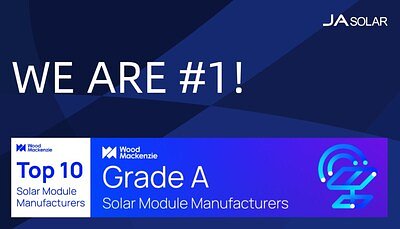
BEIJING – December 29, 2025 – In a significant validation of its strategic direction and operational prowess, JA Solar has been ranked as the world's No. 1 solar module manufacturer in Wood Mackenzie's prestigious Global Solar Module Manufacturer Ranking for the first half of 2025. The green energy giant achieved an overall score of 91.7, the highest among all 38 companies evaluated, sharing the top-tier position with competitor Trinasolar in a fiercely contested market.
This achievement marks a notable ascent from JA Solar's No. 2 position based on 2024 data, underscoring a period of consistent progress and disciplined execution. The recognition comes at a critical time for the photovoltaic (PV) industry, which is grappling with intense price competition and widespread oversupply. JA Solar's ability to climb to the top in such a turbulent environment highlights a shift in how market leadership is defined, moving beyond sheer shipment volume to a more holistic measure of stability, innovation, and trustworthiness.
The New Gold Standard for Bankability
The ranking, released by the leading global energy research and consultancy firm Wood Mackenzie, is considered a key benchmark for operational strength and, crucially, bankability. From a customer-centric perspective, the report assesses crystalline silicon PV module manufacturers on ten core dimensions that reflect a company's long-term viability and reliability as a partner for developers, financiers, and asset owners.
These ten pillars of evaluation include manufacturing experience, the depth of vertical integration, capacity utilization rates, technology maturity, R&D investment, and financial strength. Furthermore, the assessment scrutinizes supply chain resilience, ESG and corporate social responsibility performance, third-party certifications, and global footprint. According to Wood Mackenzie, several of these pillars—including ESG, financial health, and supply-chain resilience—are given equal weight, signaling their growing importance in procurement decisions.
Underscoring this focus on comprehensive quality, the H1 2025 report introduced a new 'Grade A' classification. This designation is reserved for manufacturers that meet stringent benchmark criteria across at least five key areas, serving as a clear signal of operational excellence and bankability for project finance. In the latest report, 30 manufacturers achieved this status, but JA Solar's near-perfect score places it at the apex of this elite group.
"This recognition from Wood Mackenzie reflects the trust placed in JA Solar by customers and partners globally," said Aiqing Yang, Executive President of JA Solar, in a statement. "It validates our long-term focus on manufacturing quality, technological maturity, and operational discipline, and strengthens our commitment to reliable delivery and responsible development."
Thriving Amidst Market Turmoil
JA Solar's rise to the top is made more impressive by the challenging economic backdrop of the global solar market in the first half of 2025. The industry has been characterized by a significant oversupply of modules and a sharp decline in prices across the silicon supply chain. These conditions have created what Wood Mackenzie describes as a "widening operational and financial divide" between companies.
In fact, the top ten manufacturers collectively reported a staggering net loss of $2.2 billion in the first half of the year due to these price pressures. Despite this, a clear distinction has emerged between the leaders and the rest of the pack. The top-ranked manufacturers maintained an average capacity utilization rate of 70%, in stark contrast to the 43% average for all other evaluated companies. This demonstrates a superior ability to manage operations and maintain demand even when the market is saturated.
JA Solar's performance across Wood Mackenzie's criteria suggests a strategy rooted in resilience. Its high degree of vertical integration—controlling the production process from silicon wafers to finished modules—provides a critical buffer against supply chain disruptions and cost volatility. This, combined with a strong financial position and proven operational discipline, has allowed the company to navigate the downturn more effectively than many of its peers.
The Technological and Geographic Race
Beyond operational excellence, the ranking highlights the ongoing race for technological superiority and strategic geographic positioning. The solar industry is in the midst of a rapid technological transition, with advanced n-type TOPCon (Tunnel Oxide Passivated Contact) cells becoming the new standard. This technology, known for its higher bifaciality and greater energy yield, is pushing mainstream module efficiency above 25%.
JA Solar's focus on a "mature technology platform" and its robust R&D investment, supported by over 2,000 patents, have been instrumental in keeping it at the forefront of this innovation curve. All top-ten manufacturers in the ranking have passed extensive third-party reliability testing, but leadership in next-generation technologies like TOPCon 4.0 and back-contact cells is a key differentiator.
Simultaneously, geopolitical factors and tightening trade policies are reshaping the global manufacturing map. To enhance tariff resilience and ensure stable delivery to key markets, leading companies are aggressively diversifying their production footprints. Manufacturing hubs are expanding beyond China into regions like the Middle East and North Africa (MENA), Vietnam, and Indonesia. This regionalization strategy is crucial for mitigating risk and serving protected markets in North America and Europe, where non-Chinese players have managed to maintain profitability despite the global price crunch.
Broader Implications for the Energy Transition
The consolidation of leadership around highly bankable and resilient manufacturers like JA Solar has profound implications for the global energy transition. For large-scale solar projects to secure financing and get built, developers and investors need absolute confidence in their equipment suppliers. A top ranking from a respected third-party firm like Wood Mackenzie provides precisely that, de-risking investments and potentially lowering the cost of capital.
As the world accelerates its push toward decarbonization, the ability to reliably deploy high-performance solar technology at scale is paramount. The success of companies that excel across a balanced scorecard of financial health, technological innovation, and sustainable practices ensures that the backbone of the future energy system is both robust and dependable.
Looking ahead, Wood Mackenzie forecasts a period of industry consolidation through 2026 and 2027, where weaker suppliers may be forced into mergers or face shutdowns. In this environment, companies like JA Solar, with their proven track record and comprehensive strengths, are well-positioned to not only survive but to further solidify their market leadership. As the global energy transition accelerates, the industry's focus is clearly shifting from manufacturers that simply offer scale to those that promise scale combined with unwavering resilience and sustainability.