
- 24%: Europe's AI-related data center capacity is projected to grow at a compound annual rate of over 24%.
- 100 kW: AI workloads can require rack densities exceeding 100 kW, straining power grids and cooling systems.
- 2030: EU mandates require data centers to achieve climate neutrality by 2030.
Experts agree that INVT's high-density data center solutions are critical for Europe to balance the explosive growth of AI with stringent sustainability regulations, making modular power and liquid cooling indispensable for the future of AI infrastructure.
INVT Targets Europe's AI Boom with High-Density Data Center Tech
FRANKFURT, Germany – April 29, 2026 – As the European data center market grapples with the seismic shifts brought on by artificial intelligence, Chinese infrastructure specialist INVT is positioning itself as a key enabler for the next generation of high-density computing. The company announced it will showcase a suite of AI-ready power and cooling solutions at the upcoming Data Centre World Frankfurt on May 6-7, addressing the industry's most pressing challenges.
The move comes at a critical juncture for Europe. The continent is experiencing a surge in demand for AI-related data center capacity, with projections showing a compound annual growth rate of over 24%. This boom is creating a perfect storm of technical and regulatory pressures. AI workloads require rack densities that can exceed 100 kW, generating immense heat and straining power grids—all while operators face stringent EU mandates for sustainability and climate neutrality by 2030.
At its booth, INVT will present a portfolio designed to tackle these interconnected issues, featuring new modular Uninterruptible Power Supply (UPS) systems, advanced liquid cooling units, and complete modular data center packages. The showcase signals a strategic push into a European market that is actively seeking innovative infrastructure to balance the voracious demands of AI with its ambitious green agenda.
Europe's Data Centers Face an AI-Driven Reckoning
The rapid proliferation of AI, particularly large language models (LLMs), is fundamentally reshaping data center design. Traditional architectures, built for rack densities of 10-15 kW, are ill-equipped to handle the power and thermal loads of modern GPU-packed servers. This has rendered conventional air cooling increasingly ineffective and inefficient, forcing the industry to rethink its approach from the ground up.
Compounding this technical challenge are Europe's world-leading sustainability regulations. The EU's Energy Efficiency Directive (EED) now requires data centers to report on metrics including Power Usage Effectiveness (PUE), water consumption, and waste heat reuse. Furthermore, the Climate Neutral Data Centre Pact commits signatories to achieving climate neutrality by 2030, with strict PUE targets for new facilities. This puts a premium on efficiency, as every wasted watt not only increases operational costs but also contributes to a larger carbon footprint.
Power availability itself has become a major bottleneck in established data center hubs, pushing development into secondary markets and placing an even greater emphasis on maximizing the efficiency of every available kilowatt. Against this backdrop, the industry is no longer just building bigger data centers; it is being forced to build smarter ones. Solutions that offer scalability, high efficiency, and advanced thermal management are no longer a luxury but a necessity for survival and growth.
Modular Power for Megawatt Demands
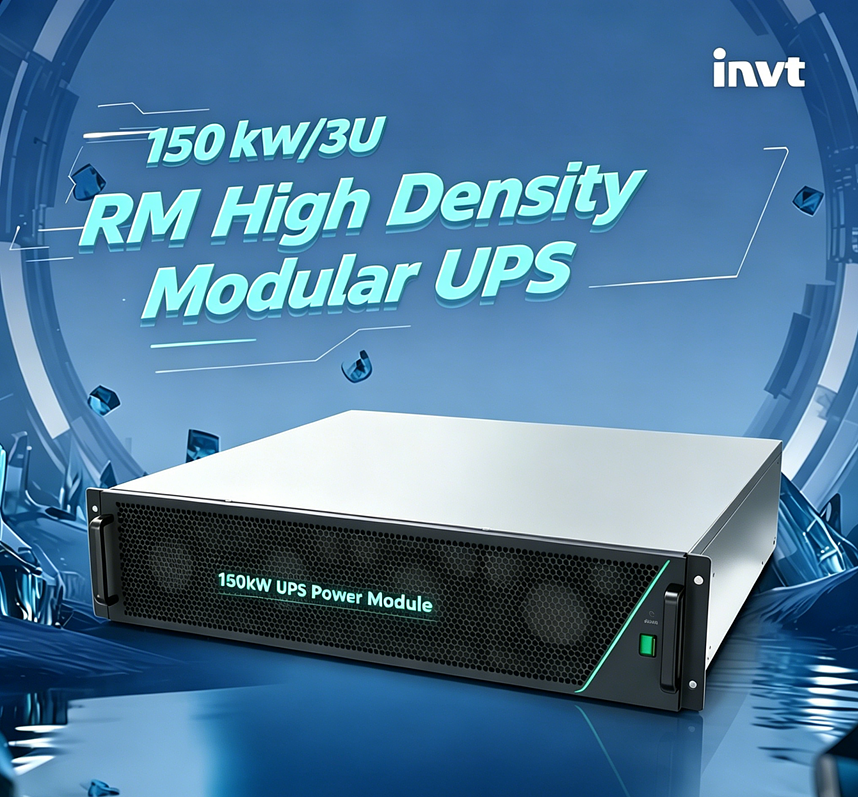
At the heart of INVT's offering is its modular UPS portfolio, designed to provide scalable and resilient power for high-density environments. The company, which has ranked among the top two in China's modular UPS market for eight consecutive years, is launching a new 150 kW high-density power module. This component is engineered to enable the flexible deployment of megawatt-level backup systems.
The modular architecture is a direct response to the dynamic nature of AI workloads. Instead of investing in massive, monolithic UPS systems that are underutilized for long periods, operators can deploy a right-sized system and scale capacity by adding modules as load demands increase. This “pay-as-you-grow” approach minimizes upfront capital expenditure and, more importantly, enhances operational efficiency by ensuring the UPS runs closer to its optimal load curve, reducing energy waste.
Beyond large-scale systems, INVT will also display rack-mounted UPS solutions in the 1–3 kVA range. These smaller units feature a power factor of 1.0, maximizing real power delivery to connected IT equipment, and offer compatibility with both traditional lead-acid and modern lithium-ion batteries, giving operators flexibility in their energy storage strategy.
Taming the Heat with Advanced Liquid Cooling
Perhaps the most critical piece of the AI infrastructure puzzle is cooling. As rack power densities soar, liquid's ability to transfer heat—up to 3,000 times more effectively than air—makes it an indispensable technology. INVT is entering this space with its SC Series Coolant Distribution Unit (CDU).
Designed for liquid-to-liquid cooling architectures, the CDU is built to support the extreme thermal demands of high-performance computing (HPC) and AI server racks. By circulating coolant directly to or near the heat-generating components, these systems can dissipate heat far more efficiently than air-based methods. This not only prevents performance throttling in expensive GPUs but also dramatically reduces the energy consumed by cooling infrastructure, which is a major contributor to a data center's overall power consumption.
The adoption of liquid cooling is a key enabler for achieving sustainability goals. By lowering energy use, it directly cuts Scope 2 emissions. Furthermore, the high-grade waste heat captured by liquid cooling systems is more easily repurposed for applications like district heating, turning a data center from a simple energy consumer into a potential contributor to the local energy ecosystem.
Building Tomorrow's Data Centers, Faster
Beyond individual components, INVT is also promoting its integrated modular data center solutions. This approach involves prefabricating and integrating power, cooling, and IT infrastructure into standardized, containerized, or skid-based modules in a factory environment. These completed units are then transported to the site for rapid assembly and commissioning.
This methodology offers significant advantages in the fast-paced AI era. It dramatically shortens deployment timelines from years to months, allowing organizations in sectors like telecommunications, finance, and healthcare to bring AI capabilities to market much faster. The factory-controlled construction process also ensures consistent quality and reduces on-site construction waste, aligning with circular economy principles.
For businesses needing to quickly establish an AI-ready facility or expand an existing one, this modular strategy provides the flexibility and scalability required. A company can start with a single module and seamlessly add more as its computing needs grow, avoiding the risks and inefficiencies of over-provisioning. As INVT prepares to engage with European leaders in Frankfurt, its message is clear: the foundational blocks for the future of AI are not just powerful and efficient, but also flexible, scalable, and ready to deploy on demand.