
- ₹6,003.65 crore ($750 million): Budget allocated for India's National Quantum Mission through 2031.
- 2030 & 2035: Deadlines for transitioning high-risk and all remaining systems to quantum-resistant standards, respectively.
- 41 years: Length of Lt Gen Nair's career in India's security establishment.
Experts agree that India's appointment of a former National Cyber Security Coordinator to lead a quantum security firm underscores the urgent need for public-private collaboration to defend against quantum computing threats and secure national digital sovereignty.
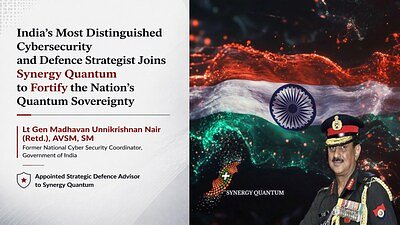
India's Quantum Shield: Cyber Chief Joins Firm to Secure Digital Future
NEW DELHI, April 30, 2026 -- In a strategic move signaling India's heightened focus on national digital security, deep-tech pioneer Synergy Quantum has appointed Lt Gen Madhavan Unnikrishnan Nair (Retd.), the country's former National Cyber Security Coordinator, as its Strategic Defence Advisor. The appointment merges one of India’s most seasoned defence strategists with a leading quantum security firm at a critical juncture, as the nation races to build defenses against the imminent threat of quantum computing.
This landmark decision places the architect of India's modern cyber defense framework into the leadership of a company at the forefront of post-quantum cryptography. It underscores a national pivot towards public-private collaboration to safeguard everything from military communications and critical infrastructure to the financial system against a new class of cyber warfare.
The New Frontier of National Sovereignty
The urgency behind this move is driven by the rapid advancement of quantum computing. Once operational at scale, these powerful machines are expected to break the cryptographic foundations that protect virtually all modern digital information. This looming 'Q-Day' renders current encryption standards, which secure military commands, banking transactions, and government data, dangerously obsolete.
Compounding the future risk is a present-day strategy known as "Harvest Now, Decrypt Later." Adversaries, including nation-states, are already believed to be intercepting and storing vast amounts of encrypted Indian data. Their goal is to hold this sensitive information until a sufficiently powerful quantum computer becomes available to unlock it, retroactively exposing years of state secrets, intellectual property, and private citizen data. For a digital-first nation like India, this represents an existential threat to its sovereignty.
"The quantum threat to our national security architecture is real, imminent, and demands urgent action," said Lt Gen Madhavan Unnikrishnan Nair (Retd.) in a statement. "Synergy Quantum possesses the technological depth, the sovereign commitment, and the institutional trust... to lead the nation’s transition to quantum-safe communications."
An Architect of India's Cyber Defense
Lt Gen Nair is a uniquely qualified figure to guide this transition. With a decorated career spanning over 41 years in the Indian security establishment, his expertise is deeply rooted in the country's defense and intelligence apparatus. An alumnus of the National Defence Academy, he rose to become the 28th Signal Officer-in-Chief, leading the Indian Army's critical communications and electronic warfare corps.
His most recent role as India's third National Cyber Security Coordinator at the National Security Council Secretariat placed him at the apex of the nation's cyber defense strategy. In this capacity, he was instrumental in orchestrating the country's cybersecurity posture across both civilian and military domains and was involved in shaping the new National Cyber Security Reference Framework (NCRF) to protect critical sectors. His declaration that cyberspace is an integral part of national security architecture has become a guiding principle for Indian policy.
Beyond his operational roles, Lt Gen Nair is a prominent thought leader. Through his writings for the Observer Research Foundation (ORF), a premier Indian think tank, he has championed a strategy of "calibrated, threat proportionate preparedness" for the quantum era, urging the nation to act with urgency but without panic.
India's National Quantum Gambit
Lt Gen Nair's move to Synergy Quantum aligns perfectly with a broader, national-level push to establish India as a global quantum power. In April 2023, the Indian government approved the National Quantum Mission (NQM) with a formidable budget of ₹6,003.65 crore (approximately $750 million) to be deployed through 2031. The mission's ambitious goals include developing indigenous quantum computers and creating secure, satellite-based quantum communication networks spanning over 2,000 kilometers within India.
This effort is guided by a detailed Post-Quantum Cryptography (PQC) migration roadmap released by the Department of Science and Technology. The roadmap mandates that India's high-risk and critical systems must transition to quantum-resistant standards by 2030, with a full migration for all remaining systems to be completed by 2035. This clear timeline has galvanized both public and private sectors to accelerate the development and deployment of quantum-safe solutions.
India is already home to the world's second-largest number of quantum cybersecurity startups, creating a vibrant ecosystem of innovation. Companies like QNu Labs and Scytale Alpha are developing homegrown solutions, but Synergy Quantum's high-profile appointments and global reach position it as a key strategic asset in this national mission.
The Push for 'Certification Sovereignty'
A cornerstone of Lt Gen Nair's strategic vision is the concept of "certification sovereignty." He has argued compellingly that for India to be truly secure, it cannot simply adopt foreign quantum-safe technologies or rely on international standards, such as those being developed by the U.S. National Institute of Standards and Technology (NIST). Instead, India must develop the sovereign capacity to independently test, validate, and certify these technologies.
This vision is already taking shape. India's PQC roadmap includes a national testing and certification framework, and the country recently rolled out its first indigenous quantum test beds. These facilities will serve as hubs for research and certification, ensuring that quantum hardware and software deployed within India's critical infrastructure are free from backdoors and meet the nation's specific security requirements. This move from being a technology consumer to a technology validator is a crucial step towards digital autonomy.
Synergy Quantum, with its full-stack platform of six TRL-9 (Technology Readiness Level 9) technologies and a portfolio of 10 patents, appears well-aligned with this vision. The company's CEO and Co-Founder, Jay Oberai, stated, "Lt Gen Nair is not merely a cybersecurity leader, he is the architect who shaped India's entire national cyber defence framework. His decision to join Synergy Quantum is a powerful validation of our mission to build quantum-safe infrastructure that safeguards India's digital sovereignty."
With a leadership team that includes Prof. Arun K. Pati, known as the 'Father of Quantum in India,' and Nishant Batra, the former Chief Strategy and Technology Officer of Nokia, Synergy Quantum is amassing a formidable brain trust. By bringing Lt Gen Nair into its fold, the company has secured unparalleled strategic guidance, ensuring its technological prowess is directed precisely where the nation needs it most. This collaboration between a seasoned national security strategist and a deep-tech pioneer may well define the success of India's efforts to build an impregnable digital fortress in the quantum age.