
- 25 TOPS: DEEPX's DX-M1 chip delivers 25 Tera Operations Per Second (TOPS) of AI processing power with ultra-low power consumption (<5 watts).
- $85 billion: Hyundai's planned investment in AI and robotics by 2030.
- $100 billion: Projected market size for robotics by 2030.
Experts view this collaboration as a strategic breakthrough in robotics, enabling autonomous, cloud-independent AI processing that will revolutionize industries from logistics to smart cities.
Hyundai & DEEPX Ignite Physical AI Revolution with On-Device Robotics
SEOUL, South Korea – December 03, 2025 – A pivotal shift in the world of robotics is underway as automotive giant Hyundai Motor Group and AI semiconductor innovator DEEPX move to commercialize a next-generation robotics platform. The collaboration, which leverages on-device artificial intelligence, aims to unleash a new generation of autonomous robots, freeing them from the constraints of cloud connectivity. This milestone marks a significant step toward the mass production of what the industry is calling 'Physical AI'—intelligent machines that can perceive, reason, and act independently in the physical world.
The announcement confirms that a co-developed on-device AI controller, built around DEEPX's ultra-low-power chip, has entered the final validation stage for real-world deployment. This transition from research to commercial readiness signals a future where robots can operate reliably in complex, network-restricted environments, from underground logistics hubs to bustling smart city infrastructure, fundamentally altering the landscape of automation.
The Dawn of 'Physical AI': Untethering Robots from the Cloud
At the heart of this innovation lies the challenge of robotic autonomy. For years, the most advanced AI processing has been relegated to powerful, energy-hungry servers in the cloud. Robots in the field acted as endpoints, collecting sensor data and streaming it to the cloud for analysis before receiving instructions. This model, while functional, is fraught with limitations: network latency can delay critical decision-making, intermittent connectivity can render a robot useless, and transmitting sensitive data raises significant security and privacy concerns.
The platform developed by Hyundai Motor and Kia's Robotics LAB in partnership with DEEPX directly confronts these challenges. The core component is DEEPX's DX-M1, a specialized Neural Processing Unit (NPU) designed for the edge. This chip delivers an impressive 25 Tera Operations Per Second (TOPS) of AI processing power while consuming less than 5 watts of energy. Its world-leading power efficiency, exceeding 10 TOPS per watt, is a game-changer for battery-powered service robots where every milliwatt counts.
By integrating the DX-M1 with a proprietary dual wide- and narrow-angle camera system and Hyundai/Kia's own vision AI software, the new controller architecture enables all critical AI tasks—from object detection and facial recognition to complex navigation—to happen directly on the robot itself. This on-device processing eliminates cloud dependency, enabling real-time responsiveness and robust operation even in GPS-denied or network-dead zones like subterranean facilities or sprawling manufacturing plants. The system's ability to run advanced AI models like YOLOv7 and PIDNet with GPU-level accuracy using highly efficient 8-bit integer operations underscores its technical prowess, setting a new standard for what is possible at the edge.
A Strategic Alliance Forging the Future of Robotics
This collaboration is far more than a simple technology integration; it represents a calculated strategic move by Hyundai Motor Group to secure a dominant position in the burgeoning robotics market. The company has made its ambitions clear, committing to a transformation into a "Smart Mobility Solutions Provider" that extends far beyond automobiles. With planned investments totaling over $85 billion in AI and robotics by 2030 and the landmark acquisition of Boston Dynamics in 2021, Hyundai is aggressively building a comprehensive robotics ecosystem.
Partnering with a specialized semiconductor firm like DEEPX gives the automotive giant a crucial competitive advantage. While competitors often rely on off-the-shelf solutions from giants like NVIDIA or Qualcomm, this deep collaboration allows for the co-development of a highly optimized hardware and software stack tailored specifically for Hyundai's service and mobility robots. This vertical integration ensures that the AI capabilities are not just powerful but also perfectly aligned with the unique power, thermal, and cost constraints of their target applications.
This move positions Hyundai to rapidly scale its robotics initiatives, which already include a diverse portfolio of wearable exoskeletons, customer service bots, and autonomous delivery platforms. By securing a proprietary, high-performance, low-power AI engine, the company can accelerate the deployment of "tens of thousands" of robots across its own manufacturing and logistics operations before expanding into broader commercial markets. It is a strategic play to control the "brain" of its future robotic fleet, ensuring a sustainable edge in a market projected to exceed $100 billion by 2030.
From Lab to Life: The Practical Impact of Autonomous AI
The true significance of this technological leap lies in its practical, real-world applications. By enabling robots to function anywhere, anytime, the Hyundai-DEEPX platform moves advanced automation from a niche capability to a versatile, scalable solution for everyday problems.
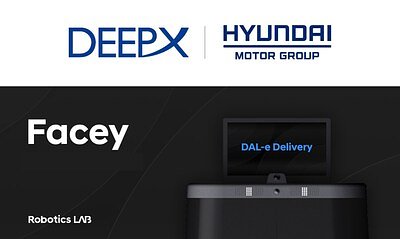
One of the first tangible examples is the 'DAL-e Delivery' robot. Powered by the DX-M1 NPU and the Robotics LAB's 'Facey' facial recognition system, this robot can already perform secure recipient authentication and provide personalized, guided interactions. This capability paves the way for reliable autonomous delivery services in corporate offices, smart buildings, and eventually residential complexes, ensuring packages reach the right person without constant human oversight or flawless network coverage.
The implications extend deep into the industrial sector. In smart factories, cloud-independent robots can perform real-time quality control on assembly lines, conduct predictive maintenance on machinery in remote areas of the plant, and navigate dynamic, crowded floors without fear of losing connection. In logistics, fleets of autonomous robots can manage warehouse inventory, transport goods, and optimize supply chains with unprecedented resilience. The global physical AI market is projected to skyrocket from approximately $4 billion in 2024 to over $60 billion by 2034, and these industrial applications are a primary driver of that growth.
Beyond industry, this technology promises to enhance public services and urban living. Robots could be deployed to inspect critical infrastructure like tunnels and pipelines, assist in emergency response scenarios where communication networks are compromised, or provide mobility support in healthcare facilities, all with a higher degree of reliability and security.
Navigating a Competitive and Growing Market
As Hyundai and DEEPX prepare for a public showcase at CES 2026 in Las Vegas, they are entering a fiercely competitive landscape. NVIDIA's Jetson platform has long been a dominant force in edge AI for robotics, while Intel's Movidius and Qualcomm's Robotics platforms offer powerful, integrated solutions of their own.
However, the collaboration's sharp focus on ultra-low-power, high-efficiency processing for service robotics carves out a distinct and valuable niche. While high-performance platforms are well-suited for large-scale industrial robots or autonomous vehicles, the sub-5W power envelope of the DX-M1 is ideal for the rapidly growing market of smaller, battery-operated robots designed for human-centric environments. This includes everything from hotel service bots to assistive healthcare companions.
The commercial validation of their platform is a clear signal to the market that 'Physical AI' is no longer a theoretical concept. It is a commercially viable technology ready for mass production. As the two companies move to expand the deployment of their platform across Hyundai Motor Group's vast operations—spanning manufacturing, logistics, and future smart city projects—they are not just building products, but creating a scalable ecosystem. This real-world implementation will serve as a powerful proof point, demonstrating the technology's robustness and efficiency as they look to capture a significant share of the global robotics market.