
- 76% of supply chain decision-makers in Europe and North America report labor shortages (2023 survey) - European logistics automation market projected to grow from $23B (2024) to $73B (2033) - €150B structural supply gap in European logistics real estate
Experts view HyperLeap's modular AI-driven robotic solutions as a promising response to Europe's logistics crisis, though success will depend on overcoming competition and addressing workforce transition challenges.
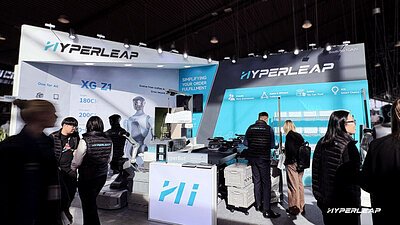
HyperLeap's AI Robots Enter Europe to Tackle Logistics Crisis
STUTTGART, Germany – March 25, 2026 – Amidst flashing lights and the hum of machinery at LogiMAT 2026, one of Europe's premier logistics trade fairs, Chinese innovator HyperLeap officially marked its entry into the European market. The debut is not merely a corporate milestone; it represents a direct response to a European logistics sector grappling with a perfect storm of labor shortages, soaring real estate costs, and unprecedented operational complexity. The company is showcasing its AI-driven, modular robotic sorting solution, HyperSort, positioning it as a flexible and scalable answer to the region's most pressing supply chain challenges.
A Sector Stretched to Its Limits
The European logistics industry, a cornerstone of the continent's economy, is facing immense pressure. While the market is projected to grow significantly—with some estimates suggesting the logistics automation segment alone could surge from around $23 billion in 2024 to over $73 billion by 2033—this growth is hampered by deep-seated structural problems.
A critical issue is the severe labor shortage. A late 2023 survey revealed that a staggering 76% of supply chain decision-makers in Europe and North America are struggling with a lack of workers. In powerhouse economies like Germany, tens of thousands of driver and warehouse positions remain unfilled, a situation exacerbated by an aging workforce and the declining appeal of logistics jobs. This scarcity of human capital directly impacts capacity and drives up operational costs.
Simultaneously, the physical space required for logistics is becoming an increasingly precious and expensive commodity. Warehouse vacancy rates across Europe are expected to dip below 5% by 2026, creating one of the most constrained real estate markets globally. Fierce competition for land, coupled with stringent regulations and lengthy permitting processes, has created a structural supply gap estimated at over €150 billion. Companies can no longer afford to solve capacity issues by simply building bigger warehouses, forcing them to maximize the efficiency of every square meter.
Compounding these issues is the relentless rise of e-commerce, which has led to a massive proliferation of Stock Keeping Units (SKUs). As consumers demand greater choice and personalization, warehouses must manage an ever-expanding and complex inventory, making traditional sorting and fulfillment processes slow, error-prone, and inefficient.
The Promise of Modular, AI-Driven Automation
HyperLeap aims to address this triad of challenges with its HyperSort solution. Instead of proposing monolithic, fixed systems that require massive upfront investment and facility overhauls, the company is promoting a modular, robotic alternative. The system integrates several key components: the HyperPick Arm for robotic picking, the HyperBot (an Autonomous Mobile Robot or AMR) for flexible transport, and the HyperWall putwall for organizing sorted items.
This modular design is central to its value proposition. It allows for flexible deployment in a variety of warehouse environments and layouts, enabling companies to automate specific processes without redesigning their entire operation. Crucially, it offers scalability; businesses can start with a smaller system and expand it as their needs grow, a key advantage in a volatile market.
"Europe is a pivotal market for the next phase of our global growth," said Vincent Chen, General Manager of HyperLeap, in a statement accompanying the debut. "By expanding internationally, we aim to bring HyperLeap's AI-driven robotics solutions to worldwide, helping partners improve efficiency while addressing key challenges such as limited space, labor shortages, and growing SKU complexity."
The "AI-driven" aspect of the solution suggests a layer of intelligence that optimizes sorting workflows in real-time, potentially improving throughput and accuracy beyond what manually managed or less advanced automated systems can achieve. By unifying multiple operations like order, parcel, and returns sorting into a single system, HyperLeap claims it can simplify workflows and deliver a faster return on investment—a compelling argument for businesses squeezed by rising labor and real estate costs.
Navigating a Competitive Landscape
HyperLeap is not entering an empty arena. The European logistics automation market is home to established giants like Germany's KION Group (which owns Dematic) and Austria's Knapp, as well as innovators like Norway's AutoStore, famous for its high-density, cube-based storage systems. These companies offer a wide array of sophisticated automation solutions and have deep-rooted relationships with major European logistics players.
To carve out a niche, HyperLeap appears to be banking on its emphasis on flexibility and a targeted, industry-focused approach. While large, integrated systems from competitors offer comprehensive solutions, they can also be rigid and prohibitively expensive for small and medium-sized enterprises (SMEs). The modularity of HyperSort could appeal to this underserved segment of the market. This strategy aligns with a growing industry trend toward Robotics-as-a-Service (RaaS) models, where companies can lease robotic capabilities, lowering the barrier to entry by reducing upfront capital expenditure by as much as 60%.
The company's success will likely depend on its ability to deliver on its promise of localized support. Building a robust network of local distributors and technical support partners will be crucial for navigating regional regulations, integrating with diverse existing systems, and building the trust necessary to compete with long-standing European providers.
The Human-Robot Future of the Warehouse
The arrival of advanced automation systems like HyperSort inevitably raises questions about the future of the logistics workforce. While fears of mass job displacement are common, the reality on the ground is more nuanced. Given the acute labor shortages, many in the industry see automation not as a tool for replacement, but as a necessary augmentation of human capabilities.
Robots are poised to take over the most physically demanding, repetitive, and injury-prone tasks, such as lifting heavy boxes or walking miles per day across a warehouse floor to sort items. This shift allows human workers to transition to more complex, value-added roles. The warehouse of the future will require more robot technicians, system managers, data analysts, and specialists in human-robot collaboration.
This technological evolution underscores a critical challenge for the continent: the urgent need for workforce reskilling and upskilling. European governments and industry bodies are increasingly focused on creating educational programs and lifelong learning initiatives to prepare the workforce for a more automated future. The goal is to manage the transition smoothly, ensuring that the efficiency gains from automation are paired with the creation of new, higher-quality jobs. As HyperLeap and its competitors deploy more intelligent systems, the focus will shift from simply moving boxes to managing the sophisticated interplay between human talent and robotic efficiency.
The company is set to continue its global push with upcoming appearances at logistics exhibitions in South Korea and Japan, signaling a clear ambition to become a significant player on the world stage of warehouse automation.