
- $7.0 billion: The value of Hut 8's 15-year lease agreement with Fluidstack for an AI data center in Louisiana.
- 245 MW: The power capacity of the new AI data center at Hut 8's River Bend campus.
- $6.9 billion: Expected cumulative net operating income (NOI) for Hut 8 over the 15-year lease term.
Experts view Hut 8's $7 billion AI data center deal as a strategic pivot that validates the company's transition from Bitcoin mining to AI infrastructure, while signaling Louisiana's emergence as a key player in the global AI economy.
Hut 8's $7B AI Data Center Deal Signals Major Louisiana Tech Boom
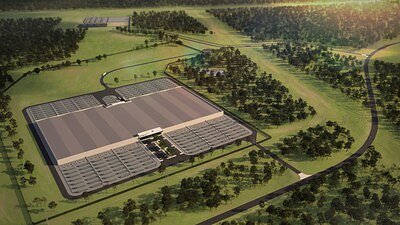
MIAMI, FL – December 17, 2025 – Hut 8 Corp. today announced a monumental $7.0 billion agreement that catapults the company from its Bitcoin mining roots into the epicenter of the artificial intelligence infrastructure arms race. The 15-year lease with AI cloud platform Fluidstack, financially backstopped by tech titan Google, will establish a 245-megawatt (MW) AI data center at Hut 8's River Bend campus in Louisiana, signaling a massive economic transformation for the region and a strategic masterstroke in the global scramble for computing power.
The deal, valued at up to $17.7 billion if all renewal options are exercised, represents one of the largest data center leases of its kind and validates Hut 8's strategic pivot to becoming a diversified energy and digital infrastructure platform.
Google's Shadow Play in the AI Arms Race
While the agreement is formally between Hut 8 and Fluidstack, the involvement of Google as a financial guarantor reveals a deeper strategy playing out among the world's tech giants. In the relentless quest for AI dominance, access to massive, power-intensive computing infrastructure has become the primary bottleneck. By backstopping the lease, Google secures a vast reservoir of AI-ready capacity without the lead time and capital expenditure of building the facility itself.
This move is a key part of Google's broader effort to expand the market for its specialized Tensor Processing Unit (TPU) hardware and challenge the market dominance of rivals like Nvidia. Fluidstack, which specializes in providing high-performance GPU and TPU infrastructure to leading AI labs and enterprises, serves as a crucial intermediary. It aggregates and orchestrates computing resources, including Google’s, offering them to a wide range of customers. This allows Google to scale its hardware ecosystem beyond its own cloud platform, generating revenue and gathering valuable data on diverse AI workloads.
This isn't the first time Google has employed this strategy. The company has previously provided multi-billion-dollar guarantees for Fluidstack's data center ventures, effectively de-risking large-scale projects to accelerate the availability of the specialized infrastructure the entire industry is clamoring for. The Hut 8 deal is the latest and one of the most significant examples of this capital-efficient approach to winning the AI infrastructure war.
From Crypto Mines to AI Powerhouses
For Hut 8, the transaction marks the culmination of a deliberate transformation. Originally known as one of North America's largest Bitcoin miners, the company has been strategically repositioning itself, leveraging its expertise in securing large-scale power agreements to serve the even more lucrative AI and high-performance computing (HPC) markets.
Asher Genoot, CEO of Hut 8, framed the deal as a validation of this "power-first, innovation-driven development model." He stated, "This Agreement is the result of disciplined, patient execution as we focused on securing the right transaction, not just the first."
The financial structure of the deal, a triple-net (NNN) lease, further highlights Hut 8's sophisticated approach. This arrangement passes most operating expenses, including property taxes and maintenance, directly to the tenant, Fluidstack. This model provides Hut 8 with a predictable, high-margin revenue stream, with an expected cumulative net operating income (NOI) of $6.9 billion over the 15-year base term.
This strategic pivot places Hut 8 in a new competitive landscape alongside specialized "neoclouds" like CoreWeave and established data center REITs such as Digital Realty, all racing to build the next generation of AI-ready facilities. Hut 8's differentiator lies in its development pipeline and its ability to originate greenfield sites with massive power capacity, a critical advantage in an industry where energy is the ultimate currency. The River Bend campus itself holds a Right of First Offer (ROFO) for up to an additional 1,000 MW, potentially making it one of the largest data center campuses in the world.
A Generational Windfall for Louisiana
The project's impact extends far beyond corporate strategy, promising a historic economic boom for Louisiana and particularly for West Feliciana Parish. At its peak, construction is expected to employ approximately 1,000 workers. Once operational, the campus will create over 75 direct high-wage jobs and more than 190 indirect jobs, figures that will expand significantly if the campus is built out to its full potential.
Governor Jeff Landry celebrated the announcement, stating, "Hut 8's investment in River Bend demonstrates that Louisiana has the resources, leadership, and vision to compete for the most consequential opportunities in the world."
The financial infusion into West Feliciana Parish is poised to be transformative. Local officials anticipate that the project could generate up to $90 million in annual revenue for the parish, a sum described as "life-changing." This revenue will fund critical public services, including schools, healthcare, and infrastructure. "River Bend puts West Feliciana firmly on the map as part of the global AI economy, and we are proud to play our role in it," said Kenny Havard, President of West Feliciana Parish.
This massive development is underpinned by a crucial partnership with Entergy Louisiana, which has secured an initial 330 MW of utility capacity for the campus. Phillip May, President and CEO of Entergy Louisiana, noted the project "will further cement Louisiana's position as a national leader in energy and innovation." The immense power draw underscores the symbiotic relationship between modern data infrastructure and energy providers, who must invest heavily in grid modernization to support such large-scale developments.
The High-Stakes Buildout: Execution and Reality
With an initial delivery date set for the second quarter of 2027, Hut 8 faces the complex challenge of executing one of the largest data center construction projects in the nation. Building facilities capable of housing dense clusters of power-hungry AI chips is significantly more complex and expensive than constructing the Bitcoin mining sites of Hut 8's past. These AI data centers require advanced liquid cooling systems, extensive electrical redundancy, and enterprise-grade security and networking.
To mitigate the inherent risks of such a massive undertaking—from supply chain delays to cost overruns—Hut 8 has assembled a roster of blue-chip partners. Global professional services firm Jacobs will serve as the Engineering, Procurement, and Construction Management (EPCM) partner, while Vertiv will provide critical infrastructure solutions. On the financial side, J.P. Morgan and Goldman Sachs are expected to underwrite project-level financing of up to 85% loan-to-cost.
"By integrating industry-leading counterparties throughout the project lifecycle, we are strengthening delivery certainty and positioning River Bend to set a new standard for how next-generation AI infrastructure is designed and developed," Genoot explained.
This institutional-grade execution model is designed to be a repeatable framework as Hut 8 advances commercialization across its broader development pipeline, which includes over 8,500 MW of capacity under various stages of diligence and development across North America. The successful delivery of the River Bend campus will not only provide a critical resource for the AI industry but also serve as the ultimate proof of concept for Hut 8's ambitious new identity.