
- 5,000 attendees: Estimated number of graduates, family members, and supporters expected at the ceremony.
- 2026 commencement: Event scheduled for May 28 at Louis Armstrong Stadium.
- 140th anniversary: Yeshiva University celebrating its 140th year alongside America's semiquincentennial.
Experts would likely conclude that Yeshiva University's selection of Ambassador Mike Huckabee as commencement speaker underscores a strategic alignment with a conservative vision of U.S.-Israel relations, reflecting both institutional values and contemporary geopolitical shifts.
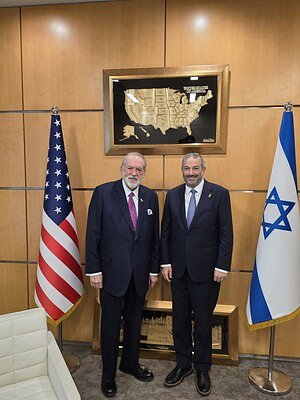
Huckabee to Headline Yeshiva University's 'America 250' Commencement
By Thomas Moore
NEW YORK and JERUSALEM – April 30, 2026 – Yeshiva University has announced that U.S. Ambassador to Israel Mike Huckabee will be the featured speaker at its 2026 commencement ceremony, a selection that places a prominent and powerful diplomatic figure at the center of its celebration of American and institutional milestones.
In a move that underscores the deep ties between the university, the American Jewish community, and the State of Israel, Huckabee will not only deliver the keynote address but will also receive the University's highest honor, the Presidential Medallion for Global Leadership. The event, scheduled for May 28 at the Louis Armstrong Stadium, is themed "America 250," marking the nation's semiquincentennial and Yeshiva University's 140th year.
A Diplomatic Choice for a Milestone Year
Yeshiva University is framing the event as a celebration of shared democratic ideals and the enduring U.S.-Israel alliance. In a statement, Rabbi Dr. Ari Berman, President of Yeshiva University, lauded the ambassador's selection.
"Ambassador Mike Huckabee is a true hero and friend of the United States, the State of Israel, the Jewish people and all people," said Rabbi Berman. "As our nation approaches its 250th anniversary, his leadership reflects the core values that shape both the American story and the mission of Yeshiva University. It is a privilege to welcome him as we recognize a new generation of graduates prepared to lead with character, conviction and a commitment to building a better world."
An estimated 5,000 graduates, family members, and university supporters are expected to attend the ceremony. Ambassador Huckabee, a former Arkansas governor and two-time presidential candidate, expressed his gratitude for the invitation.
"Yeshiva University is a globally respected institution defined by both academic excellence and a strong ethical foundation," Huckabee stated. "At a time when these principles are more important than ever, the University stands as a powerful example of how education can inspire purpose, strengthen communities and transform the future."
The Ambassador's Record: A Staunch and Controversial Stance
The choice of Huckabee is particularly significant given his active and assertive role as ambassador. Confirmed by the Senate in April 2025 on a near party-line vote, Huckabee's tenure began amidst the ongoing conflict in Gaza. A longtime evangelical Christian with a history of leading religious tours to Israel, his appointment was seen by supporters as a move to install a deeply knowledgeable and passionate friend of Israel into a critical diplomatic post.
His diplomatic record, however, has been characterized by a sharp departure from decades of established U.S. foreign policy in the Middle East. In June 2025, Ambassador Huckabee publicly stated that the United States was no longer pursuing an independent Palestinian state as a policy goal. He has consistently rejected the term "West Bank," opting instead for the biblical names "Judea and Samaria," and refers to Israeli settlements as "communities" or "neighborhoods," pointedly denying the concept of Israeli occupation.
These positions, while aligning with the views of many in Israel's right-wing government and his own conservative base in the U.S., represent a seismic shift in American diplomacy. His selection by Yeshiva University places these very current and contentious policy stances on a prominent academic stage, effectively endorsing the vision of the U.S.-Israel relationship that he champions.
A Tradition of Honoring Leadership
Yeshiva University, the flagship Jewish university in the United States, has a history of honoring figures who have made significant impacts in public service and leadership. The Presidential Medallion has previously been awarded to a diverse group of individuals, including Brigadier General (Ret.) Dr. Daniel Gold, a key architect of the Iron Dome missile defense system, as well as American political figures like Senator John Fetterman and Congresswoman Elise Stefanik.
The selection of Huckabee fits within this tradition of recognizing influential leaders, but it also elevates a figure who is not just a supporter of Israel, but an active architect of a controversial and muscular new phase in American policy toward the region. By honoring him, the university is not just looking back at a career of service but is actively engaging with the present-day geopolitical landscape.
As the university's own materials state, it is animated by core Torah values, including "Bring Redemption (Torat Tzion)," a principle tied to the Jewish people's connection to the land of Israel. Honoring Huckabee, whose diplomatic actions have been some of the most consequential in strengthening Israeli territorial claims, can be seen as a direct reflection of this institutional value.
Education, Faith, and Geopolitics on a Commencement Stage
The convergence of the "America 250" theme with Ambassador Huckabee's address creates a powerful symbolic moment. It links the university's mission—to blend Jewish tradition with Western civilization—to a specific, conservative-aligned vision of American identity and its role on the world stage. For the Class of 2026, the message is clear: leadership involves taking strong, values-driven stances on the most critical issues of the day.
While the university's leadership has enthusiastically endorsed Huckabee, the choice to honor a figure so deeply embedded in the contentious politics of the Israeli-Palestinian conflict is likely to spark discussion both within and outside the university community. It transforms the commencement from a simple academic ceremony into a statement on faith, foreign policy, and the future of the U.S.-Israel relationship.
As graduates prepare to enter a world of complex challenges, their final academic ceremony will feature a speaker whose career embodies the intersection of faith, conviction, and uncompromising political action, setting a distinct tone for their own paths forward.