
- Price: $2,499 for the device, with a mandatory subscription service costing nearly $800 per year.
- Coverage: Monitors a 5,000-square-foot area, tracking pollutants down to 0.1 microns.
- Market Positioning: Targets a premium niche with advanced features like a proprietary 'Mold Index' and access to environmental health specialists.
Experts would likely view the HomeCleanse Guardian as a highly sensitive early warning system for indoor air quality, though its diagnostic capabilities may be limited compared to professional-grade equipment. Its value lies in proactive monitoring and access to expert guidance, particularly for individuals with health sensitivities.
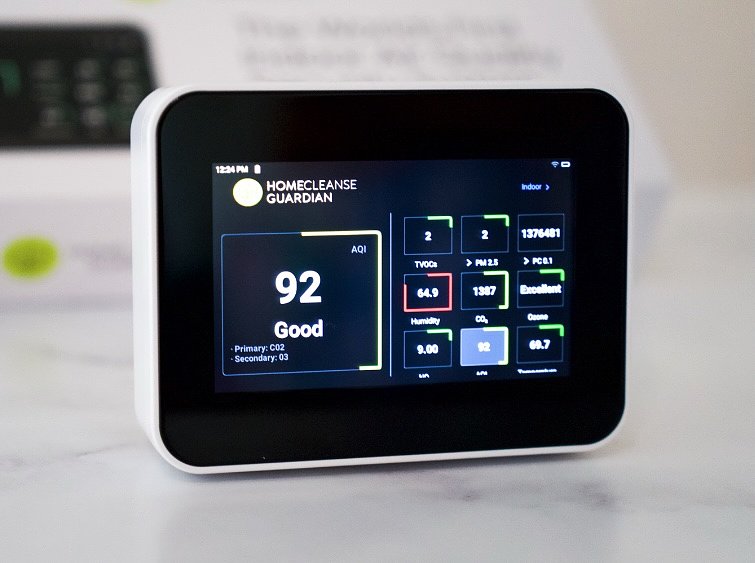
HomeCleanse Guardian: A 'Security System' for Your Home's Air
CLEARWATER, Fla. – March 17, 2026 – As awareness grows around the invisible dangers lurking in our homes, one company is positioning its latest product not merely as a gadget, but as a home security essential. HomeCleanse, a firm specializing in mold remediation, today launched the HomeCleanse Guardian, an indoor air quality (IAQ) monitor it dubs the first 24/7 "security system for your air." The device promises to continuously stand watch against silent health threats, from mold spores to industrial chemicals, fundamentally changing how we protect our indoor sanctuaries.
This is not a typical smart home accessory. With a premium price tag of $2,499 and a mandatory subscription service costing nearly $800 per year, the Guardian is a significant investment aimed at a public increasingly concerned with environmental health. It enters a growing market of IAQ monitors but seeks to create a new, ultra-premium category that blends high-tech hardware with human expertise.
The Promise of Proactive Protection
The core premise of the HomeCleanse Guardian is to shift homeowners from a reactive to a proactive stance on air quality. According to the company, the device monitors a broader spectrum of pollutants than any other consumer-grade monitor. Its sensors are designed to track particulate matter down to an exceptionally fine 0.1 microns, Total Volatile Organic Compounds (TVOCs), carbon dioxide, ozone, humidity, and temperature across a sprawling 5,000-square-foot area.
Through a connected app, the Guardian provides real-time alerts when any of its monitored metrics cross a potentially harmful threshold. The system's most distinctive feature is its proprietary "Mold Index," which aims to provide an early warning for one of the most common and concerning indoor pollutants. The subscription service is central to this ecosystem, providing not only ongoing monitoring and free sensor replacements but also optional access to HomeCleanse's own environmental health specialists for guidance.
"The Guardian answers a problem most individuals don't even realize exists," said Michael Rubino, Founder and CEO of HomeCleanse, in a press release. "We've seen firsthand how poor air quality can affect people's health and their overall lives. The Guardian empowers individuals to track their air quality in real-time, transforming awareness into prevention and action. Think of it as a home health security system, watching for changes that could compromise your well-being."
Scrutinizing the Science
While the Guardian's mission is compelling, its advanced claims venture into territory where consumer technology has historically faced significant challenges. The promise to detect particulates as small as 0.1 microns—a size that includes some viruses and mycotoxins—is particularly ambitious. Independent academic studies on consumer-grade IAQ monitors have often found that while they are effective at detecting larger particles (like the PM2.5 standard), their accuracy diminishes substantially when measuring ultrafine particles below 0.3 microns. Accurately counting particles at this scale typically requires expensive, laboratory-grade laser counters.
Similarly, the "Mold Index" represents an algorithmic interpretation rather than a direct biological measurement. Consumer devices cannot directly identify mold spores or distinguish them from other particulates like dust or pollen. Instead, such an index likely relies on a sophisticated algorithm that analyzes patterns in particulate matter counts, humidity levels, and the presence of microbial volatile organic compounds (MVOCs), which are gases released by active mold. While this can be a powerful indicator of conditions favorable to mold growth or an active infestation, it is not a substitute for professional spore trap analysis, which is necessary for definitive identification.
The Guardian's value, therefore, may lie less in its ability to provide a definitive diagnosis and more in its capacity to serve as a highly sensitive early warning system, flagging anomalies that warrant further investigation.
A New Standard or a Premium Niche?
In a market populated by capable IAQ monitors from brands like Airthings and Awair—most of which retail for under $400—the HomeCleanse Guardian's price point places it in a class of its own. The differentiation lies in its positioning as a comprehensive service, not just a product. The high-cost subscription, which includes sensor replacements and access to professional consultations, reframes the device as an ongoing managed security service for health.
This model targets a specific consumer: individuals with chronic health conditions, compromised immune systems, or severe sensitivities, as well as health-conscious families for whom the peace of mind could justify the cost. For this demographic, the potential to correlate environmental changes with physical symptoms in real-time, backed by professional guidance, is a powerful value proposition that other off-the-shelf monitors do not offer. The device’s founder, Michael Rubino, is a council-certified mold remediation supervisor and author, lending significant industry credibility to the company's mission-driven approach.
The Rising Tide of Indoor Air Awareness
The launch of the Guardian is timed perfectly with a surge in public consciousness about indoor environments. Citing EPA data, HomeCleanse notes that people spend nearly 90% of their time indoors, where air can be up to five times more polluted than outside. The COVID-19 pandemic acted as a powerful catalyst, bringing terms like 'aerosol transmission' and 'air filtration' into everyday conversation and accelerating a pre-existing wellness trend.
This device is part of a larger movement toward the 'quantified self,' where individuals use technology to monitor every aspect of their health, from sleep patterns to heart rate. The Guardian extends this concept to the home itself, treating the living space as an external organ that directly impacts well-being. Rubino’s assertion that "clean air is a human right" and that families "deserve to know what's in their air" encapsulates this paradigm shift. Whether this high-tech, high-cost approach becomes a new standard in home health or remains a niche luxury, it signals a definitive shift in how we perceive the safety of the very air we breathe.