
- 48 unicorns: Hangzhou now hosts 48 unicorn companies, up from 44 last year and nearly double the 26 in 2018.
- 83% dominance: Hangzhou commands 83% of Zhejiang province's billion-dollar firms, up from 80% in a year.
- 400 billion yuan investment: The city plans to invest 400 billion yuan ($56 billion) in technological innovation by 2030.
Experts would likely conclude that Hangzhou's unicorn boom is a direct result of its strategic, well-funded industrial policy, which has successfully fostered a world-class innovation ecosystem focused on cutting-edge technologies like AI, robotics, and semiconductors.
Hangzhou’s Unicorn Boom: How Strategy Built a Global Tech Titan
HANGZHOU, China – April 24, 2026 – While the eastern province of Zhejiang celebrated its roster of high-growth startups expanding to 58 unicorn companies this week, the real story lies in the tightening grip of its capital. Hangzhou now commands a staggering 83% of the province's billion-dollar firms, solidifying its position not just as a regional leader, but as a meticulously engineered global technology powerhouse.
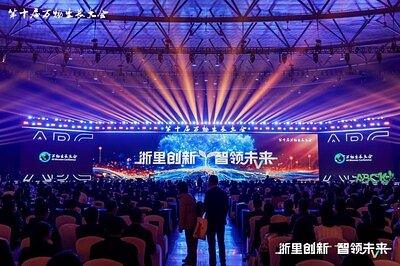
Announcements from the 10th All Blossom Conference on April 23 confirmed Hangzhou is now home to 48 unicorns, a significant jump from 44 last year and a near-doubling of its 2018 count of 26. The city's share of Zhejiang's unicorns has swelled from 80% to 83% in just twelve months, demonstrating an acceleration that outpaces the surrounding region. This growth is no accident; it is the direct result of a deliberate, well-funded, and systematic municipal strategy designed to forge a world-class innovation ecosystem.
A City's Deliberate Design
At the heart of Hangzhou's ascent is the "296X" industrial cluster system, a comprehensive blueprint introduced in October 2025. This ambitious strategy is the city's answer to integrating technological innovation with industrial might, aiming to re-anchor advanced manufacturing in an economy that had become heavily dominated by the service sector. The city has set a target of achieving 530 billion yuan in added value from these clusters by 2027.
The "296X" framework is a multi-layered approach:
- "2" refers to the cultivation of two trillion-yuan anchor clusters: Artificial Intelligence and Visual Intelligence.
- "9" represents nine established trillion-yuan clusters, including integrated circuits and biomedicine, which continue to receive support.
- "6" focuses on half a dozen high-potential, cutting-edge future sectors like commercial aerospace, the low-altitude economy, and brain-like intelligence.
- "X" signifies a commitment to exploring and leading in nascent, undefined frontiers such as the metaverse and quantum technology.
This blueprint is backed by immense financial firepower. Hangzhou plans to invest 400 billion yuan (approx. $56 billion) in technological innovation by 2030, raising its R&D spending to an impressive 4.5% of its economic output. A dedicated direct investment fund of over 10 billion yuan has also been established to speed the commercialization of new technologies, creating a fertile ground for startups to scale rapidly.
The New Breed of Unicorns
The fruits of this strategy are visible in the eight new companies that joined Hangzhou’s unicorn ranks this week. They are not a random assortment of startups but a reflection of the city's targeted industrial policy, with a heavy emphasis on robotics, semiconductors, and commercial aerospace.
Spirit AI, founded as recently as early 2024, exemplifies the city's focus on embodied intelligence. The robotics startup, which raised a staggering 2 billion yuan (approx. $280 million) in less than a year from investors including JD.com, Tencent, and Xiaomi, is developing humanoid robots capable of complex tasks. Its robot, "Xiaomo," is already being deployed on battery assembly lines at industrial giant CATL.
Another new entrant, DEEP Robotics, specializes in agile quadruped robots for industrial inspections and emergency rescue. Founded by Zhejiang University alumni, the company has deployed its machines in critical infrastructure, from power substations to the underground tunnels of the Asian Games, showcasing the real-world application of its advanced AI.
Further highlighting the city's "hard tech" pivot are Geener Microelectronics and Geespace, both linked to the automotive and technology giant Geely. Geener, founded in 2022, develops crucial automotive-grade power semiconductors for electric vehicles. Geespace, meanwhile, is building a constellation of low-earth orbit satellites to provide high-precision navigation and data services, representing a key component of the "296X" plan's focus on commercial aerospace.
Simplexity Robotics, another embodied AI firm, became one of the sector's "youngest unicorns" by raising $280 million in under six months from a who's who of Chinese venture capital, including Sequoia China and Alibaba Group. This rapid scaling underscores the potent combination of available talent, strategic focus, and abundant capital within Hangzhou's ecosystem.
The Financial Engine Room
This unicorn boom is fueled by a powerful and increasingly state-directed financial engine. In the first quarter of 2026, China's venture capital fundraising surged, driven largely by government guidance funds at the national and municipal levels targeting strategic sectors like AI, robotics, and semiconductors.
Hangzhou is a primary beneficiary of this trend. In 2024, Zhejiang province was the largest recipient of VC funding in China. The city's financial ecosystem is a sophisticated blend of public and private capital. Government-backed vehicles like the Zhejiang Provincial Industrial Fund and the Hangzhou City Investment Group are highly active, investing alongside corporate venture arms from titans like Alibaba, Tencent, and Geely, as well as top-tier private VCs.
This concerted effort was further amplified in late 2024 when Hangzhou secured an initial 90 billion yuan ($12.7 billion) in a landmark collaboration with China's five largest financial asset investment companies. The capital is explicitly earmarked to bolster key sectors outlined in the city's industrial strategy, ensuring that promising companies have the resources to transition from research to commercial success.
Building a Full-Spectrum Pipeline
Hangzhou's strategy extends far beyond simply minting billion-dollar companies. The All Blossom Conference rankings reveal a deliberate, tiered system designed to cultivate a deep and sustainable pipeline of high-growth firms. Below the 48 unicorns lies a formidable list of 413 "quasi-unicorns"—companies valued between $100 million and $1 billion—with 50 new additions this year.
These future contenders are concentrated in sectors perfectly aligned with the "296X" blueprint: life sciences lead with 118 firms, followed by next-generation IT (78) and AI/embodied intelligence (50). Below them, a vibrant class of early-stage "seed unicorns" valued at $10 million to $100 million is being nurtured, with a strong focus on new energy and life sciences.
Further evidence of this systematic approach is the designation of many of these firms as nationally recognized "specialized and refined" enterprises. Over half of Hangzhou's unicorns and quasi-unicorns—255 companies in total—hold this status, which signifies they are part of a structured national program to foster innovation champions. This structured pipeline, moving companies from seed to quasi-unicorn to full unicorn status, demonstrates a long-term vision for sustained economic growth driven by technological leadership.