
- CRN Cloud 100 Recognition: Hammerspace included in the 2026 CRN® Cloud 100, a prestigious list of innovative cloud technology companies.
- Revenue Growth: Tenfold revenue increase from 2023 to 2024.
- Investment: $100 million strategic growth investment in 2025 from investors like Altimeter Capital and ARK Invest.
Experts would likely conclude that Hammerspace's innovative 'Tier 0' storage architecture and unified namespace solution address critical AI infrastructure challenges, offering a cost-effective and performance-optimized approach to data management for enterprises.
Hammerspace Cracks AI Storage Code, Earns CRN Cloud 100 Recognition
By Anthony Hughes
SAN MATEO, CA – January 12, 2026 – As enterprises grapple with the staggering costs of scaling artificial intelligence, data platform provider Hammerspace has received a significant industry nod for its novel approach to solving one of AI's most expensive bottlenecks: data storage. The company announced its inclusion in the 2026 CRN® Cloud 100, a prestigious list recognizing the most innovative and channel-focused cloud technology companies.
The recognition from CRN, a brand of The Channel Company, highlights Hammerspace's growing influence in a market desperately seeking to balance the insatiable performance demands of AI workloads with budgetary realities. The company’s software platform is designed to feed data to power-hungry GPU clusters at maximum speed, then intelligently move that data to cheaper storage tiers, a capability that directly addresses the AI cost-performance paradox.
The Brutal Economics of AI Infrastructure
The AI revolution is well underway, but it runs on an engine of expensive, specialized hardware. GPUs, the parallel processing workhorses of AI, can only deliver a return on investment when they are actively computing. However, a common and costly problem is that these GPUs often sit idle, waiting for data to be delivered from storage systems that can't keep up. This I/O bottleneck forces organizations into a difficult choice: either accept underutilized multi-million-dollar GPU clusters or invest in vast, permanently-on high-performance storage pools that carry exorbitant price tags.
Industry trends in 2026 show that while the cost per transaction for AI may be decreasing, the sheer volume of AI usage is causing cloud and infrastructure bills to explode. Enterprises are shifting from a "cloud-first" to a "cloud-prudent" strategy, especially for critical AI workloads. The concept of "data gravity"—the idea that large datasets are difficult and costly to move—is forcing a re-evaluation of where compute happens. This has given rise to hybrid AI as the new default, where workloads are processed closer to the data, whether on-premises or in the cloud, to optimize for performance, cost, and data sovereignty.
“The performance of GPU clusters is often limited by cloud storage that can’t feed data to the GPUs fast enough,” said David Flynn, Founder and CEO of Hammerspace, in a statement. His assessment pinpoints the central challenge that his company aims to solve.
Tier 0: Performance on Demand, Not on Retainer
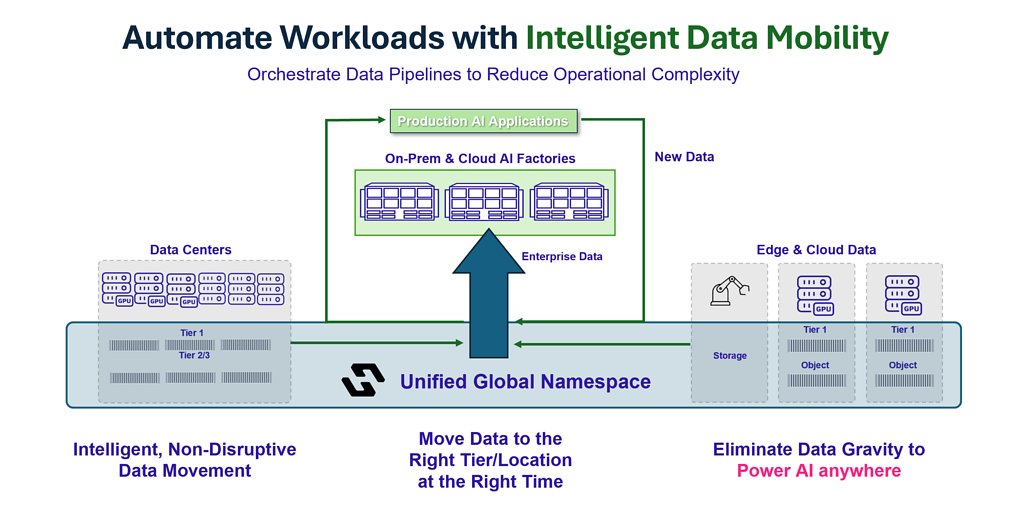
Hammerspace's answer to this challenge is its 'Tier 0' storage architecture. Instead of relying solely on slower, networked storage, the platform transforms the server-local NVMe flash storage already present in most GPU servers into a unified, high-performance shared data resource. When an AI training or inference job begins, data is delivered directly to the GPUs at NVMe-class speeds, eliminating bottlenecks and keeping the expensive processors fully utilized.
The platform's intelligence, however, lies in what happens next. Once the high-performance workload is complete, Hammerspace’s data orchestration engine automatically and transparently moves the data and its outputs to cost-effective object storage. This dynamic, workload-aware approach means organizations pay for peak performance only when they need it.
“Hammerspace delivers Tier 0 performance to AI workloads and can then move the data to object storage the moment that speed is no longer required,” Flynn explained. “That’s how you keep GPUs productive and costs under control in the real world.”
This model stands in stark contrast to competitors that often require significant, disruptive hardware overhauls or lock customers into a single tier of expensive all-flash storage. By leveraging a standards-based approach built on parallel NFS and contributing to the open-source Linux kernel, Hammerspace offers a non-disruptive software overlay that can be deployed in hours on existing infrastructure.
A Unified Namespace for a Hybrid World
Beyond just performance and cost, Hammerspace tackles the foundational problem of data silos. Modern enterprises often have data scattered across multiple on-premises data centers, edge locations, and several public clouds. Accessing this disparate data for a single AI pipeline typically requires creating new copies, leading to data sprawl, version control issues, and increased costs.
The company’s platform creates a single, unified global namespace across all of an organization's storage, regardless of vendor or location. For applications and data scientists, it appears as if all data resides in one local, easily accessible place. This eliminates the need for manual data movement or application rewrites, a critical advantage for accelerating AI development and deployment. This architecture effectively neutralizes data gravity, allowing organizations to move compute to the data, or data to the compute, based on GPU availability, cost, or compliance requirements, without being locked into a single cloud vendor or hardware platform.
This capability is becoming increasingly vital as organizations build out their own "private AI factories" and adopt strategic hybrid models to maintain control over their data and AI destiny.
Market Validation and Channel Momentum
Inclusion on the CRN Cloud 100 list is more than just an award; it's a key validator in the IT channel ecosystem. For solution providers and resellers who guide enterprise technology decisions, the list serves as a trusted resource for identifying innovative and reliable vendors. Hammerspace’s commitment to a 100% channel-driven go-to-market strategy makes this recognition particularly impactful.
Throughout 2025, the company heavily invested in its 'Partnerspace' program, launching an international roadshow, expanding its partner portal, and making key leadership hires to bolster its channel and strategic alliances. This strategy appears to be paying off, fueling significant business momentum. The company reported a tenfold revenue increase from 2023 to 2024 and secured a $100 million strategic growth investment in 2025 from prominent AI-focused investors like Altimeter Capital and ARK Invest.
With strong customer retention and a net revenue retention rate reportedly exceeding 330%, it's clear that once customers adopt the platform, they are expanding its use significantly. This combination of technological innovation, strong partner focus, and impressive growth metrics signals that Hammerspace is not just shaping the market for AI data management, but is also building the business foundation to become a dominant player in it.