
- 48% of firms are adjusting minimum required returns on new projects due to global volatility.
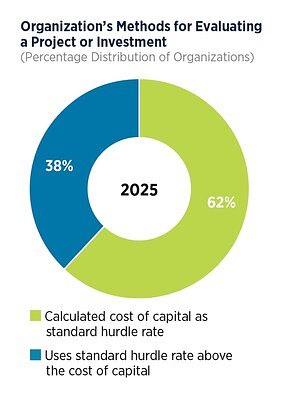
- 38% of businesses (often smaller or privately held) are setting hurdle rates higher than their calculated cost of capital.
- 83% of organizations use both the Capital Asset Pricing Model (CAPM) and Discounted Cash Flow (DCF) models in their financial decision-making.
Experts conclude that firms are strategically raising investment hurdles in response to global volatility, prioritizing resilience over aggressive growth while leveraging advanced financial models and real-time data analytics for more dynamic decision-making.
Half of Firms Raise Investment Bar Amid Global Volatility, AFP Reports
ROCKVILLE, Md. – March 10, 2026 – In a clear sign of mounting economic caution, nearly half of all organizations are actively adjusting the minimum required returns on new projects, a direct response to a landscape fraught with market volatility, geopolitical turmoil, and shifting regulations. A landmark survey released today by the Association for Financial Professionals (AFP) reveals a significant strategic pivot, as companies move away from static financial goalposts toward more dynamic and responsive investment criteria.
The 2026 AFP Cost of Capital Survey Report, which polled 295 corporate practitioners, paints a picture of a business world grappling with uncertainty. The findings indicate that the fundamental process of deciding where to invest capital is undergoing a transformation, driven by a complex mix of external pressures and internal technological advancements.
The Rising Bar for New Investments
At the heart of this shift is the concept of the "hurdle rate"—the minimum acceptable rate of return a project must promise to be green-lit. For decades, this rate was often a fixed point on a company’s financial map. Now, for approximately half of businesses, it has become a moving target.
This newfound dynamism is not arbitrary. It is a calculated reaction to a series of global shocks. Lingering geopolitical tensions, from the war in Ukraine to conflicts in the Middle East, have injected significant risk into global supply chains and energy markets. Simultaneously, a trend toward protectionist trade policies and uncertainty surrounding the future of central bank leadership, including the upcoming end of Federal Reserve Chair Jerome Powell's term, creates an unpredictable macroeconomic environment. In this climate, companies are demanding a higher "risk premium" for deploying their capital, effectively raising the bar for what constitutes a worthwhile investment.
The survey highlights that while a majority (62%) still use their calculated cost of capital as the baseline hurdle rate, a substantial 38%—often smaller or privately held firms—are setting their hurdle rates even higher. This suggests a strategic decision to build an extra cushion against unforeseen risks, prioritizing resilience over aggressive, unbridled growth.
The Engine Room: How Decisions Are Made
Despite the evolving landscape, the core mechanics of corporate finance remain anchored in established principles. The AFP report confirms that the responsibility for these critical calculations lies squarely within dedicated finance departments. Treasury (34%) and corporate finance (32%) teams are the primary owners of calculating the Weighted Average Cost of Capital (WACC), the metric that blends a company's cost of debt and equity to determine its overall cost of financing.
To arrive at these figures, financial professionals continue to rely on a trusted toolkit. The Capital Asset Pricing Model (CAPM), a method for estimating the cost of equity by linking expected return to risk, is used by a commanding 83% of organizations. In parallel, the Discounted Cash Flow (DCF) model, which evaluates projects by estimating the present value of their future earnings, is employed by an identical 83% of respondents.
When it comes to the final decision-making process, a trio of metrics reigns supreme. Over 80% of financial professionals cited Internal Rate of Return (IRR), Net Present Value (NPV), and Return on Investment (ROI) as being important to their organization's investment choices. This enduring reliance on traditional models and metrics provides a disciplined framework within which companies are now embedding a more agile response to external shocks.
Technology as the New Strategic Lever
The most significant evolution highlighted by the survey is the growing integration of technology into the cost of capital process. The era of relying solely on annual or semi-annual updates to financial models is fading. The report reveals that over half of organizations now use real-time data analytics, and a pioneering 18% are incorporating machine learning models into their cost of capital estimations.
This technological adoption is what enables the financial agility required in today's market. Instead of waiting for a scheduled review, companies can now react instantly to market shifts. Thirty-two percent of organizations now update their WACC on an "as-needed" basis, a practice more common than the traditional annual schedule (28%). Real-time data allows firms to model the impact of a sudden geopolitical event or a shift in interest rate expectations, adjusting their hurdle rates accordingly.
"The survey findings underscore how cost of capital has evolved into a dynamic strategic lever," said Tom Hunt, CTP, Director of Treasury Practice at AFP. "By integrating real-time data and external validation, treasury and corporate finance leaders ensure their hurdle rates reflect the true risk-adjusted reality of their investments."
A Duality of Validation and Secrecy
Given the immense strategic importance of a company's cost of capital, organizations are walking a fine line between seeking accuracy and maintaining confidentiality. The data is so critical that it has created a dual-pronged approach to its management.
On one hand, there is a clear drive for precision and external validation. Approximately 40% of companies have their cost of capital calculations verified by outside parties, turning primarily to investment banks (41%) and consulting firms (40%) to ensure their internal numbers align with market realities. This practice is especially prevalent in capital-intensive sectors like manufacturing and energy, where multi-billion dollar projects hinge on the accuracy of these financial benchmarks.
On the other hand, once this highly accurate number is determined, it is guarded closely. Reflecting its competitive sensitivity, an overwhelming 78% of organizations communicate cost of capital information strictly on a need-to-know basis. A company's hurdle rate can reveal its appetite for risk, its growth strategy, and its financial health—information that could be invaluable to competitors. This blend of external rigor and internal secrecy highlights the high-stakes nature of capital allocation, where the right number can unlock value and the wrong one can lead to strategic missteps in an unforgiving economic environment.
Topics & Related
AI & Machine Learning
Energy & Utilities
Manufacturing & Industrial
Geopolitics & Trade
Digital Transformation
AI & Emerging Technology
Finance & Investment
Revenue
Net Income
EBITDA
Free Cash Flow
Gross Margin
Operating Margin
EPS
Market Capitalization
P/E Ratio
Interest Rates
Inflation
Related Company Pulse