
- 50% reduction in broker-dealer compliance review time for early adopter Frec
- Hours of manual work saved weekly for robo-advisor Silo
- Unified data model integrating emails, video calls, employee records, and firm policies
Experts agree that Hadrius's AI-native compliance infrastructure represents a paradigm shift, moving beyond traditional RegTech by embedding AI at the core of compliance operations, enabling real-time, context-rich risk assessment and autonomous workflows.
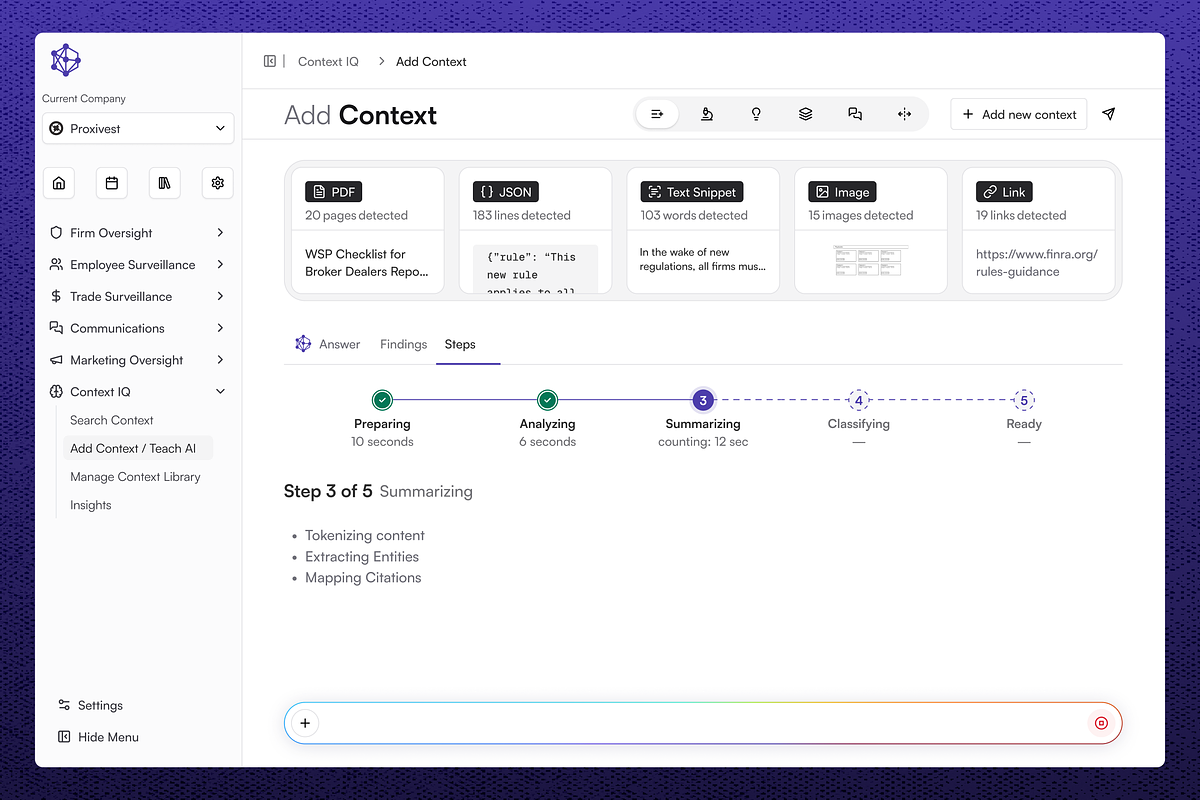
Hadrius Challenges RegTech with AI-Native Compliance Infrastructure
NEW YORK, NY – April 14, 2026 – Hadrius today unveiled its AI-native compliance infrastructure, a move that signals a significant departure from how the financial industry has approached technology-driven regulation. The company argues that while artificial intelligence has become a buzzword in compliance, most platforms are merely layering intelligence onto outdated systems, limiting its effectiveness. Hadrius claims to have rebuilt its system from the ground up, placing AI at the very core of its architecture.
This new platform aims to replace the fragmented, multi-vendor workflows that plague compliance departments with a single, interconnected system. The goal is to move beyond simply generating alerts and toward what the company calls "agentic compliance operations," where AI not only detects potential issues but also acts on them in real-time.
"The compliance industry spent decades building systems for humans to catch what machines miss. We built Hadrius for the opposite, AI that sees everything, connects it, and acts on it in real time, so humans focus on judgment, not noise," said Thomas Stewart, CEO of Hadrius. "We didn't add intelligence to compliance. We rebuilt compliance around it, and we intend to define that category."
The AI-Native Divide: Architecture vs. Add-Ons
The distinction Hadrius is drawing between "AI-native" and "AI-powered" is central to its market positioning. For years, RegTech vendors have retrofitted AI onto legacy systems, using it as a secondary filter to sift through alerts generated by older rule-based engines. This approach often leaves data siloed across different tools for communications surveillance, marketing review, and trade supervision, forcing compliance teams to manually piece together a complete picture of risk.
An AI-native architecture, by contrast, is designed with AI as its foundational engine. At the heart of the Hadrius platform is a unified data model that integrates disparate sources—from emails and video calls to employee records and firm-specific policies—into a single, context-rich environment. When the system evaluates an interaction, it doesn't just see a keyword; it understands who the employee is, their role, their supervisory structure, and their past behavior, all mapped against the firm's own rules.
This holistic view is crucial for tackling modern communication complexities. Legacy systems, built for text-based channels, struggle to analyze the "meshed" communications common today, such as screen sharing during a video call or discussions in collaborative apps. AI-native platforms are built to perform multi-modal analysis, simultaneously processing spoken words, on-screen text, and shared files to capture the full context of an interaction, something bolted-on solutions often miss. The result, according to early deployments, is a dramatic reduction in false positives, freeing compliance teams from the deluge of low-relevance alerts.
Beyond Detection: The Rise of Agentic Workflows
Perhaps the most forward-looking aspect of the Hadrius platform is its emphasis on "agentic workflows." This moves AI's role from a passive detector to an active participant in the compliance process. Because the system operates on a unified and comprehensive dataset, it can go beyond simply flagging a potential violation.
These AI-driven processes can autonomously execute testing and oversight procedures, prioritize risks across different employees and business units, and adapt to a firm’s unique compliance program. Instead of presenting a compliance officer with a raw list of 1,000 alerts to triage, the system can surface a handful of high-priority issues with clear, actionable next steps. This enables compliance teams to operate at the level of strategic decision-making rather than getting bogged down in manual execution.
The tangible benefits of this approach are already being seen by early adopters. Fintech firm Frec reported cutting its broker-dealer compliance review time in half, while robo-advisor Silo streamlined its SEC compliance program, saving hours of manual work each week. Furthermore, a strategic partnership with wealth infrastructure company BridgeFT, announced in late 2025, underscores a move toward eliminating manual data transfers and providing compliance teams with the real-time, normalized data needed for effective oversight. This shift allows firms to scale their compliance capabilities to match business growth without a proportional increase in headcount.
Navigating the New Regulatory Gauntlet
The launch comes as regulatory bodies are intensifying their scrutiny of how financial firms use artificial intelligence. Both the SEC and FINRA have named AI governance as a key examination priority for 2026. The message from regulators is clear: innovation is welcome, but it must be governed. Firms are no longer just being asked if they use AI, but how they manage its risks, ensure its outputs are accurate, and maintain auditable records.
This regulatory pressure is driving a need for systems with built-in transparency. A critical component of AI-native architecture is "explainability"—the ability for the system to articulate precisely why it flagged a particular communication or action. This is non-negotiable for satisfying auditors and regulators, who require a clear audit trail for compliance decisions. The era of "black box" algorithms is rapidly closing.
This evolving landscape is transforming AI governance platforms from a luxury to a necessity. As one industry analysis notes, the core challenge for many firms is that their AI usage has outpaced their AI policies. Platforms that can not only deploy AI but also help govern its use—ensuring it adheres to rules like Books & Records (Rule 204-2) and providing the necessary transparency—are becoming indispensable tools for mitigating risk in an increasingly complex environment.
The Compliance Officer Reimagined
The rise of powerful, autonomous systems naturally raises questions about the future of the human compliance officer. However, the narrative emerging from Hadrius and the broader RegTech industry is one of augmentation, not replacement. By automating the repetitive, time-consuming tasks that currently dominate a compliance analyst's day, AI-native platforms aim to elevate the human role.
The goal is to shift professionals away from the manual triage of endless alerts and toward higher-value work that requires nuanced judgment, strategic thinking, and complex problem-solving. A "human-in-the-loop" model is widely seen as the optimal approach, where technology handles the immense scale of data processing and initial review, while humans provide critical oversight and make the final call on complex issues.
This shift will likely reshape the compliance profession, demanding new skills and even creating new roles. Professionals who can effectively orchestrate AI, understanding its capabilities and limitations, will become invaluable. The focus will move from finding the needle in the haystack to deciding what to do with the needle once the machine has found it. As firms look to consolidate fragmented tools into single, intelligence-driven platforms, the question is no longer just about keeping up with technology.
"Most platforms are adding AI to keep up," said Som Mohapatra, COO of Hadrius. "We rebuilt compliance from the ground up to move ahead."