
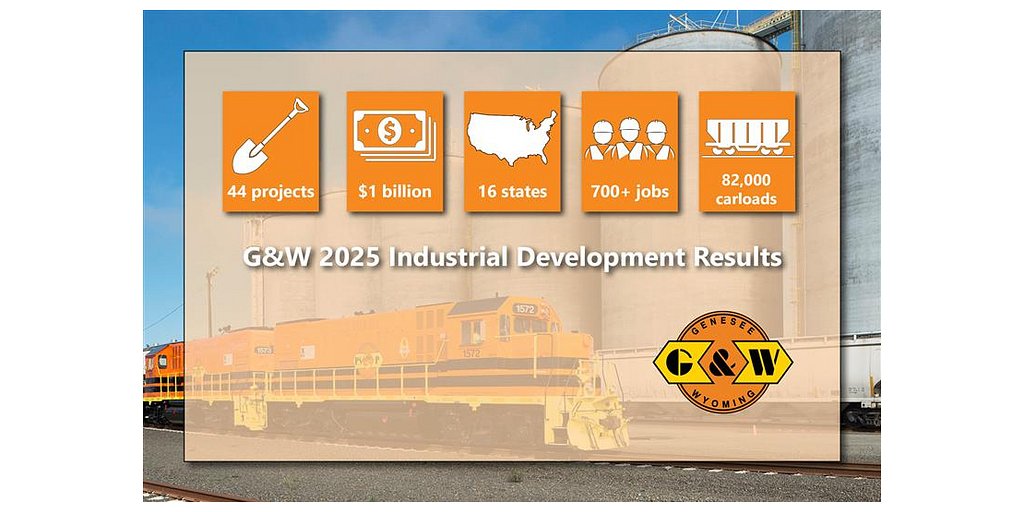
- $1 billion in customer investments across 44 projects in 16 states
- 700+ jobs created and 82,000+ new carloads annually added to the rail network
- $400 million expansion by Incobrasa Industries in Illinois
Experts would likely conclude that this investment signals a strong resurgence in U.S. industrial rail infrastructure, driven by the need for resilient, efficient, and environmentally sustainable supply chains.
G&W's $1B Investment Signals U.S. Industrial Rail Revival
DARIEN, Conn. – January 14, 2026 – In a significant demonstration of confidence in the American industrial sector, short line railroad giant Genesee & Wyoming Inc. (G&W) has announced a wave of new industrial development projects poised to inject over $1 billion in customer investments across the country. The 44 projects, spanning 16 states, are projected to create more than 700 jobs and add over 82,000 new carloads to the nation's rail network annually.
The initiative underscores a growing trend where businesses are turning to rail infrastructure to strengthen supply chains, enhance efficiency, and drive growth. The investments cover a wide array of industries, from agriculture and chemicals to automotive and construction materials.
“Industrial development projects are a key component of our growth strategy,” said G&W CEO Michael Miller in the announcement. He noted that the projects, which include new plants, facility expansions, and the reopening of shuttered sites, prove that customers “view rail transportation as critical to their success.” Miller added that customers recognize the “safety, efficiency and economic benefits of using rail” and trust G&W’s network to support their expansion.
A Nationwide Boom on Rails
The scope of the investments highlights the broad-based nature of this industrial resurgence. While the agriculture, chemical, and minerals & stone sectors represent the largest share, the projects touch nearly every corner of the industrial economy. This diverse portfolio of developments signals a robust and widespread belief in the power of rail-centric logistics.
Among the flagship projects is a monumental $400 million expansion by Incobrasa Industries, a soybean processor and biodiesel manufacturer in Illinois. “G&W’s Toledo, Peoria & Western Railway and Illinois & Midland Railroad are integral to this growth, providing the critical infrastructure to move more product efficiently and connect global markets,” said Aluizio Ribeiro, CEO of Incobrasa. “This partnership exemplifies how strategic investments in rail unlocks economic opportunity and strengthens supply chains for decades to come.”
In Washington, a more than $200 million terminal expansion will significantly boost the export capabilities of soybean processor Ag Processing Inc. (AGP). Leonard Barnes, executive director of the Port of Grays Harbor, which facilitates the exports, praised the collaboration with G&W's Puget Sound & Pacific Railroad. “This is a transformative time at the Port... We deeply value our partnership with G&W and its Puget Sound & Pacific Railroad. They make it easy to do business, and their collaboration is instrumental in delivering improvements,” Barnes stated.
Other key projects include a new facility in Texas for aggregate construction materials company BURNCO and a new cottonseed unit train facility in Georgia for Penny Newman Grain. Tom Zais, CEO of BURNCO, commented on the development of their new Trenton, Texas, facility, saying, “We greatly valued the opportunity to collaborate with G&W’s Dallas, Garland & Northeastern Railroad... This new location represents another growth milestone in our rich 113-year history.” Similarly, Todd Parker of Penny Newman Grain praised G&W’s Georgia Southwestern Railroad as a “great partner” whose professionalism and reliability were key to their project's success in Bainbridge, Georgia.
The Strategic Power of the Short Line
Genesee & Wyoming's success in attracting these substantial investments hinges on its unique position as North America's largest short line railroad holding company. Operating over 100 regional and short line railroads, the company provides the crucial “first-mile, last-mile” service that connects thousands of businesses in smaller towns and rural areas to the national and global supply chain.
Unlike the massive Class I railroads that focus on long-haul, high-density corridors, short lines offer a more nimble and customer-focused service. Industry analysis indicates that businesses often turn to short lines for their flexibility, consistent service, and ability to create customized logistics solutions. This model is proving essential as companies seek to build more resilient supply chains that are less vulnerable to the disruptions seen in recent years, such as trucking shortages and port congestion.
G&W actively cultivates these opportunities through a dedicated industrial development team that works with shippers, economic development agencies, and utilities to transform properties along its 13,000-mile network into productive industrial sites. By simplifying the process of integrating rail access, the company helps businesses lower transportation costs and access markets that would be uneconomical to reach by truck alone.
Fueling a More Flexible, Greener Supply Chain
A key innovation highlighted in G&W’s announcement is the establishment of several rail-to-truck transloading sites. This logistics strategy is rapidly gaining traction as a way for shippers to combine the long-haul economic and environmental benefits of rail with the last-mile flexibility of trucking. By moving bulk commodities via rail over long distances and then transferring them to trucks for final delivery, companies can significantly reduce fuel costs and carbon emissions.
Rail transport is substantially more fuel-efficient than trucking, capable of moving one ton of freight over 470 miles on a single gallon of fuel. As companies face increasing pressure to meet Environmental, Social, and Governance (ESG) targets, the shift to multimodal solutions like transloading offers a practical path toward a greener supply chain. Research shows the global market for multimodal transportation is projected to grow significantly, driven by this demand for efficient, cost-effective, and sustainable logistics.
These new transloading facilities, including one along G&W’s Central Oregon & Pacific Railroad, provide businesses that are not directly located on a rail line with the opportunity to leverage rail economics. This expands the reach of the rail network and provides a powerful tool for optimizing freight movement, enhancing supply chain agility, and ultimately reducing the environmental impact of transporting goods across the country.