
- $500,000: The estimated property tax hike threatening the closure of the Fairgrounds Racket Club.
- 2.3x: The ratio of commercial property taxes compared to residential rates in Toronto, creating a financial disincentive for community activations.
- 1 site: The vacant lot transformed into a community hub, now at risk of returning to vacancy due to tax policy.
Experts argue that Toronto's rigid property tax framework creates a 'perverse incentive' that penalizes temporary, community-focused land uses, stifling urban activation efforts and favoring vacant lots over active community spaces.
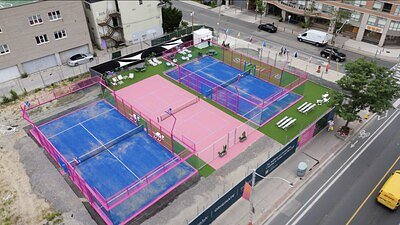
Good Deed Punished: Pop-Up Racket Club Faces $500K Tax Hike
TORONTO, ON – March 19, 2026 – An innovative project that transformed a vacant lot into a vibrant community racket club is now facing its own demise, not from lack of popularity, but from a property tax bill that suddenly swelled by an estimated $500,000. The Fairgrounds Racket Club at 8 Rosehill Avenue, a temporary hub for pickleball and padel players, is now at risk of being dismantled, highlighting what critics call a major flaw in Toronto's tax policy that penalizes positive community engagement.
The club, located near Yonge and St. Clair, was hailed as a model for activating urban spaces awaiting redevelopment. Instead of a boarded-up construction site, residents gained a much-needed recreational amenity. However, because the club charges booking fees to cover its operational costs, the Municipal Property Assessment Corporation (MPAC) reclassified the property from residential to commercial, triggering the massive tax increase and threatening the project's viability.
A Community Hub on Borrowed Time
The vision for Fairgrounds was to combat urban vacancy while making racket sports more accessible. The site at Yonge and Rosehill, owned by Originate Developments, is slated for a future mixed-use residential tower. With development timelines often stretching for years, especially in a slowing condominium market, the land was destined to sit empty.
"Our goal with Fairgrounds is simple: take sites that might otherwise sit empty and turn them into places where people can play, socialize, and spend time in their neighbourhood," said Drummond Munro, co-founder of Fairgrounds. His model focuses on removing the high costs and exclusivity often associated with traditional sports clubs.
This sentiment was shared by the developer, who actively sought to put the land to good use during the lengthy pre-construction phase.
"This site was intentionally activated so it wouldn't sit empty while the development process moves forward," explained Adam Sheffer, Co-Founder of Originate Developments. "Instead of a boarded-up lot, the community gained a place to play, gather, and stay active. Unfortunately, the current property tax system unintentionally penalizes these kinds of temporary uses."
Without a resolution, the courts will likely be torn down, and the lot will return to the very state of vacancy its activation was meant to prevent, remaining fenced off until construction eventually begins.
The 'Perverse Incentive' of Urban Policy
The heart of the issue lies in a rigid tax framework that struggles to accommodate temporary, community-focused land uses. Under the current system, vacant land awaiting development can often retain its previous, lower tax classification—in this case, residential. However, the moment that land is put to an active use that generates revenue, even to simply sustain itself, it risks being reclassified as commercial.
In Toronto, commercial property taxes are approximately 2.3 times higher than residential rates. This discrepancy creates what many involved are calling a "perverse incentive": it is financially safer and easier for a landowner to leave a property dormant and derelict than to partner with an organization to bring life and activity to a neighbourhood.
This policy conflict is becoming increasingly relevant as development cycles lengthen across the city. With many properties sitting in transition for extended periods, opportunities for interim uses that benefit the public are being stifled by the fear of incurring crippling tax liabilities. The Fairgrounds case serves as a stark warning to others considering similar community-minded projects.
A Boost for Local Businesses
The potential closure of the Rosehill courts is not just a loss for players; it's a blow to the surrounding business community. Local business leaders argue that activations like Fairgrounds are crucial for creating the energy and foot traffic that help small businesses thrive.
"Activating underused spaces helps create energy and foot traffic that benefits surrounding businesses," stated John Kiru, CEO of the Toronto Association of Business Improvement Areas (TABIA). "These kinds of interim uses bring people into neighbourhoods, support local restaurants and shops, and make communities feel more vibrant."
This positive impact has already been felt in the Yonge and St. Clair area. The local BIA has championed the project as a textbook example of how to strengthen a commercial district.
"Having activity on this site has been a real benefit for the neighbourhood," said Jason Glionna of the Yonge + St. Clair BIA. "People come to play, and then they visit local cafes, restaurants, and shops. It's exactly the kind of activation that strengthens and supports small businesses."
Forging a Path Forward
Supporters of the racket club argue that the situation demands a policy-level solution to prevent this from happening again. Several potential paths are being explored that could provide a lifeline for Fairgrounds and future interim-use projects across Toronto. One leading proposal is the creation of a new Interim Use Property Tax Sub-Class. This would establish a specific, lower tax rate for lands in transition that host temporary public or community uses, acknowledging their unique, non-permanent nature. The City of Toronto has already created specialized tax subclasses for small businesses and new multi-residential rental properties, setting a precedent for using tax policy to achieve specific community goals.
Another option is a Community Improvement Plan (CIP), a tool that would allow the City to provide grants to offset punitive tax increases associated with beneficial interim activations. Finally, a Municipal Capital Facility (MCF) designation could be applied. This mechanism has been used in Toronto to grant tax exemptions to facilities that provide a public benefit, such as affordable housing projects and community service centers.
As cities like London and Berlin embrace "meanwhile spaces" and "temporary urbanism" to foster social value and prototype future developments, Toronto faces a critical decision. The fate of the Fairgrounds Racket Club at Rosehill is more than a dispute over a single tax bill; it's a test case for whether the city's policies can adapt to support the innovative, community-building spirit it claims to encourage. Without a change, Toronto risks choosing empty lots over active communities.