
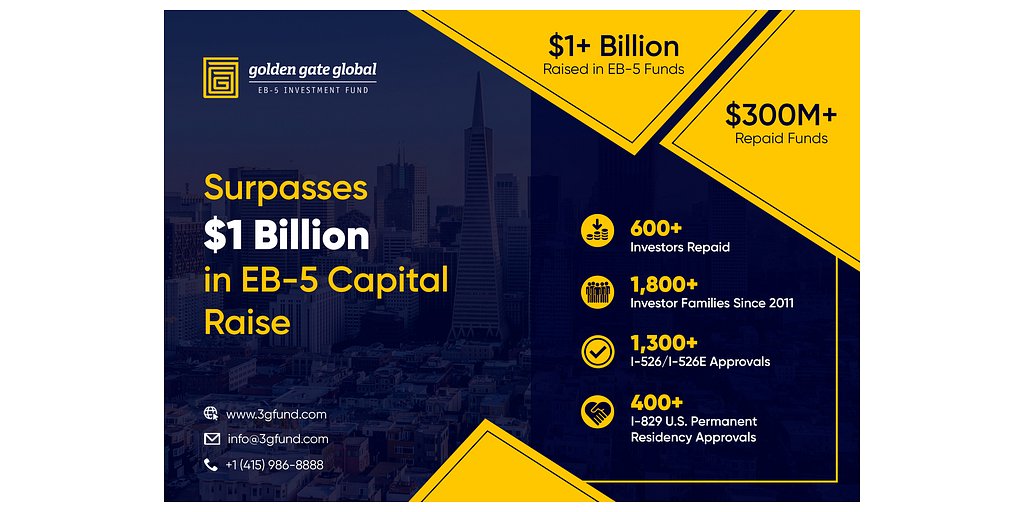
- $1 billion in capital raised through the EB-5 program
- $300 million repaid to over 600 investor families
- Minimum investment amounts increased to $800,000 (TEAs) and $1,050,000 (others) under the EB-5 Reform and Integrity Act of 2022
Experts view Golden Gate Global's milestones as a validation of the EB-5 program's evolving focus on investor trust, capital preservation, and regulatory compliance under the 2022 reforms.
Golden Gate Global's $1B Milestone Signals New Era for EB-5 Program
SAN FRANCISCO, CA – January 16, 2026 – Golden Gate Global, a prominent EB-5 regional center, has announced two significant financial milestones that are sending ripples through the U.S. immigration investment landscape. The firm confirmed it has raised over $1 billion in capital through the EB-5 Immigrant Investor Program and, crucially, has successfully repaid more than $300 million of that capital to over 600 investor families.
These twin achievements do more than just cement the firm's position as a major player; they highlight a critical evolution in an industry where investor trust and capital preservation are becoming the new currency. In a market historically focused on the promise of raising funds, the emphasis is now shifting decisively toward the performance of returning them.
“Raising EB-5 capital is ultimately about trust, but repayment is where credibility is earned,” said Steven Kay, Founder and Co-CEO of Golden Gate Global, in a statement accompanying the announcement. “Crossing $1 billion in capital raised reflects the investor's belief in our company and EB-5 projects. Crossing $300 million in EB-5 repayments validates our execution, discipline, and long-term focus on investor outcomes.”
A New Chapter of Stability and Reform
The milestones arrive at a pivotal moment for the EB-5 program. The industry is still adapting to the landmark EB-5 Reform and Integrity Act of 2022 (RIA), legislation designed to bring long-term stability and robust oversight to a program that had previously been plagued by uncertainty and short-term extensions. The RIA reauthorized the Regional Center Program through 2027 and introduced a slate of changes aimed squarely at enhancing investor protection and transparency.
Among the most significant changes were increased minimum investment amounts—now $800,000 for projects in Targeted Employment Areas (TEAs) and $1,050,000 for others—and stringent new compliance measures for regional centers. These centers now face mandatory audits and are required to make annual contributions to an EB-5 Integrity Fund. These reforms have forced a maturation of the market, favoring established operators with a demonstrable history of regulatory compliance and successful project completion.
Furthermore, the RIA introduced visa set-asides, reserving 32% of the annual EB-5 visa allocation for specific project types: 20% for rural areas, 10% for high-unemployment areas, and 2% for infrastructure projects. For investors from backlogged countries like India and China, these set-asides can offer a much faster path to a Green Card, making the program more attractive than ever.
The Repayment Gold Standard
While raising capital remains a key function, sophisticated investors are increasingly scrutinizing a regional center's repayment history as the ultimate measure of success. Golden Gate Global's announcement that it has returned over $300 million to its clients directly addresses this growing demand for proven performance. This focus on capital preservation is particularly acute in markets like Vietnam, India, and China, where families view the EB-5 program not only as an immigration tool but also as a significant financial undertaking.
The RIA itself has influenced this dynamic. By clarifying that an investor's capital generally needs to be sustained in the investment for just two years after being deployed into the job-creating enterprise, the act has provided more predictable timelines for capital return. This change moves away from the old model where funds could be tied up indefinitely due to immigration processing delays, a major source of anxiety for past investors. Firms that can demonstrate a clear and consistent track record of navigating projects to completion and returning funds are now at a distinct advantage.
A Lifeline for America's Stranded Talent
Perhaps the most compelling narrative emerging from the modern EB-5 landscape is its growing appeal to highly skilled professionals already living and working in the United States. Individuals on temporary visas such as the H-1B, L-1, and E-2 face a notoriously difficult and uncertain path to permanent residency. The U.S. employment-based Green Card system is crippled by staggering backlogs, with per-country caps creating waits that can span decades. For Indian nationals in the EB-2 and EB-3 categories, the estimated wait time has stretched to an astonishing 134 years.
This gridlock leaves professionals in a state of perpetual limbo, tethered to a sponsoring employer, unable to change jobs freely, and facing the risk that their children will "age out" of dependent status at 21, forcing them to leave the country. For this demographic, the EB-5 program has become a strategic alternative. The RIA's provision for the concurrent filing of the I-526E immigration petition and the I-485 application for adjustment of status is a game-changer. It allows eligible U.S.-based investors to receive work and travel authorization in a matter of months, granting them career mobility and stability long before the Green Card is approved.
Golden Gate Global has leaned into this trend, dedicating internal teams to guide U.S.-based professionals through the process. By offering a more predictable, albeit expensive, route to a Green Card, the EB-5 program is effectively serving as a private-sector solution to the public policy challenge of retaining top global talent.
The firm's strategy of focusing on institutional-quality real estate developments with experienced partners appears tailored to the demands of this new, more risk-averse environment. Such projects are often better positioned to meet the program's strict job-creation requirements and offer clearer exit visibility, aligning with the dual investor goals of securing a Green Card and preserving their capital. As the EB-5 program continues to mature under the RIA's framework, the ability to demonstrate both large-scale capital deployment and consistent repayment will likely define leadership for years to come.