
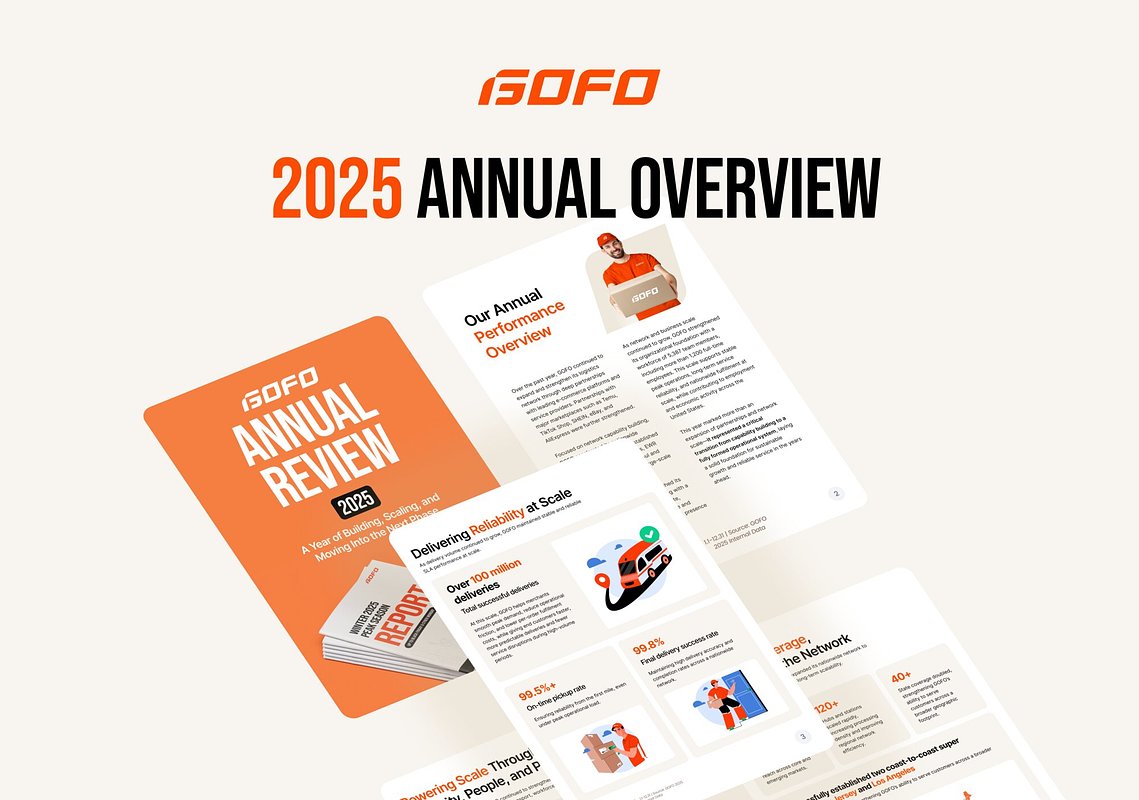
- 100 million packages delivered in 2025: GOFO's milestone achievement in its second year of operation.
- 0.4% of U.S. parcel market: GOFO's share in a market dominated by giants like UPS, FedEx, and Amazon Logistics.
- 40 states covered: GOFO's rapid expansion to over 120 hubs and 8,500 ZIP codes, reaching 70% of the U.S. population.
Experts view GOFO's decision to hold delivery prices flat as a strategic challenge to industry norms, leveraging operational efficiency and automation to offer cost predictability in a volatile logistics market.
GOFO Holds Delivery Prices Flat, Challenging Logistics Giants
LOS ANGELES, CA – January 13, 2026 – In a bold move that sends ripples through the competitive U.S. logistics market, last-mile provider GOFO announced it will not increase its service fees for 2026. The decision comes as the company celebrates a landmark year, having delivered over 100 million packages in 2025, a significant achievement for a firm that launched just over two years ago.
This commitment to price stability directly challenges the industry-standard practice of annual rate hikes, positioning GOFO as an increasingly attractive partner for e-commerce merchants grappling with rising operational costs. While the company's volume remains a fraction of that handled by titans like UPS, FedEx, and Amazon Logistics, its aggressive growth and pricing strategy signal a new front in the battle for the American doorstep.
The Price of Stability in a Volatile Market
GOFO's announcement to hold prices steady for 2026 arrives at a critical juncture for the logistics sector. Major carriers have traditionally implemented General Rate Increases (GRIs) at the start of each year to offset inflation, rising labor costs, and infrastructure investments. This practice has become a predictable, albeit unwelcome, part of budgeting for e-commerce businesses of all sizes.
In contrast, GOFO is betting that operational efficiency can serve as a shield against inflationary pressures. The company credits its ability to freeze fees to "ongoing efficiency improvements across its network," including automation and optimized routing that lower its unit operating costs. This strategy sets it apart from incumbents like UPS and FedEx, which are currently navigating revenue pressures and soft demand by focusing on higher-margin deliveries—a "better not bigger" approach that often involves shedding less profitable volume and adjusting prices to maximize yield.
For the thousands of e-commerce sellers that rely on third-party logistics, cost predictability is paramount. GOFO's move offers them a potential reprieve from the annual cycle of rising shipping expenses, a key variable that directly impacts their pricing, profit margins, and ability to compete. By delivering efficiency gains to customers rather than passing on cost volatility, the company is making a clear statement about its value proposition in a market where pricing and delivery time are the primary battlegrounds.
From Startup to Nationwide Network in Two Years
GOFO's journey from a regional concept to a national player has been remarkably swift. Founded in Los Angeles in August 2023 by Henry Zheng, the company was built on the belief that a logistics network could be shaped from the ground up to meet the specific needs of U.S. shippers and consumers. This locally grounded perspective aimed to make last-mile delivery feel seamless from coast to coast.
What began as a focused Southern California operation has exploded into a significant national footprint. As of December 2025, GOFO's network spans more than 40 states, operating out of over 120 hubs and stations. Its reach now covers more than 8,500 ZIP codes, putting its services within range of over 70 percent of the U.S. population.
Underpinning this rapid scaling was a crucial strategic investment: the establishment of two coast-to-coast "Super Hubs" in New Jersey and Los Angeles. These facilities are designed to bolster nationwide linehaul capacity and handle large-scale sorting, providing the foundational throughput necessary to support long-term growth on both coasts. This bi-coastal backbone has been instrumental in transforming GOFO from a collection of regional outposts into a cohesive, interconnected national logistics provider.
A Blueprint Built on Bytes and Automation
At the core of GOFO's growth and pricing strategy is its stated philosophy: Drive Efficiency, Deliver Trust. The company asserts that it achieves this by weaving advanced technology into its physical operations to deliver a cost-efficient and dependable service at scale.
According to its 2025 Annual Review, the company has aggressively deployed automated sortation equipment at key hubs, reducing the need for manual package handling and dramatically increasing throughput. This is complemented by automated induction systems and intelligent network planning software that optimizes routing to reduce unnecessary miles traveled and re-handling of packages. While automation is a major focus across the entire logistics industry—with giants like UPS targeting 66% of its volume through automated hubs—GOFO's relative youth may be an advantage. Building a network from scratch allows for the integration of modern technology from day one, potentially avoiding the complex and costly process of retrofitting legacy infrastructure.
These technological upgrades are not just about speed; they are central to the company's economic model. By systematically taking costs out of the operation—through fewer manual touchpoints, shorter routes, and more integrated planning between its linehaul and last-mile legs—GOFO generates the savings that enable it to hold service fees flat. This approach also carries sustainability benefits, as reducing avoidable miles and streamlining processing naturally lowers fuel consumption and operational waste.
Carving a Niche in a Giants' Playground
While delivering 100 million packages is a notable milestone, it is essential to view it within the context of the colossal U.S. parcel market. With total U.S. package shipments estimated to exceed 24 billion in 2025, GOFO's volume represents approximately 0.4% of the market. The industry remains heavily concentrated, with USPS, Amazon Logistics, UPS, and FedEx collectively managing around 98% of all U.S. parcel shipments.
However, GOFO is part of a growing and dynamic segment. The category of "Independent Carriers" has seen a significant surge, with shipment volume growing 23% in 2024 to 800 million packages, capturing a 3.5% market share. GOFO's rapid expansion places it as a key contributor to this trend. Rather than attempting to dethrone the giants overnight, its strategy appears focused on capturing a meaningful niche by serving e-commerce platforms and merchants who are increasingly seeking alternatives.
By offering consistent performance, greater predictability, and, most critically, price stability, GOFO is positioning itself as a vital partner for businesses looking to diversify their shipping options and control costs. As the company continues to deepen its network density and invest in technology, its ability to maintain this competitive edge while scaling its operations will be the defining challenge in its next phase of growth.