
- Certificate Validity Period: Reduced from 398 days to 200 days (March 15, 2026), with further reductions to 100 days (March 15, 2027) and 47 days (March 15, 2029).
- SMB Preparedness: 68% of SMBs feel under-prepared for cyber threats, relying on manual tracking methods.
- Outage Impact: 88% of organizations have suffered unplanned outages due to certificate expiration.
Experts agree that the rapid shortening of certificate lifespans poses a significant operational challenge for SMBs, necessitating automation tools like TLS Connect to prevent security breaches and service disruptions.
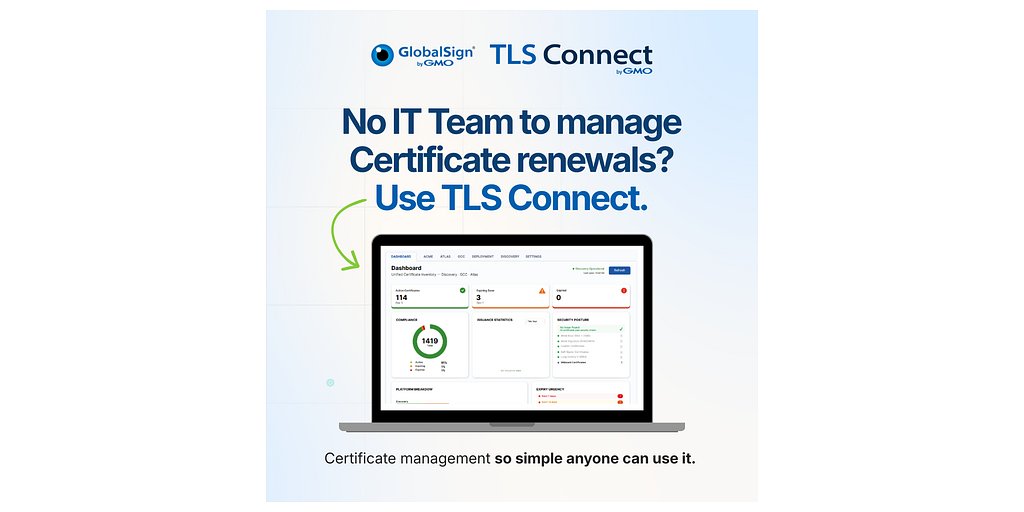
GlobalSign Offers SMBs a Lifeline for the 47-Day Certificate Era
BOSTON, MA – April 27, 2026 – As the digital clock ticks down on long-term web security certificates, certificate authority GMO GlobalSign has launched a new tool aimed at throwing a lifeline to small and medium businesses (SMBs) struggling to keep up. The company today introduced TLS Connect, a Certificate Lifecycle Management (CLM) platform designed to automate the complex and increasingly frequent task of renewing the digital certificates that secure websites and online services.
The launch comes as the entire industry braces for a series of dramatic reductions in certificate validity periods, a change that threatens to overwhelm businesses that lack dedicated IT security teams. For many SMBs, the new tool could mean the difference between seamless security and catastrophic service outages.
The Closing Window: A Looming Crisis for Small Business
At the heart of modern internet security is the TLS (Transport Layer Security) certificate, a small data file that cryptographically links an organization's details to a cryptographic key, enabling secure connections. When a user sees a padlock icon in their browser, it’s a TLS certificate at work, encrypting data and verifying the website's identity. If that certificate expires, browsers will issue stark warnings to visitors, or block access entirely, bringing business to a grinding halt.
Historically, managing these certificates was a relatively infrequent task. However, driven by a need to enhance security and limit the damage from potential key compromises, the CA/Browser Forum—the industry’s governing body—has mandated a rapid shortening of certificate lifespans. On March 15 of this year, the maximum validity period was cut from 398 days to just 200. The timeline continues to accelerate, with a reduction to 100 days scheduled for March 15, 2027, and a final drop to just 47 days by March 15, 2029.
This shift transforms certificate renewal from a manageable annual task into a high-frequency, operational burden. For large enterprises with deep pockets and dedicated Public Key Infrastructure (PKI) experts, this is a manageable, albeit significant, challenge. For SMBs, it represents a potential crisis. Research shows that 68% of SMBs feel under-prepared for cyber threats, and many rely on manual tracking methods like spreadsheets to manage their certificates. With a 47-day cycle, manual management becomes virtually impossible, and the risk of a missed renewal skyrockets.
The consequences are severe. High-profile outages at major corporations like Microsoft and Spotify have been traced back to a single expired certificate, costing millions in downtime and reputational damage. For an SMB, such an outage can be an existential threat. Studies indicate that 88% of organizations have suffered unplanned outages due to certificate expiration, a number that is expected to climb as lifespans shorten.
Automation as the Answer: Introducing TLS Connect
GMO GlobalSign's TLS Connect is designed to directly address this escalating problem by automating the entire certificate lifecycle. The new tool provides SMBs with capabilities previously reserved for large enterprises, but in a package tailored to their resources and expertise.
“There is a huge business risk in not knowing what certificates you have in your network. If you miss even one certificate renewal, that could bring websites and critical applications to a halt,” said Julie Gaunt, Senior Product Manager at GMO GlobalSign. “That is why we are so pleased to introduce TLS Connect. We believe it is exactly what today’s SMBs need to automate their TLS certificates and stay ahead of business disruptions.”
Deployed on-premises within a customer's network, TLS Connect acts as a central command center for certificate management. Its key feature is a discovery scanner that scours the network to create a complete inventory of all existing TLS certificates, eliminating dangerous blind spots from forgotten or shadow IT deployments. Once certificates are identified, the platform leverages the ACME (Automatic Certificate Management Environment) protocol—the same standard used by services like Let's Encrypt—to handle the automated issuance, renewal, and installation of certificates across various servers and network devices.
This automation removes the element of human error and the administrative overhead that makes short-lifespan certificates so daunting for smaller teams. The platform provides a centralized dashboard for reporting and oversight, giving IT managers a single, clear view of their security posture without requiring deep PKI expertise.
Bridging the Gap in the Security Market
The CLM market has traditionally presented SMBs with a difficult choice: invest in powerful but costly and complex enterprise-grade solutions, or rely on free but often technically demanding open-source tools that lack centralized management and support. TLS Connect is positioned to fill what analysts see as a critical and growing gap in the market.
“Full enterprise CLM often proves too costly for SMBs while settling for no operational CLM at all exposes organizations to certificate outages, potential downtime, and brand and reputational damage,” noted ABI Research Senior Analyst Aisling Dawson. She added that TLS Connect “occupies a quickly growing gap in the CLM marketspace between organizations that require full enterprise CLM and those relying on manual tracking processes.”
This sentiment is echoed by company leadership, who see the tool as a way to democratize essential security technology.
“The critical difference is that most midsize and large enterprises have CLM tools in place to manage their certificates, while SMBs do not,” said Aditya Anand, Head of Business Unit for TLS & CLM CA Division at GMO GlobalSign. “TLS Connect will remove the sting of transitioning to shortened certificate lifespans. Customers will get a powerful CLM solution designed just for SMBs at a price point they can afford, giving them the confidence they need to run their business without fear of a certificate expiring.”
The Inevitable March Towards Crypto-Agility
The industry's push for shorter certificate lifespans is not merely an administrative challenge; it is a fundamental strategic shift towards greater security and agility. Shorter validity periods dramatically reduce the window of opportunity for an attacker to misuse a stolen or compromised certificate. This forces organizations to adopt automation, which in turn builds a crucial capability known as crypto-agility—the ability to respond quickly to cryptographic threats and migrate to new standards.
As Dawson of ABI Research points out, the countdown to 47-day certificates is also a dress rehearsal for even bigger challenges on the horizon, such as “preparing for the migration to quantum-ready systems.” The automated infrastructure that companies build today to handle frequent certificate renewals will become the foundation for navigating the next generation of cryptographic change. For SMBs, adopting a tool like TLS Connect is not just about solving today's renewal problem, but about building the resilience needed to remain secure in the increasingly complex digital landscape of tomorrow.