
- 5.9% GDP growth: Hong Kong's GDP grew by 5.9% in Q1 2026, driven by technology exports and domestic demand.
- 3rd year of summit: The Global Prosperity Summit is in its third year, bringing together global leaders to discuss stability and governance.
- 2020 National Security Law: Implementation of this law reshaped Hong Kong's political landscape, centralizing authority under Beijing's objectives.
Experts view China's Global Governance Initiative as a strategic effort to reshape international norms, with developing nations supporting its emphasis on sovereign equality, while Western capitals approach it with caution.
Global Summit Spotlights China’s New World Order, HK's Role
HONG KONG – May 19, 2026 – The Global Prosperity Summit 2026 opened today against a backdrop of increasing geopolitical friction, with organizers positioning Hong Kong as a vital platform for dialogue and China using the stage to detail its ambitious vision for a reformed world order. Now in its third year, the two-day summit brings together policymakers, academics, and business leaders to tackle issues shaping global stability and Hong Kong's future.
The event’s centerpiece was a keynote address on "China's Global Governance Initiative" (GGI), which advocates for a multipolar world order prioritizing solidarity and development, challenging the post-war international system.
A New Blueprint for Global Order
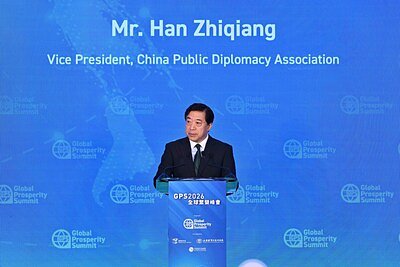
Ambassador Han Zhiqiang, Vice President of the China Public Diplomacy Association, delivered a forceful articulation of China's GGI, framing it as a necessary response to "mounting instability and uncertainty." He argued that the rise of unilateralism and protectionism has made the reform of global governance an "urgent task for all."
"Global affairs should be discussed by all, the global governance system built by all, and the governance outcomes shared by all," Ambassador Han stated, calling for a rejection of unilateral actions. The initiative's core tenets, he explained, are a call for solidarity over confrontation, a steadfast commitment to multilateralism, and a vision for a future rooted in fairness and justice. He specifically called for "greater representation and voice for developing countries" and an end to the "bullying of the small and weak."
This initiative is the latest in a series of global frameworks proposed by Beijing, following the Global Development Initiative (GDI), Global Security Initiative (GSI), and Global Civilization Initiative (GCI). Launched in 2025, the GGI is presented by China as a means to build a "community with a shared future for humanity." While it has found support among many developing nations who welcome its emphasis on sovereign equality and development without ideological strings, it is viewed with caution in some Western capitals. Critics interpret the suite of initiatives as a strategic effort to reshape international norms and institutions to better align with Beijing's interests, particularly in emerging domains like AI and climate policy.
Hong Kong's Bid as an 'Oasis of Stability'
In her opening remarks, Mrs. Regina Ip, the summit's founder and a prominent Hong Kong political figure, cast the city as a crucial intermediary. "Amid uncertainties, Hong Kong continues to stand out as an oasis of stability, connectivity and opportunity," she declared, emphasizing the summit's role as a platform for "pragmatic cooperation."
This positioning comes as Hong Kong navigates a complex economic and political reality. Economically, the city has shown resilience. Recent data shows its GDP grew by 5.9% in the first quarter of 2026, driven by strong technology-related exports and recovering domestic demand. The International Monetary Fund recently reaffirmed Hong Kong's status as a major international financial center and a "superconnector" between mainland China and the world.
Politically, however, the landscape has been fundamentally reshaped since the implementation of the National Security Law in 2020 and the subsequent Safeguarding National Security Ordinance this year. These laws have centralized authority and embedded national security as the primary principle of governance, leading to what many observers describe as an erosion of the city's traditional autonomy. The current political framework emphasizes a "patriots administering Hong Kong" model, ensuring governance aligns with Beijing's objectives. Hosting high-profile international events like the Global Prosperity Summit is a key part of the city's strategy to project an image of stability and continued global relevance despite these profound internal changes.
Think Tanks Propose New Model for APEC
Highlighting the growing influence of non-governmental policy shapers, Mrs. Ip and Professor Kaisheng Li, Vice-President of the Shanghai Institutes for International Studies, introduced a new proposal to enhance regional cooperation. Their joint briefing, titled "'APEC+' vs '+APEC'," outlines a collaborative initiative to build new layers of engagement within the Asia-Pacific Economic Cooperation framework.
Professor Li noted the critical timing of the discussion, referencing former U.S. President Trump's recent state visit to China as "a critical moment to re-calibrate the world economic order and the China-U.S. relations."
Mrs. Ip elaborated on the proposal, suggesting that cooperation could extend beyond the traditional leader and ministerial levels. "Think tanks have the capacity to do research and generate forward-looking ideas," she said. The initiative proposes creating an "APEC Global Cities Network," a network of Chinese cities that have hosted APEC meetings, and a "council of APEC think tanks." This new structure would formalize collaboration between institutions like Hong Kong's Savantas Policy Institute, the Shanghai Institutes for International Studies, and other regional partners, creating a foundation for what Ip termed "greater global regional cooperation and prosperity." This form of track-two diplomacy underscores a strategy to foster integration through academic and civil society channels, potentially bypassing more contentious governmental negotiations.
A Broader Agenda for Growth and Culture
Beyond geopolitics, the summit’s first day featured a diverse agenda aimed at reinforcing Hong Kong's multi-faceted strengths. Panel discussions addressed practical avenues for regional growth, including "Innovative Drug Development in the Guangdong–Hong Kong–Macao Greater Bay Area," highlighting the city's potential role in the region's burgeoning life sciences sector.
Another panel focused on "Hong Kong as a Sports, Cultural and Recreational Hub," exploring strategies to leverage the city's cultural assets for economic benefit and international appeal. This theme was further reinforced by a presentation from Mr. Septime Webre, Artistic Director of the Hong Kong Ballet, on "Telling Hong Kong's Story through Art." These discussions reflect a concerted effort to diversify Hong Kong's economy and strengthen its soft power. As the summit continues, the dialogues are set to further explore the intricate connections between regional development, cultural influence, and global economic stability.