
- Oscar the Grouch is the new spokesperson for Glad's 'Don't Get Mad. Get Glad.' campaign, replacing Hollywood celebrities.
- The campaign features a Broadway-esque musical number reimagining Oscar's 'I Love Trash' song.
- Special edition Oscar-branded Glad ForceFlex boxes will hit Walmart shelves in spring 2026.
Experts agree that Glad's partnership with Oscar the Grouch is a strategic masterstroke, leveraging cultural nostalgia and authentic character alignment to transform a mundane product category into an engaging brand experience.
Glad's Grouch Gambit: Why Oscar is the New A-List Endorser
OAKLAND, CA – December 02, 2025 – In a surprising and strangely perfect piece of brand casting, Glad has resurrected its iconic “Don’t Get Mad. Get Glad.” slogan, not with a frustrated Hollywood celebrity, but with the one cultural figure who has never been mad at trash a day in his life: Oscar the Grouch.
The centerpiece of the relaunched campaign is a full-blown musical number, a Broadway-esque spectacle that sees the famously cantankerous Sesame Street resident imagining a world where everyone shares his deep affection for refuse. Directed by the award-winning duo Will Speck and Josh Gordon, the spot reimagines Oscar’s signature ballad, “I Love Trash,” as a joyous ensemble piece. Why the sudden cheer? Because with Glad bags, the usual frustrations of rips, leaks, and smells are gone, freeing humanity to finally appreciate trash in its purest form.
On the surface, it’s a whimsical, high-production ad. But look closer, and you’ll see a masterclass in modern brand strategy. Glad, a household staple from The Clorox Company, has sidestepped the predictable route of product-feature warfare in the hyper-competitive trash bag category. Instead, it’s making a calculated play for cultural relevance, nostalgia, and authentic character alignment that competitors will find difficult to replicate.
The Power of a Perfect Partnership
The brilliance of this collaboration lies in its unimpeachable logic. As Glad’s Marketing Director, Kellie Li, noted in the announcement, “No one feels more strongly about trash than Oscar the Grouch.” This isn’t a shoehorned celebrity endorsement; it’s arguably the most authentic spokesperson a trash bag brand could ever hope for. The campaign’s premise—that Glad products are so effective they can turn the chore of trash disposal into a source of joy—is a message uniquely deliverable by Oscar.
For decades, brands have struggled to make mundane household products memorable. Glad’s solution is to reframe the entire conversation. The goal isn’t just to solve a problem (a leaking bag) but to change an emotion (from “ick” to fun). By borrowing Oscar’s perspective, the brand cleverly transforms a low-engagement product category into a piece of entertainment. Jennifer Ahearn, a Senior Vice President at Sesame Workshop, the nonprofit behind the beloved characters, noted their excitement in teaming up with Glad, underscoring the natural fit for their “grouchy green friend.”
The creative execution, a remix of a classic song, further deepens this connection. It taps into the collective memory of generations who grew up with Sesame Street, creating an instant emotional shorthand. This isn't just an ad; it's a cultural mashup that leverages decades of accumulated goodwill.
From Hollywood Stars to a Sesame Street Icon
For those with long memories, the “Don’t Get Mad. Get Glad.” campaign, which first premiered in 1987, is synonymous with a revolving door of human celebrities getting comically angry at their inferior food storage and trash bag solutions. This revival marks a significant strategic pivot, reflecting a broader shift in the advertising landscape. The move from a human A-lister to a felt-and-fur icon is about more than just novelty; it’s about risk mitigation and expanded appeal.
A beloved character like Oscar the Grouch comes with a built-in, pre-vetted brand identity that is both timeless and scandal-proof. Unlike a human celebrity whose public image can be volatile, Oscar’s persona is fixed and universally understood. Furthermore, his appeal is uniquely cross-generational. He resonates with nostalgic Gen Xers and Millennials who grew up watching him, their parents, and a new generation of children discovering Sesame Street on Netflix and PBS KIDS.
This move acknowledges that in today's fragmented media environment, a truly iconic piece of intellectual property (IP) can offer broader and more reliable reach than many human influencers or movie stars. The choice of Oscar is a masterstroke of casting that understands the currency of character in the modern attention economy.
The Rising Currency of Character IP
Glad’s partnership is not happening in a vacuum. It’s part of a larger trend where trusted characters are being licensed to add personality to products and even to simplify complex corporate messaging. Oscar the Grouch, in particular, has become a surprisingly versatile brand ambassador.
Just last year, United Airlines appointed him its “Chief Trash Officer” in a clever campaign to explain the benefits of sustainable aviation fuel (SAF), which can be made from household waste. Before that, he starred in a Squarespace ad that humorously positioned his trash heap as a discovered work of modern art. In both cases, Oscar’s established identity was used as a vehicle to make a topic—sustainability or web design—more accessible and engaging.
For a CPG brand like Glad, the benefit is clear. In a commoditized market where product differentiation often comes down to marginal gains in strength or scent, an emotional connection is the ultimate competitive advantage. By aligning with a character who embodies the very subject of their product category, Glad creates a powerful and defensible brand narrative.
An Ecosystem Beyond the 30-Second Spot
This campaign is also a prime example of modern, multi-platform brand building. Glad isn't just airing a commercial; it's creating a holistic brand experience. The core musical number will exist as long-form content online, with shorter 30- and 15-second versions distributed across social platforms like TikTok, Instagram, and Facebook.
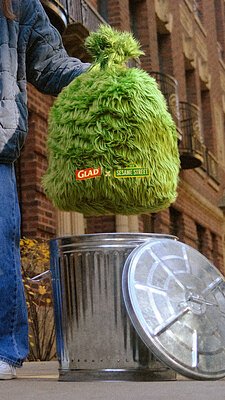
Crucially, the campaign extends into the physical and digital worlds. A social media giveaway for limited-edition, Oscar-fur-covered tote bags creates a layer of exclusivity and fan engagement, turning a simple ad into a participatory event. This is followed by a retail activation, with special edition Oscar-branded Glad ForceFlex boxes hitting Walmart shelves in the spring, perfectly timed for spring cleaning season.
This ecosystem approach ensures the campaign has multiple touchpoints, driving conversation and consumer action far beyond the initial video view. It transforms a passive ad-watching experience into an active brand interaction. In a world saturated with fleeting influencer posts and performance marketing metrics, Glad’s bet on a 50-year-old puppet proves that the most powerful brand asset might just be a timeless, authentic story—even if it starts in a trash can.