
- 867/1000 points: Georgia Tech's score in the EcoCAR EV Challenge, showcasing their dominance in technical and communications evaluations.
- 15 universities: Number of North American institutions participating in the four-year program.
- 2023 Cadillac LYRIQ: The state-of-the-art EV reengineered by competing teams.
Experts view the EcoCAR EV Challenge as a critical pipeline for developing the next generation of automotive engineers, equipping them with real-world experience and industry-standard tools to drive innovation in electrification and automation.
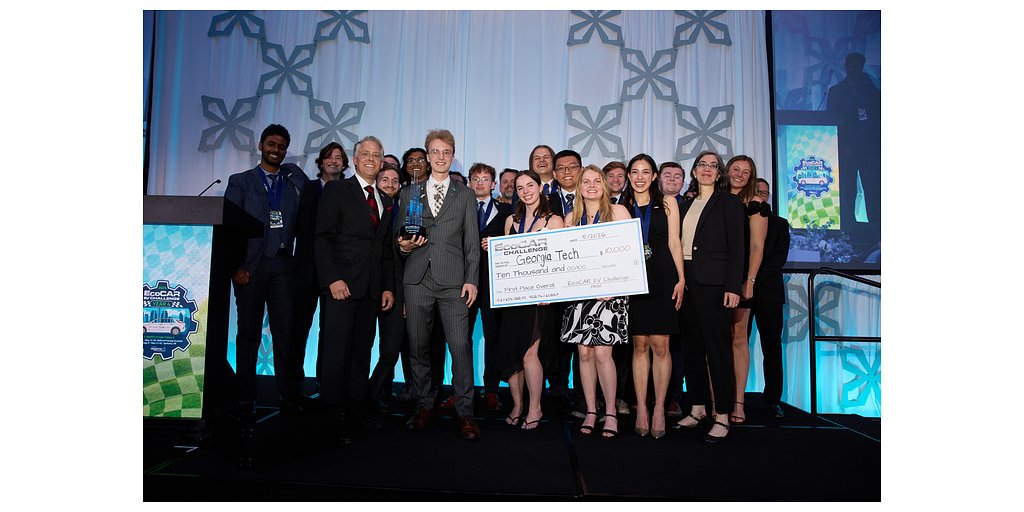
Georgia Tech Wins EcoCAR, Fueling a New Generation of Auto Engineers
DETROIT, MI – May 22, 2026 – Amid the gleaming architecture of General Motors’ global headquarters, a team of students from Georgia Tech celebrated a victory that signifies more than just a first-place trophy. They have won the final year of the EcoCAR EV Challenge, a premier collegiate engineering competition that serves as a crucial incubator for the future leaders of the automotive industry. Their win, with McMaster University and Virginia Tech taking second and third place respectively, marks the culmination of a demanding four-year program that challenged 15 North American universities to redefine the capabilities of a modern electric vehicle.
A New Generation of Automotive Engineers
The EcoCAR EV Challenge, managed by Argonne National Laboratory and sponsored by the U.S. Department of Energy (DOE), General Motors, and MathWorks, is far more than an academic exercise. It is a direct response to the automotive industry's seismic shift toward electrification and automation—a revolution that demands a new kind of engineer. For over three decades, the DOE’s Advanced Vehicle Technology Competitions (AVTCs) have served as a critical talent pipeline, and EcoCAR is its latest evolution.
This program has become a proven launchpad for successful careers. Graduates of AVTC programs often command higher starting salaries and are aggressively recruited by top automotive and technology firms. The reason is simple: they leave university not just with a degree, but with years of hands-on experience solving complex, real-world problems. They have managed budgets, led multidisciplinary teams, and presented their work to seasoned industry executives, making them uniquely prepared to make an immediate impact.
“Inspiring the next generation of engineering talent is an important component of DOE's strategy to maintain America's leadership in applied energy research and innovation,” said Matthew Grosso, Deputy Assistant Secretary for Energy Technology at the DOE. This sentiment underscores the program's national importance, framing it as a strategic investment in both technological leadership and workforce development.
Inside Georgia Tech's Winning Formula
To secure the top spot, each team was tasked with reengineering a 2023 Cadillac LYRIQ, a state-of-the-art EV, to push the boundaries of automation and vehicle-to-everything (V2X) connectivity. Georgia Tech’s team distinguished itself by dominating both the technical vehicle events and the communications portions of the competition, earning a remarkable 867 out of 1,000 possible points.
Their re-engineered LYRIQ was lauded for its seamless and intuitive operation, which included an innovative one-pedal driving capability that enhances both efficiency and driver experience. However, their most significant achievements were in the realm of connected automation. The team delivered the top performance in the Connected Driving Evaluation (CoDE), a sophisticated test developed by Argonne National Laboratory to assess how well a vehicle’s automated features integrate with external connectivity, such as traffic signal data.
Furthermore, Georgia Tech excelled in lateral automation, earning the highest scores for its lane-centering and automatic parking systems. They were a standout as they successfully demonstrated the complex automatic parking feature during the final competition events at GM’s Milford Proving Ground. This combination of advanced propulsion and cutting-edge autonomy earned them the coveted Consumer Acceptability Award, a testament to their ability to create technology that is not only innovative but also practical and desirable for future car buyers.
Forging the Future Through Partnership
The success of EcoCAR lies in its unique collaborative model, which brings together government, industry, and academia to achieve shared goals. For the Department of Energy, the program accelerates research and helps achieve national clean energy objectives. For sponsors like General Motors and MathWorks, it’s a direct line to the brightest new talent and a laboratory for fresh ideas.
“Four years ago, these students took on one of the most ambitious challenges in collegiate automotive engineering,” noted Ken Morris, Senior Vice President at General Motors. He highlighted the journey from the proving grounds to the streets of Detroit as a “defining milestone” that reflects the “confidence, capability, and readiness of these future engineers to shape the future of mobility.” By providing the vehicles, access to professional testing facilities, and invaluable mentorship, GM invests in the very people who will one day lead its own transformation.
Similarly, MathWorks provides the students with industry-standard software like MATLAB and Simulink, ensuring they are fluent in the tools used for professional vehicle development. “EcoCAR has given them the industry-standard tools and the real-world experience they need to hit the ground running in their careers,” said Lauren Tabolinsky, a senior manager at MathWorks, congratulating the teams on their achievements.
From Classroom Theory to Real-World Proving Grounds
What truly sets the EcoCAR experience apart is its departure from traditional classroom learning. Instead of just studying theory, students are immersed in a four-year project that mirrors GM’s own Global Vehicle Development Process. They design, build, test, and validate complex systems on a production vehicle, facing the same challenges with deadlines, budgets, and interdisciplinary collaboration as professional engineers.
This hands-on, project-based learning model transforms universities into hubs of automotive innovation. Students from engineering, business, and communications work side-by-side, learning to bridge the gap between technical design and market viability. This holistic experience is invaluable, teaching them not only how to build a better vehicle but also how to work as a cohesive, high-functioning organization.
The culmination of this work at the GM Milford Proving Ground, where vehicles underwent a battery of rigorous tests including a Connected Intersection Navigation Challenge and an Adaptive Cruise Control Feature Evaluation, provided the ultimate validation. The program's success has already spurred its next iteration, the EcoCAR Innovation Challenge, where GM will provide the 2026 Chevrolet Blazer EV, ensuring this powerful cycle of education, innovation, and partnership will continue to drive the future of transportation.