
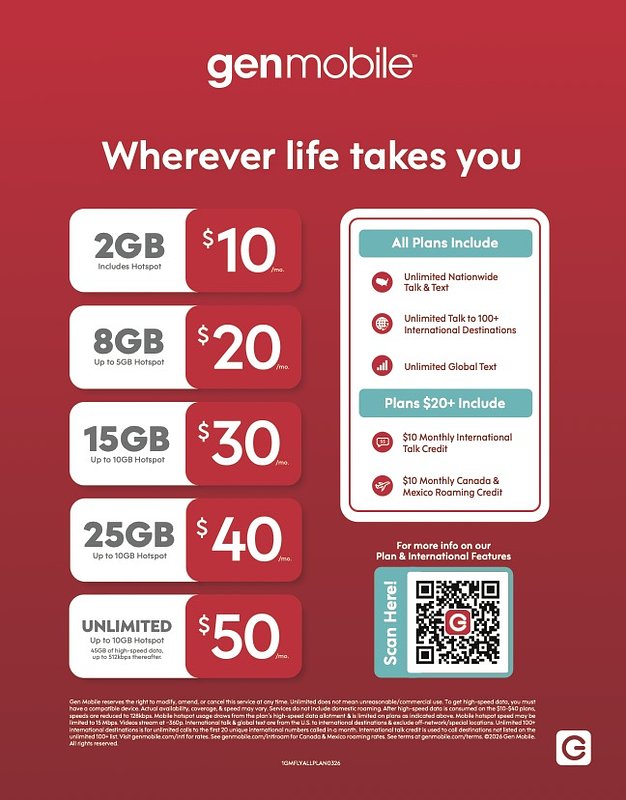
- Data increases across plans: $10 (1GB → 2GB), $20 (5GB → 8GB), $30 (11GB → 15GB), $40 (17GB → 25GB)
- Lifeline provider in 41 states, enhancing digital equity for low-income households
- Unlimited international calling to 100+ countries included in all plans
Experts would likely conclude that Gen Mobile's data boost without price hikes intensifies prepaid wireless competition, offering significant value to budget-conscious and underserved consumers while challenging rivals in the MVNO space.
Gen Mobile Boosts Data, Escalating Prepaid Wireless Price Wars
EL SEGUNDO, Calif. – April 02, 2026 – In a move poised to ripple through the hyper-competitive prepaid wireless market, Gen Mobile today announced substantial increases in high-speed data across its most popular plans without increasing their monthly cost. The initiative, effective immediately, enhances the value proposition for budget-conscious consumers and signals a new offensive in the ongoing battle for market share among mobile virtual network operators (MVNOs).
The upgrades target four key monthly plans, providing a significant data bump at each tier:
- $10 Plan: Data doubles from 1GB to 2GB
- $20 Plan: Data increases by 60%, from 5GB to 8GB
- $30 Plan: Data grows from 11GB to 15GB
- $40 Plan: Data jumps from 17GB to 25GB
"Our mission is to keep people connected wherever life takes them," said Robert Yap, Senior Vice President of Gen Mobile, in the company's official announcement. "By increasing data allotments without raising prices, we are ensuring our customers have the essential tools they need for work, school, and family."
A New Front in the Prepaid Battle
Gen Mobile's aggressive pricing strategy places it in direct confrontation with other major players in the value-oriented MVNO space. While the prepaid market has always been price-sensitive, the increasing demand for mobile data has made the data-to-price ratio a critical battleground.
At the entry-level, the new $10 plan with 2GB of data carves out a strong position, as many competitors like Mint Mobile and T-Mobile Connect begin their offerings at the $15 price point. This makes Gen Mobile a highly attractive option for light data users or those on the tightest budgets.
In the crowded mid-tier, the competition is more complex. While Gen Mobile’s $20 plan now offers a respectable 8GB, it faces formidable rivals. Mint Mobile, for instance, offers 15GB for a similar price, though it requires customers to pay for multiple months in advance. Meanwhile, Visible, operating on Verizon's network, provides unlimited data for just $25 per month, a compelling offer for heavy data users.
However, Gen Mobile's key differentiator remains its robust international calling feature. Every plan, including the $10 option, includes unlimited calling to over 100 countries. This is a significant advantage over most competitors, who typically limit free international calling to Mexico and Canada or sell it as a separate add-on. This feature makes the service particularly appealing to immigrant communities and individuals with family or business contacts abroad.
Bridging the Digital Divide
The impact of Gen Mobile's announcement extends beyond market competition and into the realm of digital equity. The company is a registered Lifeline provider in 41 states, a federal program administered by the FCC to help low-income households afford essential communication services. For these customers, the increased data allotments are not just a convenience but a crucial enhancement to their digital lifeline.
With data consumption becoming non-negotiable for tasks like remote work, online education, telehealth appointments, and applying for jobs, a lack of sufficient data can be a significant barrier to economic and social mobility. By providing more data at no extra cost, Gen Mobile effectively increases the value of the Lifeline subsidy, allowing eligible families to do more online without the fear of hitting data caps or incurring overage fees.
This commitment to affordable connectivity, combined with its inclusive international calling package, directly addresses the needs of underserved populations. It provides a more robust toolkit for communities that rely heavily on mobile devices as their primary, and sometimes only, access to the internet and to loved ones across the globe.
EchoStar's Expanding Connectivity Vision
This strategic enhancement of Gen Mobile's offerings should also be viewed within the larger context of its parent company, EchoStar Corporation. A longtime giant in satellite communications, EchoStar has been aggressively expanding its footprint in the terrestrial wireless market, notably through its acquisition of brands like Boost Mobile and Gen Mobile itself. This diversification strategy aims to build a comprehensive connectivity ecosystem that can serve customers across different geographies and economic segments.
By strengthening its retail wireless division, EchoStar can better compete with telecom behemoths like AT&T, Verizon, and T-Mobile. A more competitive Gen Mobile helps attract and retain subscribers, growing the overall user base under the EchoStar umbrella. This move leverages the company's wholesale network agreements while aiming to improve key performance indicators like subscriber growth and average revenue per user (ARPU), metrics closely watched by investors and industry analysts.
The Network and the Fine Print
Gen Mobile states its service is powered by "the nation’s largest 5G networks," which means it leases network access from one or more of the major carriers like T-Mobile or AT&T. This MVNO model allows the company to offer nationwide coverage without the immense cost of building and maintaining its own cellular infrastructure.
For the consumer, this generally means receiving the same broad coverage footprint as customers of the underlying major network. However, a common practice in the MVNO industry is data deprioritization. During times of heavy network congestion, traffic from MVNO customers may be temporarily slowed to prioritize users who subscribe directly to the parent carrier. While often unnoticeable in everyday use, this can result in slower speeds in crowded areas or during peak hours. It is the fundamental trade-off that enables the lower prices and high-value features that define the prepaid market, a factor savvy consumers must weigh against the benefits of more data and lower costs.