
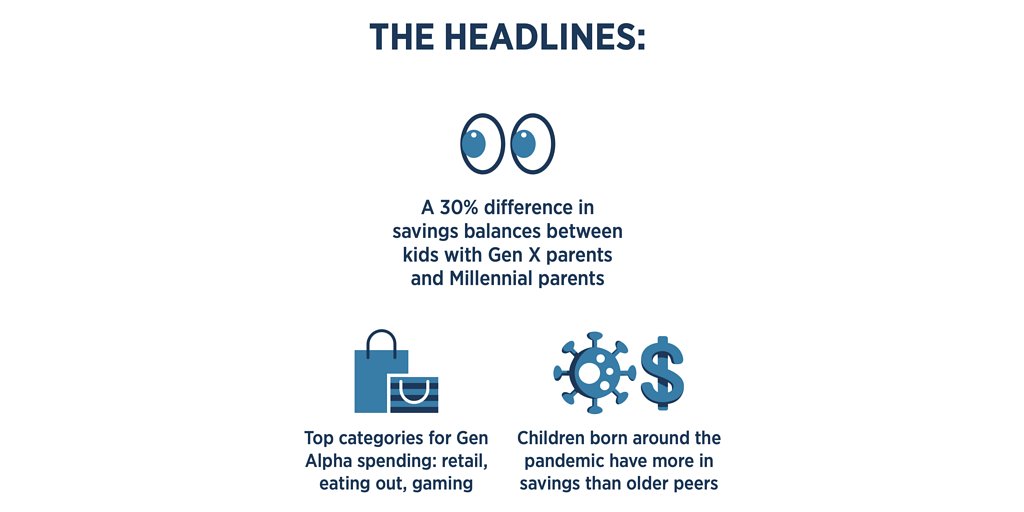
- Children of Gen X parents have 30% higher savings account balances than those with Millennial parents.
- Gen Alpha kids with Millennial parents use P2P payment apps twice as frequently as those with Gen X parents.
- 15% of incoming funds to Gen Alpha checking accounts come from payroll deposits.
Experts agree that parental influence remains the most critical factor in shaping Gen Alpha's financial habits, with Gen X parents fostering savings-oriented behaviors and Millennials emphasizing digital financial fluency.
Gen Alpha's Money: Gen X Parents Foster Savers, Millennials Digital Spenders
SAN ANTONIO, TX – January 13, 2026 – The financial habits of America’s youngest generation, Gen Alpha, are taking shape in a world their parents could have scarcely imagined, and new data reveals a fascinating divide in their behavior, heavily influenced by whether their parents are Gen X or Millennials. A landmark analysis from USAA Federal Savings Bank suggests a generational schism in parenting that is creating two distinct financial pathways for children born after 2010: one rooted in traditional saving and the other in digital fluency.
The study, which examined over 579,000 youth bank accounts, found that children of Gen X parents have, on average, 30% higher savings account balances. These children also dip into their savings a third less often than their peers with Millennial parents. This stark difference exists despite both groups receiving nearly identical initial deposits, pointing directly to the influence of ongoing parental guidance and financial modeling.
The Generational Money Divide
The divergence in financial behavior appears rooted in the formative experiences of the parents themselves. Gen X, born between 1965 and 1980, navigated a series of economic shocks, including the dot-com bust and the 2008 financial crisis, during their prime working years. Often called the "sandwich generation" for financially supporting both their children and aging parents, they developed a reputation for financial caution and a focus on building stability through traditional means. This cautious approach seems to be passed down, encouraging their Gen Alpha children to accumulate and preserve savings.
Conversely, Millennial parents, born between 1981 and 1996, came of age in a digital-first world. While many are saddled with significant student loan debt and delayed traditional wealth-building milestones, they are exceptionally tech-savvy. This digital comfort is directly influencing their children. The USAA data shows that Gen Alpha kids with Millennial parents use peer-to-peer (P2P) payment apps like CashApp and Zelle twice as frequently as their counterparts with Gen X parents, both in transaction volume and as a percentage of their overall spending.
“Helping children start on a strong financial footing is impactful for the long-term wellbeing of our members and their families,” said Michael Moran, President of USAA Federal Savings Bank, in the original press release. “Our data shows that Gen Alpha is forming their financial habits from an earlier age, with digital commerce available to them like no previous generation.”
This "trickle-down tech" effect means Millennial-parented children are learning to manage money in an environment where transactions are instant, digital, and less tangible than physical cash. While this prepares them for a future economy, it also presents new challenges in teaching the value of money when it can be spent with a simple tap on a screen.
Gen Alpha: The First Truly Digital Money Generation
Gen Alpha is the first cohort to grow up entirely in the age of the smartphone, where the economy is increasingly cashless and online. Their spending habits reflect this reality. According to the data, their money primarily flows toward retail, dining, and gaming platforms. Three major online and brick-and-mortar retailers alone account for more than 10% of their total spending, highlighting the powerful draw of both digital and physical consumerism.
This unprecedented digital exposure has both positive and negative implications. On one hand, digital banking apps with parental controls can serve as powerful educational tools, offering real-time spending trackers and budgeting features that make financial concepts more engaging. Some older Gen Alphas are already experiencing the world of work, with 15% of incoming funds to their checking accounts coming from payroll deposits, a significant step toward financial independence.
On the other hand, the abstract nature of digital money can make it harder for children to grasp its value. The ease of in-app purchases and online checkouts can encourage impulsive spending and obscure the real-world consequences of financial decisions. Furthermore, this digital-first environment introduces new security and privacy risks, as children become potential targets for online scams and data collection. The challenge for parents and financial institutions is to leverage technology for education while simultaneously instilling the critical thinking skills needed to navigate these digital dangers.
The study also noted an interesting trend among the youngest members of Gen Alpha. Children born around 2020 have savings balances 6-9% higher than the generational average. This may be a lingering effect of parents funneling pandemic-era stimulus funds into their children's accounts, mirroring a broader savings trend seen among adults during that period.
The New Rules of Financial Parenting
As the financial landscape evolves, so too must the strategies for teaching children about money. The USAA data underscores that parental influence remains the single most important factor, even as the tools change. The "Bank of Mom and Dad" is still the primary funder for most Gen Alpha kids, with about 70% of incoming money to their checking accounts originating from parental bank accounts.
This highlights the critical role parents play in modeling behavior and providing guidance. Experts suggest a blended approach that combines timeless principles with modern tools. For younger children, tangible methods like clear savings jars to visualize progress toward a goal remain effective. As they get older, introducing budgeting concepts like the "save, spend, and give" buckets or a simplified 50/30/20 rule can build a strong foundation.
For Millennial parents who are already comfortable with technology, their native digital environment can be an asset. They can use youth banking apps to have transparent conversations about spending, set limits, and teach their children how to manage a debit card responsibly. For Gen X parents, the focus might be on ensuring their children’s strong savings habits are complemented with the skills to navigate the digital payment systems they will inevitably use.
Ultimately, the goal is to raise financially capable adults. Opening a youth checking or savings account with parental controls provides a safe, real-world training ground. It allows teens to manage allowances or paychecks from a first job, make mistakes in a low-stakes environment, and learn the fundamentals of banking long before they are on their own.
These early lessons are proving more crucial than ever. As Gen Alpha begins to enter its teen years and gain more financial autonomy, the habits they form now—whether as diligent savers or savvy digital spenders—will likely set the stage for their financial futures and shape the consumer economy for decades to come.