
- Global Pickup Market Value: $212 billion in 2024
- China's Commercial Vehicle Export Growth: 33% year-over-year in early 2025
- Target Markets: Australia, Saudi Arabia, Chile, and Mexico
Experts view GAC's SMILODON PRO as a strategic challenge to global pickup giants, leveraging advanced technology and cost-effectiveness to carve out a new niche in a highly competitive market.
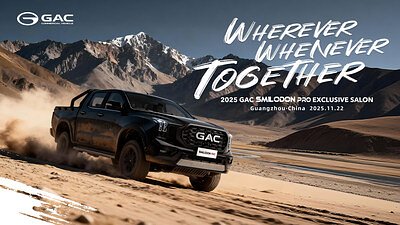
GAC's Pickup Offensive: SMILODON PRO Targets Global Auto Giants
GUANGZHOU, China – November 24, 2025 – In a meticulously staged event just outside Guangzhou, GAC Commercial Vehicle showcased more than just a new truck; it unveiled a clear and aggressive strategy for global expansion. The “SMILODON PRO Exclusive Salon” gathered international dealers to test drive its new pickup, culminating in the on-site signing of two new overseas partnerships. While the event was themed “Wherever, Whenever, Together,” the underlying message was one of disruption.
This move by the commercial vehicle arm of Guangzhou Automobile Group (GAC Group) is not a tentative step but a calculated push into the lucrative and fiercely defended global pickup market. By positioning the SMILODON PRO as an “all-domain travel companion,” GAC is signaling its intent to compete not just on price, but on technology, versatility, and design—a direct challenge to established giants like Ford, Toyota, and Mitsubishi. The immediate formalization of dealer relationships underscores a playbook focused on building a ground-up network, a critical component for any brand seeking to overcome the high barriers to entry in the automotive world.
The 'All-Domain' Challenger
The vehicle at the center of this strategy, the SMILODON PRO, appears to be the production-ready version of the GAC PICKUP 01 concept that captured attention at the Shanghai International Auto Show. The concept vehicle sheds light on the company's ambitious vision. Built on GAC's proprietary GAIA (GAC Adaptive Intelligent Architecture) platform, the truck is designed for dynamic adjustment, theoretically allowing its suspension and powertrain to adapt to urban commuting, heavy-duty work, or challenging off-road conditions.
This is a significant departure from the traditional, utilitarian perception of Chinese pickups. GAC is loading its challenger with features typically found in premium passenger vehicles. The marketing highlights a “mecha-style exterior design” that evokes comparisons to the Tesla Cybertruck, a “dual-mode intelligent cockpit,” and the “Starlight Safety Shield,” a top-tier advanced driver-assistance system (ADAS) suite. This focus on a smart, comfortable cabin and passenger-grade safety configurations aims squarely at the growing lifestyle segment of the pickup market.
Consumers globally are increasingly demanding vehicles that blend work-week utility with weekend adventure, and GAC is betting that its blend of powerful performance, high-tech features, and expected cost-effectiveness will prove a compelling formula. The company's emphasis on tackling 13 different off-road courses during its dealer event was a clear demonstration of confidence in the vehicle's rugged capabilities, aiming to preemptively counter any lingering doubts about the quality and durability of Chinese engineering.
Navigating a Crowded Global Field
GAC's ambition is entering a market that is both enormous and deeply entrenched. The global pickup truck market, valued at over $212 billion in 2024, is projected to grow steadily, but it is dominated by a few key players. In North America, which accounts for over 75% of the market, Ford, GM, and Ram have cultivated generations of brand loyalty. In other key regions, the Toyota Hilux and Mitsubishi Triton are legendary for their reliability and toughness.
The SMILODON PRO will have to compete directly with updated models like the 2025 Ford Ranger, which offers powerful V6 engine options and a 7,500-pound towing capacity, and the 2025 Mitsubishi Triton, lauded for its 3.5-ton towing capability and advanced 4WD systems. GAC’s strategy appears to be to sidestep a direct, feature-for-feature battle by redefining the value proposition. By integrating advanced technology and a futuristic design language, it aims to create a new niche that blurs the line between traditional pickups and emerging electric lifestyle vehicles like the Rivian R1T and Ford F-150 Lightning.
This move is not without risk. Building a service and parts network to support a new vehicle in foreign markets is a capital-intensive and logistically complex challenge. Furthermore, brand perception remains a significant hurdle. However, the rapidly growing Asia-Pacific market and other emerging regions present a substantial opportunity where brand loyalties are less rigid and consumers may be more open to new, high-value alternatives.
China's Automotive Export Blueprint
GAC's global push is a microcosm of a much larger industrial trend. Chinese automakers are aggressively expanding overseas, driven by a combination of intense domestic price wars and a strategic imperative outlined in national policies like “Made in China 2025.” China's vehicle exports have surged, with commercial vehicles being a significant component of this growth; in the first two months of 2025 alone, commercial vehicle exports jumped nearly 33% year-over-year.
To mitigate the immense financial risks of global expansion, many Chinese firms are adopting “asset-light” strategies. Instead of building wholly-owned plants from scratch, they are forming joint ventures and leveraging partners' existing sales and service channels. GAC's focus on its “Trusted Partnership” playbook and the immediate signing of dealers in Guangzhou align perfectly with this model. It's a method of accelerating market entry and building a local presence without the massive upfront capital outlay.
The initial target markets for the SMILODON PRO—Australia, Saudi Arabia, Chile, and Mexico—were not chosen at random. Each possesses a strong, established pickup culture but also shows a growing interest in new technologies and alternatives to the status quo. By targeting these specific regions, GAC can concentrate its resources and build momentum before tackling the formidable North American and European markets. This methodical, partnership-first approach may prove to be the key to turning a bold ambition into a sustainable international presence.