
- 23,448 acres burned in the January 2025 Palisades Fire, destroying 6,800+ structures.
- Rebuild completed in 7 months (permit to occupancy) vs. typical multi-year delays.
- Steel construction reduces fire risk, seismic vulnerability, and maintenance needs.
Experts would likely conclude that Cover's integrated, steel-based construction model offers a scalable, efficient, and resilient solution for post-disaster rebuilding, particularly in fire-prone regions like California.
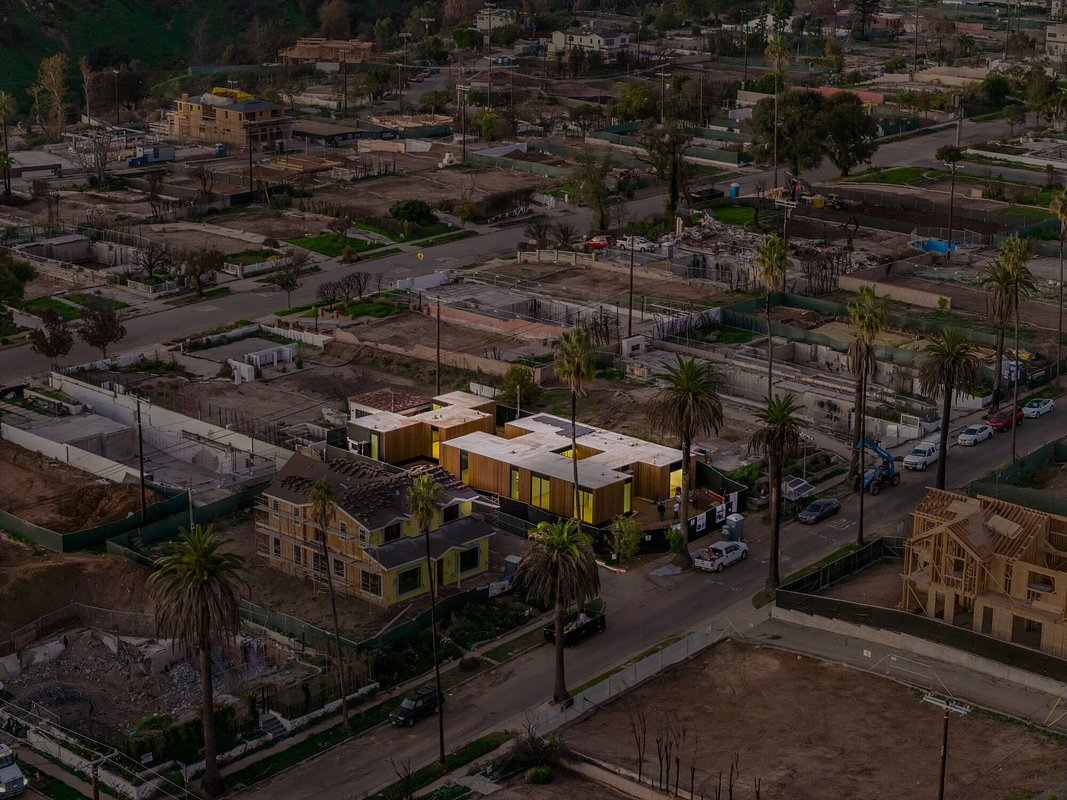
From Ashes to Steel: A New Blueprint for Post-Fire Rebuilding
LOS ANGELES, CA – January 19, 2026 – Less than a year after losing her home of nearly five decades to the devastating January 2025 wildfires, Sue Labella has moved back into her Pacific Palisades neighborhood. Her return marks a significant milestone, not just for her family, but for the entire region grappling with post-disaster recovery. Labella is the first homeowner in the area to complete a ground-up rebuild, a process made possible by Los Angeles-based homebuilder Cover, whose innovative approach to construction is setting a new benchmark for speed, resilience, and efficiency.
Her new, custom-designed residence stands as a testament to what is possible in the wake of catastrophe. Where smoldering ruins sat just twelve months ago, there is now a modern, fire-resistant home, fully permitted and occupied. The project challenges the conventional wisdom that rebuilding after a wildfire is a multi-year ordeal fraught with bureaucratic delays, spiraling costs, and emotional exhaustion.
A New Benchmark in Disaster Recovery
The January 2025 Palisades Fire was a catastrophic event, burning 23,448 acres and destroying over 6,800 structures in the area. For thousands of displaced residents like Labella, the path back home seemed impossibly long. Typically, post-disaster reconstruction is a grueling marathon involving debris removal, navigating complex insurance claims, and enduring lengthy permitting processes before a single nail can be hammered. Many homeowners face waits of several years.
Labella's experience charts a dramatically different course. Her building permit was issued on May 23, 2025, and she received her certificate of occupancy on January 7, 2026—a timeline of just over seven months from permit to completion. The project includes a 2,300-square-foot main home organized around a courtyard and a detached 800-square-foot guest home, known as an Accessory Dwelling Unit (ADU).
"Pacific Palisades has been my home and beloved community for nearly 50 years," said homeowner Sue Labella. "After the fire, a friend who had built with Cover referred me. I wanted to rebuild without the stress of managing architects, contractors, and permits. Cover listened to me, heard what I wanted, and delivered. Now, less than one year since the fire, my new house and ADU are finished, beautifully built, and ready to welcome a new chapter."
Her sentiment reflects the core value proposition offered by Cover: a streamlined, single-point-of-contact process. The company handled every aspect of the project—design, engineering, permitting, manufacturing, and on-site construction—insulating the homeowner from the logistical nightmare that rebuilding can often become.
The Resilience of Steel Construction
The key to both the speed and the safety of Labella's new home lies in its very bones. The structures are built from non-combustible, all-steel panels. In a state where wildfires are a seasonal threat, building with materials that do not burn is a revolutionary, rather than evolutionary, step forward.
Unlike traditional wood-frame construction, steel does not ignite or contribute fuel to a fire, a critical factor in fire-prone areas. This inherent fire resistance is a primary reason Cover's homes exceed California's famously stringent building codes. Beyond fire safety, the all-steel system provides superior structural integrity against seismic events, a constant concern in Southern California. The material is also impervious to rot, mold, and termites, promising a level of durability and low maintenance that traditional construction struggles to match.
These high-performance building components are not sourced from a typical lumber yard. They are precision-fabricated as a panelized system in Cover's own factory in Gardena. This manufacturing approach allows for immense quality control and minimizes construction waste. The panels are then transported to the site and assembled without the need for heavy cranes, further reducing neighborhood disruption and construction time.
Disrupting the Construction Playbook
Cover's success with the Labella residence highlights a broader disruption underway in the construction industry. The company's integrated model, which combines design, manufacturing, and building under one roof, is a real-world application of the design-build project delivery method. Independent studies have shown this approach can be up to 33% faster and yield significant cost savings compared to the traditional model where the homeowner must hire and manage separate architects and contractors.
"At Cover we believe that homeowners shouldn't have to choose between uncompromising architecture and a simpler, efficient and predictable process," said Cover CEO Alexis Rivas. "Sue's rebuild makes that case clearly, and we're so proud to have helped bring her back home."
This philosophy is powered by technology. The company uses proprietary software to streamline the design and engineering phases, translating architectural plans directly into manufacturing instructions for its factory. This high-tech, automotive-style production method ensures that components fit together perfectly on-site, dramatically accelerating the construction phase and reducing the costly errors and change orders that plague conventional projects.
Scaling a Solution for a State in Need
While the completion of a single home is a personal victory, its implications are far-reaching. California is facing a dual crisis of a severe housing shortage and the escalating threat of climate-driven disasters. Solutions that can deliver high-quality, resilient homes quickly and efficiently are no longer a luxury, but a necessity.
Recognizing this demand, Cover has already expanded its operations. After focusing on the Los Angeles market for years, primarily with ADUs, the company expanded its service area to all of Southern California in late 2024. This move was supported by an expansion of its manufacturing capabilities, which can now produce up to 100 homes a year. The company has already broken ground on additional fire rebuilds in Pacific Palisades and Altadena.
The model's potential to scale is attracting attention. The construction technology sector, or ConTech, has seen a surge in investment, with venture capital flowing toward companies that can automate, streamline, and improve the archaic homebuilding process. As demonstrated by Sue Labella's rapid return home, this technology is not just theoretical. It is providing a tangible, repeatable blueprint for how communities can build back faster, stronger, and more intelligently from the ashes.