
- 120+ specialized suppliers contribute to the IBCS ecosystem, highlighting its complex industrial base. - $70 billion projected global IAMD market by 2030, driven by escalating threats. - Poland became the first international partner to adopt IBCS, achieving Initial Operational Capability in late 2024.
Experts agree that the success of modern air defense systems like IBCS hinges on collaborative partnerships across industry, military, and policymakers, ensuring technological advancement and strategic readiness against evolving threats.
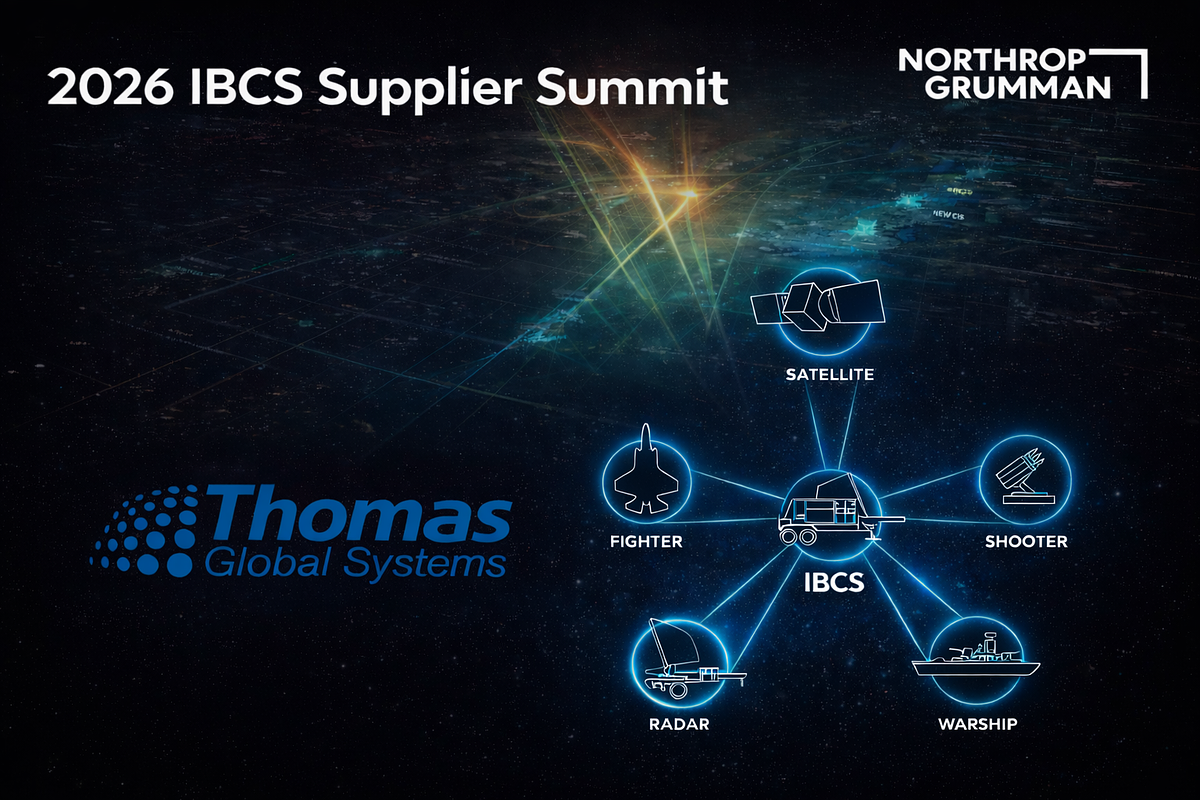
Forging the Shield: Inside the Summit Powering US Air Defense
WASHINGTON, D.C. – March 20, 2026 – In the corridors of power on Capitol Hill, the future of American and allied air defense is being forged not just through policy, but through partnership. This was vividly illustrated at the Northrop Grumman 2026 Integrated Battle Command System (IBCS) Supplier Summit held March 16–17, an event that brought a sprawling defense ecosystem—from prime contractors and specialized technology suppliers to U.S. Army leaders and Members of Congress—under one roof.
At the heart of the discussion was IBCS, the U.S. Army's revolutionary command and control system, and the intricate network of companies essential to its success. Among them was Thomas Global Systems, a provider of high-reliability electronic solutions, whose participation underscored the critical, often behind-the-scenes role that specialized suppliers play in delivering one of the world's most advanced defense platforms.
The Brains of the Battlespace: Decoding IBCS
The Integrated Battle Command System represents a paradigm shift in military strategy. Developed by Northrop Grumman, IBCS is the cornerstone of the Army's Integrated Air and Missile Defense (IAMD) modernization—a network-enabled architecture designed to counter a rapidly evolving spectrum of aerial threats, from swarming drones and cruise missiles to advanced ballistic and hypersonic weapons.
Its core principle is a concept known as “Any Sensor, Best Shooter.” For decades, air defense systems operated in stovepipes; a specific radar could only communicate with its designated launcher. IBCS shatters these limitations. It fuses data from disparate sensors across the battlespace—radars, satellites, and other platforms—into a single, coherent, and real-time picture of the sky. This allows a commander to use the most effective weapon, or “shooter,” to intercept a threat, regardless of which sensor detected it. This capability dramatically increases responsiveness, optimizes the use of expensive interceptors, and creates a more resilient and survivable defense network.
After years of rigorous development and testing, IBCS was approved for full-rate production in 2023 and is now a fielded system. It is replacing a host of legacy command systems with a single, modular, and open architecture that can integrate new technologies as they emerge. For the warfighter, this means enhanced situational awareness and a decision-making speed that can match the velocity of modern conflict.
The Unseen Engine: A Symphony of Suppliers
A system as complex as IBCS is not the product of a single entity. It is the result of a vast industrial symphony, with a prime contractor like Northrop Grumman acting as the conductor for a large orchestra of over 120 specialized suppliers. The D.C. summit was a testament to this collaborative model, providing a forum for these partners to engage directly with military leadership and policymakers.
Companies like Thomas Global Systems are the lifeblood of this ecosystem. While the press release noted their contribution of “high-reliability electronic solutions,” their broader expertise in rugged vehicle electronics, tactical computing, and advanced displays hints at the types of mission-critical components they provide. These are the hardened, failsafe systems that must function flawlessly in the harshest battlefield conditions, forming the physical backbone of the digital IBCS network. With over 70 years of experience and a recent expansion of its California manufacturing facility, the company exemplifies the deep industrial capability required to support such programs.
“Thomas Global Systems is proud to support Northrop Grumman, the U.S. Army and its global allied partners, in advancing integrated air and missile defense capabilities,” said Kyle Stockman, the company's Director of Business Development & Strategy, during the summit. “Our participation in the IBCS Supplier Summit highlighted the importance of strong collaboration between prime contractors and trusted technology partners to deliver innovative, reliable solutions for the warfighter.”
This sentiment reflects a broader industry truth: in modern defense, the supply chain is not just a chain, but a strategic web. Events like the IBCS summit are crucial for aligning this web, ensuring production can scale to meet demand, and fostering the innovation needed to stay ahead of adversaries.
A New Era of Threats and Alliances
The urgency driving the IBCS program and its supporting industrial base is rooted in a stark geopolitical reality. The global IAMD market is projected to grow significantly, reaching nearly $70 billion by 2030, fueled by escalating international tensions and the proliferation of advanced missile technologies. The character of aerial threats has changed, with existing defense systems struggling to counter the speed and maneuverability of hypersonic glide vehicles or the sheer volume of coordinated drone attacks.
IBCS is designed to meet these challenges, and its strategic importance extends beyond U.S. borders. Poland, facing heightened security concerns on NATO's eastern flank, became the first international partner to acquire the system, declaring Initial Operational Capability for its IBCS network in late 2024. The move integrates Poland’s new Wisla and Narew air defense programs into a unified command structure, significantly strengthening both its national defense and its interoperability with U.S. and NATO forces. This adoption serves as a powerful proof of concept for the system's global appeal and its role in bolstering integrated deterrence among allies.
Forging Policy and Partnerships on Capitol Hill
Hosting the summit in Washington, D.C., was a deliberate choice, placing industry leaders in direct conversation with policymakers who authorize and fund these critical defense programs. The attendance of figures like Senator Alex Padilla, Senator Adam Schiff, and several other representatives provided suppliers a rare opportunity to articulate the value of their contributions directly to legislators.
These interactions are vital. While debates over the scale of the national defense budget are a perennial feature of Washington politics, events like the IBCS summit help ground these discussions in tangible reality. They demonstrate how appropriations translate into advanced capabilities, high-tech jobs across the country, and a more robust national security posture. For lawmakers, it offers a direct look into the complex public-private partnerships that form the nation’s defense industrial base.
Ultimately, the summit was more than a series of meetings; it was a demonstration of a modern defense paradigm. It showed that securing the skies against 21st-century threats requires not only revolutionary technology like IBCS but also a resilient, collaborative, and deeply interconnected ecosystem of partners, all working in concert from the factory floor to the halls of Congress to Congress to the forward edge of the battlespace.