
- Average home price in top STR markets: $296,000
- Average annual revenue per property: $40,500
- Projected yield in top markets: ~14%
Experts agree that the most profitable short-term rental opportunities in 2026 are shifting from traditional vacation destinations to affordable cities with stable, year-round demand driven by industry, healthcare, and government sectors.
Forget the Beach: Why Affordable Cities Are the New STR Goldmines
DENVER, CO – January 27, 2026 – For years, the short-term rental investment dream was painted with images of beachfront cottages and ski-in, ski-out mountain cabins. But according to a new report, the most lucrative opportunities in 2026 are found far from traditional vacation hotspots. The new formula for success, it seems, involves a three-bedroom house in Port Arthur, Texas.
Data analytics firm AirDNA today released its annual “Best Places to Invest in Short-Term Rentals” report, a comprehensive analysis that is upending conventional wisdom. By prioritizing affordability and stable, year-round demand over seasonal tourist appeal, the report identifies a new class of high-yield markets. These are not the destinations splashed across travel magazines, but rather the economic hubs of middle America, powered by industry, healthcare, and government.
"This year's results challenge some of the usual assumptions about where short-term rental opportunities exist," said Jamie Lane, Chief Economist at AirDNA. "When revenue and growth aren't viewed in isolation, affordability plays a much bigger role in how returns stack up across markets."
The 'Hidden Gems' Playbook
The core of AirDNA's findings lies in a simple but powerful economic principle: superior returns are found where acquisition costs are low and demand is steady. The report's Top 10 markets boast an average home price of just $296,000, a figure that stands in stark contrast to the seven-figure price tags common in prime vacation destinations. Despite the lower entry cost, these properties have the potential to generate an average annual revenue of $40,500, leading to impressive yields near 14%.
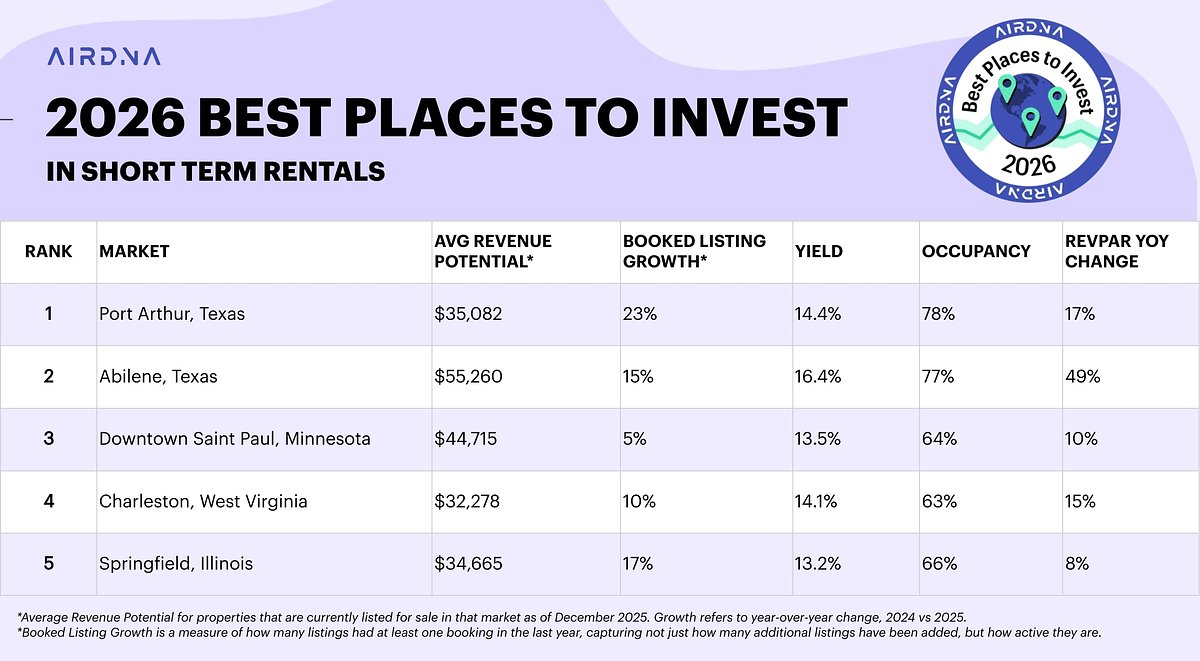
This data-driven approach shifts the investment playbook away from saturated coastal and mountain markets toward often-overlooked urban and industrial corridors. The 2026 top markets include:
- Port Arthur, Texas
- Abilene, Texas
- Downtown Saint Paul, Minnesota
- Charleston, West Virginia
- Springfield, Illinois
- Lake Charles, Louisiana
- Montgomery, Alabama
- Akron, Ohio
- Lebanon, Pennsylvania
- Jackson, Mississippi
These locations reveal a clear trend: profitability is no longer exclusively tied to leisure. Instead, it’s being redefined by the consistent, non-discretionary needs of a modern, mobile workforce.
Beyond Tourism: The Resilient Demand of Work and Healthcare
The secret to the success of these emerging markets is the diversification of their demand drivers. Instead of relying on the whims of seasonal tourism, cities like Port Arthur, Akron, and Springfield are buoyed by resilient, year-round economic activity.
In Port Arthur, Texas, the nation's top-ranked market, the economy is dominated by the petrochemical industry. Major refineries and chemical plants operated by giants like Motiva, Valero, and Exxon Mobil create a constant flow of contract workers, engineers, and technicians in need of temporary housing. Investors in the area report that their properties are consistently booked for weeks or months at a time by this industrial workforce, providing a level of stability that seasonal tourism rarely offers.
Similarly, Akron, Ohio, which also appeared on the 2025 list, thrives on its robust healthcare and education sectors. Institutions like Akron Children's Hospital, Summa Health, and the University of Akron generate a steady stream of demand from traveling nurses, visiting medical professionals, and families of patients or students. This creates a predictable, non-seasonal rental calendar that is less susceptible to economic downturns affecting leisure spending.
In Springfield, Illinois, the state capital, the primary drivers are government and healthcare. The city's status as the seat of state government ensures a regular influx of lobbyists, consultants, and officials, while major medical centers like Memorial Health System provide another layer of consistent demand. For hosts in these cities, understanding the local legislative calendar or a hospital's hiring cycle is more important than tracking school vacation schedules.
Navigating a Patchwork of Local Regulations
While these markets present significant opportunities, they are not a regulatory free-for-all. AirDNA's analysis actively filters out markets with overly restrictive rules, but investors must still navigate a complex and varied landscape of local ordinances. The top-ranked cities offer a glimpse into this diversity.
In Port Arthur, the regulatory environment is currently light, with no specific local short-term rental permits required. Hosts must simply comply with state law, which primarily involves collecting and remitting the 6% state hotel occupancy tax. This low barrier to entry can be attractive, though it also carries the risk of future regulatory changes.
Conversely, Akron has a more structured system. In January 2023, the city implemented an ordinance requiring hosts to register their properties annually for a $250 fee and collect a 5.5% excise tax. The rules also mandate that the property owner must reside within the city and establish clear guidelines on occupancy and quiet hours. While more demanding, such regulations can create a more stable and predictable operating environment by preventing oversaturation and legitimizing the industry.
Springfield falls somewhere in between, requiring registration and tax collection but with rules that vary based on zoning and whether the property is owner-occupied. This patchwork approach underscores the critical need for investors to perform thorough due diligence on local laws before purchasing a property.
A Maturing Market: What 2026 Holds for Investors
The shift towards these affordable, non-traditional markets is occurring within a broader context of a stabilizing and maturing short-term rental industry. According to AirDNA's leadership, the investment climate is stronger than it has been in years.
"2026 is one of the strongest environments we've seen for short-term rental investment in recent years," said Rohit Bezewada, CEO of AirDNA. He noted that the firm's report provides a framework for identifying top opportunities, which investors can then use to evaluate specific deals.
This positive outlook is supported by several key market trends. After a period of rapid expansion, the growth in the supply of available listings is slowing to a more sustainable rate of around 4.6% for 2026. This moderation, combined with cooling home prices and resilient travel demand, is creating a more balanced market. With less new competition and more predictable demand, operators are in a better position to achieve stable occupancy and strengthen their average daily rates.
To help investors navigate this evolving landscape, the full 2026 report includes breakout rankings for different investment budgets and for markets anchored by specific demand drivers, such as universities, national parks, and military bases. This granular data empowers investors to move beyond broad assumptions and make informed decisions based on what truly drives profitability in today's short-term rental market.