
- 200+ global participants visited FIRSTHABIT's booth at CES 2026, expressing interest in potential collaborations.
- Two CES 2026 Innovation Awards in AI and EdTech categories for CHALK 4.0.
- Seven countries co-hosted the Global Innovation Forum, including South Korea, France, and Israel.
Experts view FIRSTHABIT's CES win as a strong validation of its AI-driven educational approach, signaling potential for global scalability and market leadership in adaptive learning technologies.
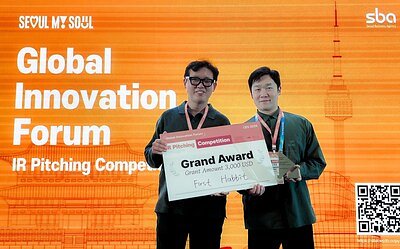
FIRSTHABIT's AI Tutor Wins Big at CES, Aims for US Schools
LAS VEGAS, NV – January 08, 2026 – In a move that could reshape the future of digital learning, South Korean edtech company FIRSTHABIT has captured the top prize at the prestigious Global Innovation Forum (GIF) IR Pitching Competition, held amidst the technological spectacle of CES 2026. The Grand Award recognizes the company's groundbreaking AI learning platform, CHALK 4.0, and its ambitious vision to move beyond simple information delivery to actively foster student understanding.
The win provides a powerful international endorsement for a technology that aims to transform AI from a mere tool into a true cognitive partner for students. The forum, an official CES event co-hosted by national pavilions from seven countries including South Korea, France, and Israel, brought together a discerning audience of global venture capitalists, media, and startup ecosystem leaders. FIRSTHABIT's victory, decided by a panel of VCs and media experts, signals strong market confidence in its unique pedagogical approach and its potential for global scalability.
A "Thinking Partner" in the Classroom
At the heart of FIRSTHABIT's acclaim is CHALK 4.0, an AI model the company describes as the first of its kind. The platform's success at CES—where it also secured two CES 2026 Innovation Awards in both the AI and EdTech categories—stems from its unique architecture, which combines a Visual Large Language Model (Visual LLM) with a proprietary Cognition Model.
During the company's award-winning pitch, delivered with technical authority by AI Engineering Lead Lee Chang shin, the focus was not on what the AI knows, but how it teaches. Unlike many existing educational AI tools that function like advanced flashcards or automated tutors checking for correct answers, CHALK 4.0 is designed to analyze and adapt to a student's individual cognitive flow.
"I believe the direction we have taken technically designing how AI determines explanatory methods and visual materials is what led to this Grand Award recognition," stated Lee Chang shin. He emphasized the platform's higher purpose: "We will continue to advance an AI architecture that goes beyond simply providing correct answers and instead supports learners' concept formation and understanding processes through Visual LLMs."
This process-oriented design means the AI dynamically alters its teaching methods, visual aids, and interactive elements based on a learner's real-time level of comprehension. Through scenario-based demonstrations, FIRSTHABIT showcased how CHALK 4.0 can present a complex scientific concept in multiple ways—using 3D models, interactive diagrams, or simplified analogies—until it finds the path that best resonates with the student's way of thinking. This effectively creates a personalized learning journey for every user, making them feel as if they are interacting with an intuitive, face-to-face educator.
Kang Jung woo, Head of the AI Team at FIRSTHABIT, highlighted the engineering feat behind this approach. "CHALK 4.0 is the result of the AI engineering team led by Lee Chang shin focusing on translating learners' cognitive flows into a concrete technical structure," he noted. "The integrated design of explanation strategies, visual information, and conceptual connections within a single cognition model has been recognized as a key point of differentiation on the global stage."
Validation on a Global Stage
The Grand Award was not a token honor. The Global Innovation Forum has rapidly become a significant platform for international startups seeking validation and partnership opportunities at CES. Its evolution from a Seoul-centric event in 2025 to a multi-national collaboration in 2026, backed by government agencies from seven leading innovation hubs, lends significant weight to its accolades. The competition's focus on investment attractiveness and global promotional potential means that FIRSTHABIT was judged not just on its technology, but on its business viability.
The on-site reaction at the Caesars Palace venue underscored this interest. Following the pitch, judges and attendees engaged in an in-depth Q&A session, probing the technical architecture and practical classroom applications of CHALK 4.0. This curiosity translated into tangible traffic, with the company reporting that over 200 global participants, including educators, investors, and tech industry professionals, visited its exhibition booth for a firsthand experience. Several of these interactions have already led to requests for follow-up meetings to discuss potential collaborations, suggesting the win could quickly catalyze business development.
This recognition places FIRSTHABIT at the forefront of a major trend at CES 2026, where AI was seen moving "out of the cloud and into the real world." The surge in AI-related submissions for CES awards highlights a market hungry for practical, impactful applications of the technology, and education is a prime target for this innovation.
Ambitious Plans for the US K-12 Market
Buoyed by its success, FIRSTHABIT is setting its sights on one of the largest and most complex educational landscapes in the world: the US K-12 market. The company announced its intention to make a concerted push into the United States, leveraging the award as a springboard for credibility and market entry.
This is a notoriously challenging market for foreign companies, with a fragmented system of state and local regulations, varied technology adoption rates, and entrenched competitors. However, FIRSTHABIT's strategy appears to be built on collaboration rather than direct assault. The company has already forged partnerships with world-class US institutions, including MIT and The Concord Review, a prestigious journal for high school history essays. These collaborations provide a crucial foundation of both technological and content-based credibility.
The plan is to expand these partnerships across AI technology, educational content, and curriculum development to build a comprehensive ecosystem. The ultimate vision extends far beyond a single-subject tool. FIRSTHABIT aims for CHALK 4.0 to evolve into a "global learning OS"—an operating system for education that organically connects a student's entire learning journey, adapting across subjects and grade levels based on their unique cognitive profile.
This approach could be a powerful differentiator in a market often cluttered with disparate, single-function apps. By offering a holistic platform that focuses on the process of learning, the company hopes to appeal to educators and administrators seeking deeper, more sustainable educational outcomes rather than just incremental improvements in test scores. The significant venture capital presence at the Global Innovation Forum, coupled with the robust US investment market, suggests that if FIRSTHABIT can demonstrate scalability, it will find no shortage of potential backers for its ambitious global expansion. As the company continues to participate in international forums, the industry will be watching to see if this CES triumph can be converted into lasting market leadership.