
- $250 million in complex financing backing the project
- 396 residential units, with 20% (80 units) designated as affordable housing
- $90 million in tax credits from New Jersey’s ASPIRE program
Experts view 22 Fulton Street as a pioneering model for urban revitalization, demonstrating how innovative financial structuring and public-private partnerships can balance luxury development with affordable housing needs in a city facing a severe housing crisis.
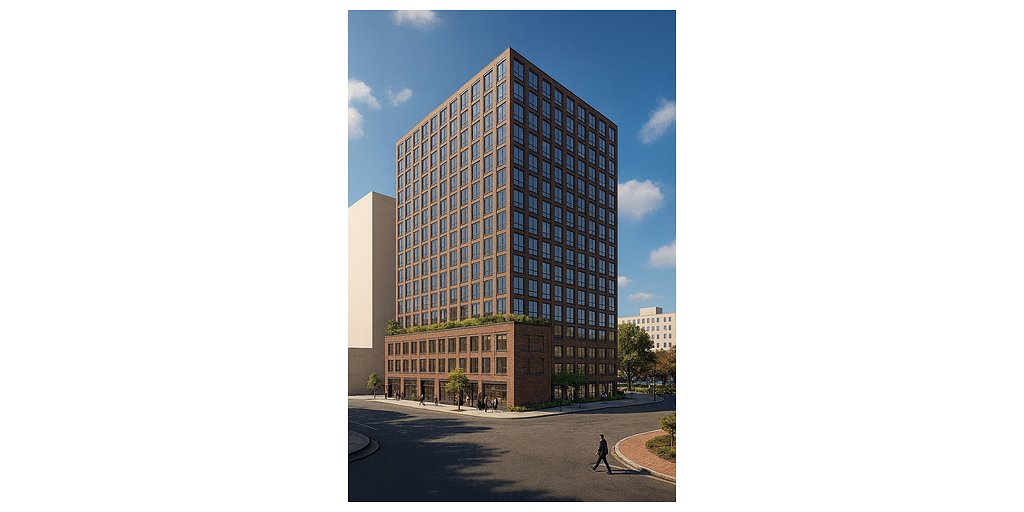
Financing a Future: Inside Newark’s Landmark Mixed-Income Skyscraper
NEWARK, NJ – December 08, 2025 – In the heart of Newark’s historic Military Park neighborhood, a new vision for urban living is taking shape. The development of 22 Fulton Street, a 21-story mixed-income residential tower, represents more than just another addition to the city's evolving skyline. Backed by a highly complex financing package exceeding $250 million, the project stands as a monumental test case for the future of urban revitalization, blending high-end luxury with deep affordability in a city grappling with both rapid growth and a severe housing crisis.
Developed by a partnership between SK Development and the long-established Berger Organization, the tower is slated to deliver 396 residential units, panoramic views of the Manhattan skyline, and ground-floor retail. Yet, its true significance lies beneath the surface, within the intricate financial architecture that makes such an ambitious project possible. Orchestrated by advisory firm Walker & Dunlop, the deal weaves together private capital with a tapestry of public incentives, offering a potential blueprint for how cities can tackle the dual challenges of attracting investment and ensuring inclusive growth.
Deconstructing the Capital Stack
A project of this magnitude, particularly one with a significant affordable housing component, rarely gets built on the back of a simple construction loan. The financing for 22 Fulton Street is a masterclass in modern real estate finance, layering multiple sources of capital to mitigate risk and bridge the economic gap that often makes mixed-income developments unfeasible.
The cornerstone of the package is nearly $119 million in financing from the Urban Investment Group at Goldman Sachs Alternatives, which includes a construction loan, equity from the 4% Low-Income Housing Tax Credit (LIHTC) program, and a related bridge loan. This is supplemented by $20 million in preferred equity from one institutional lender and a $100 million forward commitment for a permanent loan from another.
“This landmark mixed-income development serves as a blueprint for how we can leverage innovative financial solutions to expand access to quality housing and help revitalize communities,” said Dan Alger, head of the Urban Investment Group at Goldman Sachs Alternatives. His sentiment is echoed by the developers, who emphasize the critical role of expert financial structuring.
“Walker & Dunlop was instrumental in structuring a complex capital stack that aligned with our vision and timeline,” noted Scott Shnay, principal at SK Development. “Their team navigated every layer of the transaction with precision and delivered a seamless execution.”
The private capital is powerfully augmented by a suite of government programs. The project leverages $90 million in tax credits from New Jersey’s ASPIRE program, a tool designed to fund projects that face a financing gap. These credits were monetized through a sale to MassMutual, generating crucial upfront capital. Furthermore, a 30-year Payment in Lieu of Taxes (PILOT) agreement with the City of Newark provides long-term financial predictability, a key incentive for developers undertaking large-scale projects. Finally, its location within a Qualified Opportunity Zone (QOZ) provides significant federal tax benefits for long-term investors, adding another layer of appeal.
A Tale of Two Markets
The 22 Fulton Street development emerges at a pivotal moment for Newark. The city is experiencing a renaissance, with a competitive housing market fueled by its proximity to New York City and a wave of redevelopment transforming its downtown core. Median home prices have seen steady increases, and luxury apartments are in high demand as residents seek more affordable alternatives to Manhattan and New Jersey's Gold Coast. The 315 market-rate units in the new tower are designed to cater directly to this demand, offering high-end finishes and amenities.
However, this boom exists alongside a starkly different reality. Newark faces a critical shortage of affordable housing, with an estimated deficit of 16,000 units. Over half of the city’s renter households are cost-burdened, spending more than 30% of their income on housing. This affordability crisis has fueled concerns about “jobless gentrification,” a phenomenon where rising property values and an influx of high-end development outpace local wage and job growth, threatening to displace long-time residents.
It is within this complex dynamic that 22 Fulton Street aims to strike a balance. In exchange for the public incentives it receives, the project is mandated to set aside 20% of its units—80 apartments in total—as affordable housing for households earning up to 60% of the Area Median Income (AMI). This commitment directly addresses the city’s inclusionary zoning ordinance and provides a tangible, albeit modest, contribution toward alleviating the affordability crunch. “This property will help reshape Newark’s historic downtown, and we’re proud to contribute to the significance of bringing much-needed affordable housing to the community,” stated Miles Berger, chairman and COO at Berger Organization.
ESG in Action: A Blueprint for Responsibility?
Beyond its financial and social structure, 22 Fulton Street is being positioned as a model for Environmental, Social, and Governance (ESG) principles in action. The developers have committed to building the tower to the National Green Building Standard (NGBS) at a level purported to be 115% above code, signaling a significant focus on energy efficiency, water conservation, and sustainable materials.
“By integrating best-in-class ESG practices and sustainable design, 22 Fulton will be environmentally responsible, socially inclusive, and economically viable,” said Aaron Appel, senior managing director at Walker & Dunlop. This commitment to sustainability is not merely aspirational; adherence to green building standards is often a requirement for state-level incentive programs like ASPIRE.
The “Social” component of the ESG framework is most clearly embodied in the project’s mixed-income design. The integration of affordable and market-rate units within the same luxury building is a direct attempt to foster a more socially inclusive community. Critically, the “Governance” aspect is reinforced through a mandatory Community Benefits Agreement (CBA). As a condition of receiving the ASPIRE tax credits, the developers must enter this binding agreement with the city and the New Jersey Economic Development Authority, ensuring the project delivers specific, negotiated benefits to the local community, which may include provisions for local hiring and other services.
As construction prepares to get underway with a projected completion by the end of 2028, the project serves as a high-stakes experiment. It brings immense investment and a promise of revitalization, complete with luxury amenities and over 4,700 square feet of new retail space. At the same time, it enters a sensitive urban landscape where the benefits of growth are not always evenly distributed. The success of 22 Fulton Street will ultimately be measured not just by its financial returns or the gleam of its glass façade, but by its ability to create a truly integrated community and provide a sustainable model for equitable development in other cities facing similar crossroads.