
- 50 acres of prime developable land acquired at Farmingdale Republic Airport (FRG) for new hangar facility.
- 28-foot door heights in new hangars to accommodate large-cabin, long-range private jets like the Gulfstream G700.
- $214 million in annual economic activity generated by Farmingdale Republic Airport for Nassau and Suffolk Counties.
Experts view SRAI's acquisition and development at Farmingdale as a strategic solution to the critical shortage of private jet hangar space in the New York metropolitan area, positioning the airport as a premier hub for corporate and private aviation.
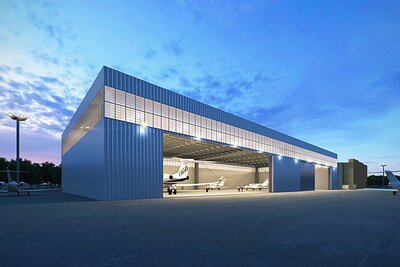
Farmingdale's Ascent: SRAI Tackles NYC's Private Jet Hangar Crisis
FARMINGDALE, NY – February 26, 2026 – A major move in the high-stakes world of private aviation real estate is set to reshape the skies over New York. SR Aviation Infrastructure (SRAI), the specialized aviation subsidiary of real estate firm SomeraRoad, has announced its acquisition of Republic Jet Center and Stratosphere Development, securing over 50 acres of prime developable land at Long Island's Farmingdale Republic Airport (FRG).
The company plans to complete approved development plans for a state-of-the-art hangar facility, a direct response to a critical and worsening shortage of private jet storage in one of the world's most congested aviation markets. The project promises to provide a much-needed relief valve for the region and signals Farmingdale's rapid evolution into a premier hub for corporate and private flyers.
A Strategic Answer to Regional Gridlock
For years, the New York metropolitan area's private aviation sector has been a victim of its own success. Sky-high demand has consistently outstripped the capacity of its primary airports, Teterboro Airport (TEB) in New Jersey and Westchester County Airport (HPN) in New York. Teterboro, often cited as the busiest private jet airport in the United States, frequently experiences significant ramp bottlenecks, ground stops, and airspace congestion, leading to frustrating delays for high-value clients and corporate flight departments.
This persistent gridlock has created what industry insiders describe as an extraordinary scarcity of modern, accessible hangar space. SRAI's acquisition at Farmingdale is strategically positioned to capitalize on this supply-demand imbalance. By developing at FRG, the company is creating a viable, high-quality alternative that can absorb overflow and offer a more efficient experience for operators.
"Farmingdale represents a significant growth milestone for SRAI and marks the expansion of our national portfolio into one of the country's most dynamic private aviation markets," said Jonathon Reeser, President of SRAI, in a statement. He emphasized the airport's strategic importance, calling the project "a pivotal step in SRAI's continued growth and leadership in the general aviation infrastructure sector."
The sentiment is echoed by company advisors who see the project as a landmark opportunity. "As demand for private and business aviation continues to surge, accessible hangar space in the New York region has become extraordinarily scarce," noted Monte Koch, Senior Advisor of SRAI. "By delivering purpose-built, modern hangars at Farmingdale, SRAI is not only addressing a critical infrastructure gap but will also set a new benchmark for quality and operational sophistication in one of the nation's busiest aviation corridors."
Building for the Future of Flight
The planned multi-phase development is not just about adding more space; it's about adding the right space. The new hangars are designed with 28-foot door heights, a crucial feature required to accommodate the latest generation of large-cabin, long-range private jets like the Gulfstream G700 and Bombardier Global 7500. Many older facilities at competing airports lack the clearance for these modern aircraft, effectively locking them out.
This focus on cutting-edge infrastructure reflects a broader trend at Farmingdale. SRAI's project joins other recent developments, including Modern Aviation's 81,000-square-foot hangar complex that also features 28-foot doors. This collective push to modernize is transforming the airport into a purpose-built destination for the most advanced private aircraft, raising the standard for the entire region.
The development SRAI is undertaking was already in motion, as the firm will complete previously approved plans associated with Republic Jet Center's own expansion announced in late 2025. This suggests that significant regulatory and environmental assessments have likely been addressed, potentially streamlining the path to completion for the new owners.
A National Blueprint for a Niche Market
While the Farmingdale acquisition is a game-changer for the New York market, it is also a key piece of a larger national strategy for SRAI and its parent company, SomeraRoad. The firm has been methodically building an institutional-grade portfolio of aviation real estate across the country, targeting markets with high growth and a clear supply shortage.
SRAI's national platform launched in November 2024 with the acquisition of the 23-acre Quail Air Center at Harry Reid International Airport in Las Vegas. This was followed by the purchase of a fully leased, Class A private hangar complex at San Antonio International Airport in March 2025. More recently, in October 2025, the company acquired the Bridger Hangar Complex at Bozeman Yellowstone International Airport—a hub for a growing concentration of wealth—and announced plans to build an additional 40,000-square-foot hangar on an adjacent development site.
This pattern of acquiring and developing premier facilities in Las Vegas, San Antonio, Bozeman, and now New York, demonstrates a clear and calculated approach. SRAI is positioning itself as a leading institutional owner and developer in a specialized but highly lucrative real estate sector that has historically been fragmented.
Cementing Farmingdale's Economic Role
The impact of this large-scale development extends beyond the runway. Farmingdale Republic Airport is already a significant economic engine for Long Island, generating an estimated $214 million in annual economic activity for Nassau and Suffolk Counties. The construction and subsequent operation of SRAI's new facilities will inject millions more into the local economy and create numerous jobs.
By attracting more corporate flight departments, charter companies, and high-net-worth individuals to the airport, the project will further solidify FRG's standing not just as an alternative to Teterboro, but as a destination in its own right. The move represents a pivotal moment in the airport's long history, which dates back to its origins as a hub for aircraft manufacturing in the 1920s.
With this landmark investment, SR Aviation Infrastructure is placing a major bet on the future of Farmingdale. In doing so, it is providing a tangible solution to New York's private aviation congestion while simultaneously elevating the airport's profile on the national stage.