
- EXALTA's microbiology laboratory achieved ISO/IEC 17025:2017 accreditation, enhancing in-house testing capabilities. - The accreditation supports a vertically integrated model, reducing reliance on external testing partners. - The move is part of a broader industry shift toward comprehensive, strategic partnerships in MedTech development.
Experts view EXALTA's ISO 17025 accreditation as a strategic advantage that strengthens quality control, accelerates development cycles, and aligns with the industry's shift toward vertically integrated MedTech partnerships.
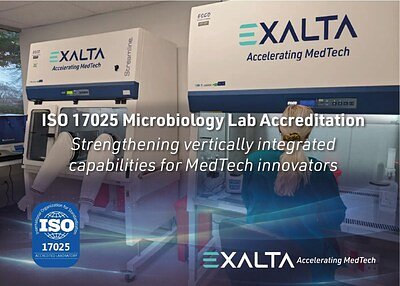
EXALTA's Lab Accreditation Signals Shift in MedTech Development
BETHLEHEM, Pa. – April 22, 2026 – EXALTA Group has secured a critical accreditation that promises to accelerate the journey from concept to clinic for medical device manufacturers. The company announced its microbiology laboratory in Bethlehem has achieved ISO/IEC 17025:2017 accreditation, a move that reinforces a growing industry trend toward fully integrated development and manufacturing partnerships.
This internationally recognized standard is a formal acknowledgment of a laboratory's technical competence and its ability to produce precise and reliable data. For EXALTA's MedTech clients, this means the addition of in-house microbiology testing to an already connected model of development, regulatory support, and manufacturing, strategically designed to shorten notoriously long product development cycles.
A Strategic Move Towards Vertical Integration
The pursuit of ISO 17025 is more than a procedural milestone; it's a strategic pillar in EXALTA's vertically integrated business model. In an industry where outsourcing critical functions is common, bringing accredited microbiology testing in-house represents a significant move to consolidate control, enhance efficiency, and ensure program continuity. By reducing dependence on external testing partners, the company can eliminate communication gaps and scheduling conflicts that often create bottlenecks in the development pipeline.
This integration enables stronger, real-time coordination between development, quality assurance, and manufacturing teams. Problems identified during testing can be communicated and addressed immediately, fostering a more agile and responsive product development process. This approach is crucial for navigating the increasing complexity of modern medical devices and the pressures of a competitive global market.
"This accreditation reflects the rigor, competence, and quality mindset our teams bring to work every day," said Dr. Dan Hickey, Lab Director & Lead Research Scientist at EXALTA Group, in the company's official announcement. "Just as importantly, it strengthens an in-house capability that supports continuity, responsiveness, and alignment as we empower our customers to launch products worldwide, at scale and at pace."
Navigating a Complex and Demanding MedTech Landscape
EXALTA's investment in its in-house lab capabilities comes at a time of mounting pressure on medical device OEMs. The industry is characterized by a push for rapid innovation, increasingly sophisticated device technology, and a stringent, ever-evolving global regulatory framework. Furthermore, recent global events have highlighted the fragility of extended supply chains, prompting a strategic re-evaluation of outsourcing risks.
In this environment, the traditional model of fragmented, transactional vendor relationships is giving way to a demand for comprehensive, strategic partnerships. MedTech innovators are increasingly seeking Contract Development and Manufacturing Organizations (CDMOs) that can act as a seamless extension of their own teams, managing the entire product lifecycle from initial design to scaled production. By securing ISO 17025 accreditation, EXALTA solidifies its position as such a partner, offering a key differentiator in a competitive field that includes major players like Jabil, Flex, and Phillips-Medisize, all of whom are championing end-to-end service models.
The accreditation serves as a powerful de-risking tool for clients. It provides objective, third-party validation of the lab's quality systems and technical proficiency, which can streamline regulatory submissions to bodies like the FDA and EMA. For a MedTech company, having test data generated from an accredited in-house lab provides a higher degree of confidence and a single source of accountability, mitigating the risks associated with data integrity and quality control.
Redefining the Standard for MedTech Partnerships
This development signifies a broader shift in what OEMs expect from their manufacturing partners. The focus is moving beyond simple compliance to a proactive commitment to quality and operational excellence. An accredited in-house laboratory is no longer just a value-add; for many, it's becoming a prerequisite for partnership.
This integrated approach allows for a holistic view of the product, where design for manufacturability, regulatory strategy, and quality testing are not siloed activities but concurrent, interwoven processes. This synergy is critical for avoiding costly redesigns and regulatory hurdles late in the development cycle. By embedding accredited testing within the development workflow, potential issues related to biocompatibility, sterilization, or material interaction can be identified and resolved much earlier.
The trend reflects a maturation of the MedTech outsourcing market. As devices become more complex and market windows shrink, the ability of a partner to manage and control every critical step of the process becomes a decisive competitive advantage. EXALTA's accreditation is a clear signal that the future of MedTech development lies in deep, technically proficient partnerships that can offer both speed and uncompromising quality.
As quality expectations, regulatory scrutiny, and execution demands continue to rise, recognized laboratory standards are an essential component of a robust MedTech operating platform. This milestone reinforces EXALTA's infrastructure and specialized expertise, positioning it to support the industry's most ambitious programs from early-stage concepts through global, scaled manufacturing.