
- 130% price surge forecast for DRAM and SSDs by end of 2026 (Gartner).
- 90-95% Q1 2026 price jump in conventional DRAM, with another 58-63% expected in Q2 (TrendForce).
- Server memory to account for 56% of total memory revenue in 2026, up from 37% in 2025 (Counterpoint Research).
Experts agree that the AI-driven memory supercycle represents both a significant investment opportunity and a disruptive force in global tech supply chains, with structural shifts favoring high-performance memory components over consumer-grade chips.
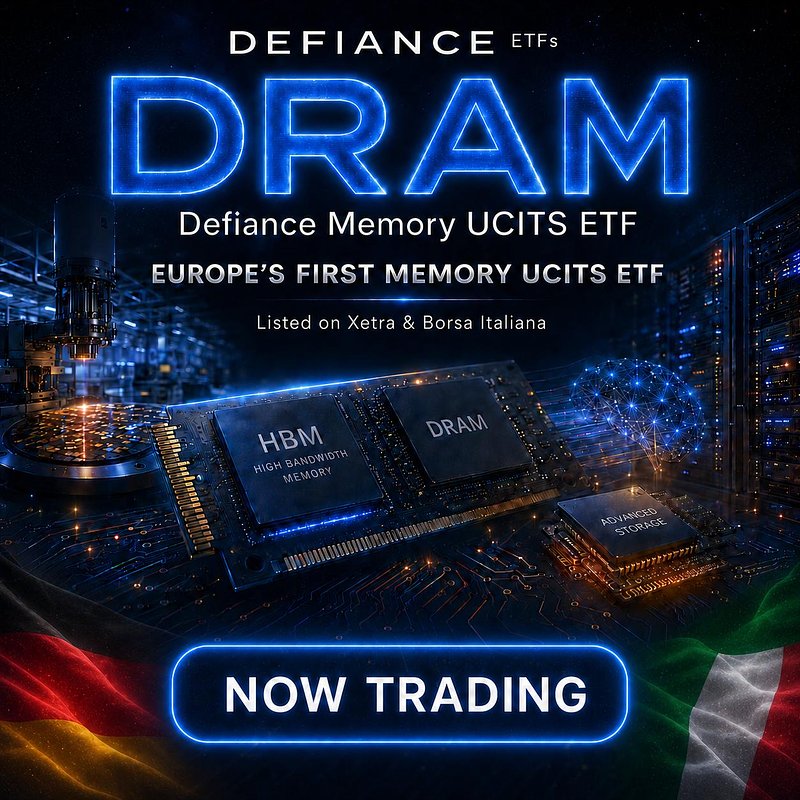
Europe Gets Its First Memory ETF as AI Boom Creates a Supply Crunch
MIAMI, FL – June 19, 2026 – In the quiet, data-driven world of semiconductors, a storm is brewing. Fueled by the insatiable appetite of artificial intelligence, the market for memory chips—the unsung workhorses of the digital age—is entering what analysts are calling a "supercycle." Prices are skyrocketing, supply is tightening, and the ripple effects are poised to reshape the entire technology landscape. Tapping into this seismic shift, Defiance ETFs has just launched the Defiance Memory UCITS ETF (ticker: DRAM), Europe's first exchange-traded fund offering investors direct exposure to this critical and volatile sector.
The launch provides European investors a new tool to navigate a market dynamic previously only accessible through US-listed funds, where similar products have attracted nearly $20 billion in assets. As major tech companies scramble to secure the components powering the AI revolution, Defiance is betting that investors will want a piece of the action, not just in the AI models themselves, but in the foundational hardware that makes them possible.
The New Digital Gold: Why Memory is AI's Critical Bottleneck
For years, the memory market was defined by its cyclical, almost predictable, booms and busts, largely tied to the sales of PCs and smartphones. That era is decisively over. Today, the market is driven by an unprecedented demand shock from a single, powerful source: artificial intelligence. The complex models behind generative AI require colossal amounts of high-speed memory to train and operate, turning memory chips into a strategic, and increasingly scarce, resource.
The numbers behind this trend are staggering. Industry analysts at Gartner are forecasting that the prices for DRAM and solid-state drives (SSDs) could surge by as much as 130% by the end of 2026. Other estimates are even more dramatic, with some projecting a 125% increase for DRAM and a staggering 234% for NAND flash memory in 2026 alone. Data from TrendForce shows the surge is already well underway, with conventional DRAM contract prices jumping by 90-95% in the first quarter of this year, with another 58-63% increase expected for the second quarter.
At the heart of this demand is a specialized component known as High-Bandwidth Memory (HBM). HBM is essential for the high-performance AI accelerators, like NVIDIA's Blackwell platform, that hyperscale data centers run by Microsoft, Google, Meta, and Amazon are deploying en masse. This has created a fierce competition for a limited supply, transforming the memory market from a consumer-driven cycle to an allocation-driven battleground where the biggest tech giants vie for capacity. As one analyst noted, HBM has become the primary bottleneck in the AI infrastructure buildout. In response, major memory manufacturers like Samsung and SK Hynix are reallocating their production lines away from consumer-grade chips to focus on higher-margin HBM and server-grade DRAM. This structural shift is underscored by Counterpoint Research, which forecasts that server memory will account for 56% of total memory revenue in 2026, a sharp increase from 37% in 2025.
A New Way for Europeans to Invest
Until now, European investors looking to directly target this theme have been on the sidelines. The launch of the Defiance Memory UCITS ETF (DRAM) changes that. The fund, which carries a Total Expense Ratio (TER) of 0.69% and is listed on Germany's Xetra and Italy's Borsa Italiana, is the first of its kind in the European UCITS framework, offering a diversified, long-only vehicle to invest in the companies developing, manufacturing, and commercializing memory technology.
The potential appetite is significant. In the US, a similar memory-focused ETF became the fastest fund in history to reach $10 billion in assets, demonstrating a powerful investor desire to participate in this foundational part of the AI value chain. While Defiance's UCITS-compliant fund will necessarily be more diversified than its highly concentrated American counterparts, the core investment thesis remains the same.
"Memory is the foundational layer of the AI economy," commented Sylvia Jablonski, CIO of Defiance ETFs. "Every model training run, inference workload, and hyperscale data centre expansion depends on DRAM, HBM, and advanced storage. DRAM gives European investors a direct, rules-based way to access this segment of the AI value chain."
Ripple Effects: The Squeeze on the Global Tech Supply Chain
The memory supercycle isn't just an opportunity for investors; it's a major disruption for the rest of the technology world. As manufacturers prioritize the lucrative HBM market, the supply of memory for everyday devices is tightening, and costs are rising. The same memory chips that go into a high-end AI server are, in their less advanced forms, essential for laptops, smartphones, and cars.
This squeeze is expected to translate directly into higher prices for consumers. Projections indicate that PC prices could climb by up to 17% and smartphone prices by up to 13% by the end of 2026 due to rising memory costs. The impact could be so profound that some analysts predict the sub-$500 entry-level PC segment, a staple for students and budget-conscious buyers, could completely disappear by 2028. Consumers and businesses alike may be forced to extend their device upgrade cycles, slowing down refresh rates across the board.
Defiance's European Playbook
The DRAM ETF is not a standalone product but a key piece of Defiance's broader strategy for the European market. The firm, founded in 2018, has built its brand on offering targeted, thematic ETFs in high-growth, and often disruptive, sectors. The DRAM fund is its fourth European launch this year, following the Defiance AI & Power Infrastructure UCITS ETF (AIPO), the Drone UCITS ETF (DRON), and the Ukraine Reconstruction UCITS ETF (UKRN).
This expansion is facilitated by a partnership with HANetf, a white-label platform that helps asset managers like Defiance navigate Europe's complex regulatory and distribution landscape. The strategy appears to be focused on creating a suite of interconnected thematic funds centered on the AI buildout. The AIPO ETF, for example, invests in the power grid and infrastructure needed to support data centers, making it a natural complement to the new DRAM fund, which invests in the memory inside those centers.
Hector McNeil, Co-Founder and Co-CEO of HANetf, highlighted this synergy, stating, "The ETF captures a sector that has seen significant growth recently, driven predominantly by the rise of AI and its infrastructure. This ETF particularly complements Defiance’s AIPO ETF, which provides access to the power infrastructure behind the AI buildout." By identifying and moving quickly on these specialized themes, Defiance is carving out a distinct niche for itself in the competitive European ETF market, offering investors a way to look beyond the obvious tech giants and invest in the critical enabling technologies powering the next wave of innovation.