
- $1.2M raised: Etherdyne successfully crowdfunded $1.2M in its first Reg CF campaign, oversubscribed a week early.
- 400+ investors: The campaign attracted over 400 individual investors, signaling strong market validation.
- 100W capacity: The Ether Power™ Platform can deliver up to 100 total watts across multiple devices in a power zone.
Experts view Etherdyne's one-to-many wireless power technology as a breakthrough in the industry, positioning it as a key player in the future of cordless environments.
Etherdyne's Wireless Power Tech Promises a Truly Cord-Free Future
SANTA CLARA, CA – March 11, 2026 – In a move that signals strong public appetite for a truly wireless future, startup Etherdyne Technologies Inc. has successfully raised over $1.2 million in its first-ever Regulation Crowdfunding (Reg CF) campaign. The offering, hosted on the StartEngine platform, was oversubscribed a full week ahead of its scheduled close, attracting capital and validation from more than 400 individual investors.
While the financial milestone is significant for the Santa Clara-based company, the raise represents something more profound: a vote of confidence in a technology that aims to fundamentally change our relationship with electricity. Etherdyne isn't just building a better charger; it's developing the infrastructure to make power as accessible and invisible as a Wi-Fi signal.
"This isn't about creating another charging pad for your phone," said Dr. Jeff Yen, co-founder and CEO of Etherdyne, in a statement accompanying the announcement. "We've developed the infrastructure to make accessing power as effortless as Wi-Fi."
Beyond the Charging Pad: A New Power Paradigm
For years, the promise of wireless power has been largely confined to the inductive charging pad. Dominated by the Qi standard, this technology requires a device to be placed in a specific spot, in direct contact with a charging surface. It is a one-to-one solution that, while convenient, has done little to eliminate the fundamental problem of cable clutter and battery anxiety.
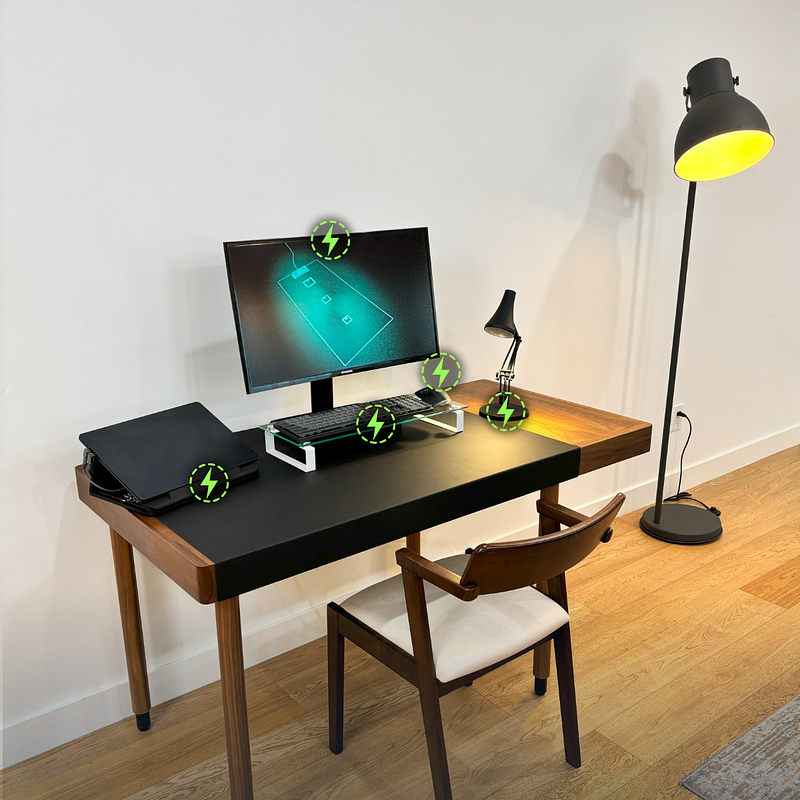
Etherdyne is pioneering a different approach. Using magnetic resonance, its Ether Power™ Platform creates a three-dimensional 'Ether Power Zone'—a volume of space the size of a desk, a kitchen countertop, or even an entire room—within which multiple devices can be powered or charged simultaneously and without precise placement. A phone, a laptop, a smart speaker, and a desk lamp could all draw power continuously just by being within the zone, free to move around without interrupting the energy flow.
This 'one-to-many' capability is what sets the technology apart. "The individual receiver range we've focused on is a 10th of a watt up to about 50 watts per device," shared Dr. Robert Moffatt, co-founder and Chief Science Officer. This range, he noted, covers the majority of consumer and office electronics in use today. The platform can deliver up to 100 total watts across all devices in the zone.
This leap from one-to-one to one-to-many charging is seen by industry watchers as the technology's key innovation. "The wireless power industry has been advancing very gradually with a focus on 1:1 charging, which is not solving the bigger picture of having a cordless environment," noted Dinesh Kithany, an industry analyst at Wired and Wireless Technologies (WAWT). "Etherdyne's solution is very interesting because they are doing one-to-many. That is the future of wireless power."
Navigating a Crowded and Competitive Field
Etherdyne is not alone in the race to cut the cord. The advanced wireless power market is a dynamic and competitive space with several players pursuing different technological paths. The global market is projected to grow from around $11 billion in 2023 to over $42 billion by 2032 as demand for ubiquitous power solutions intensifies.
Competitors include companies like WiTricity, which also uses magnetic resonance but has largely focused on higher-power applications like wireless charging for electric vehicles. Others, such as Ossia and Energous, are developing far-field solutions that use radio frequency (RF) to beam power over longer distances, akin to a Wi-Fi router.
Etherdyne's approach carves out a distinct and potentially massive niche. It avoids the long-distance, lower-power-density challenges of RF while offering far more flexibility than the high-power, application-specific systems for EVs. Its focus on creating a volumetric, medium-range power zone for a wide array of consumer and industrial devices positions it as a versatile platform solution. Bolstering this strategic position is a formidable intellectual property portfolio of 44 granted patents, creating a significant barrier to entry for potential competitors.
Democratizing Deep Tech Investment
The success of the crowdfunding campaign is as much a story about modern finance as it is about technology. By using a Reg CF platform like StartEngine, Etherdyne tapped into a pool of retail investors, effectively democratizing access to a deep-tech opportunity once reserved for venture capitalists and institutional funds.
For a company built on complex physics and a long research and development cycle, raising capital from the public carries unique significance. It provides not only funding but also crucial market validation. The fact that over 400 individuals chose to invest suggests a genuine public desire for the future Etherdyne is selling. This groundswell of support can be a powerful asset when approaching larger partners and in subsequent funding rounds, demonstrating proven demand for a truly cordless environment.
From Lab to Living Room: The Path to Adoption
With fresh capital and a validated market, Etherdyne is focused on commercialization. A critical step already achieved is securing key regulatory approvals, including FCC and CE certifications. These are not minor hurdles; they represent rigorous testing to ensure the technology is safe for human exposure and does not interfere with other electronic devices, clearing the way for integration into consumer products.
Etherdyne's business model is not to manufacture end-user devices but to license its Ether Power™ Platform to the companies that do. This B2B strategy allows it to scale rapidly by enabling device makers across industries—from smart homes and industrial IoT to medical devices and office furniture—to integrate wireless power into their products. Imagine a future where desks come with built-in power zones, factory floors have perpetually powered sensors, and smart homes are free from the clutter of chargers and cables.
This licensing model could position Etherdyne as the 'Intel Inside' of a new generation of perpetually powered electronics. The oversubscribed crowdfunding campaign is a clear indicator that investors and consumers alike are ready for this shift. The success of this funding round suggests that for a growing number of people, a future free from the tyranny of the power cord cannot arrive soon enough.