
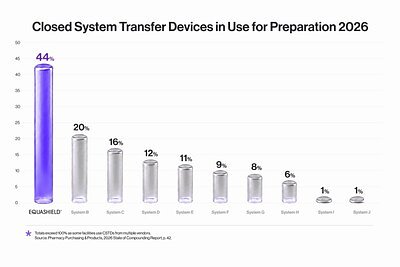
- 44% market share: Equashield commands 44% of the Closed System Transfer Device (CSTD) market for hazardous drug compounding in the U.S.
- 93% adoption rate: 93% of U.S. healthcare facilities that compound hazardous drugs now use CSTDs.
- $6 billion market: The global market for automated compounding devices is projected to reach over $6 billion by 2033.
Experts agree that Equashield's sustained leadership in hazardous drug safety is a testament to its reliability and effectiveness, reinforcing the critical role of CSTDs in protecting healthcare workers and ensuring regulatory compliance.
Equashield's Eight-Year Grip on Hazardous Drug Safety
PORT WASHINGTON, NY – May 08, 2026 – In the high-stakes environment of healthcare, where the line between treatment and toxicity is razor-thin, Equashield has once again cemented its role as a guardian of safety. For the eighth consecutive year, the company’s Closed System Transfer Device (CSTD) has been named the most-used system for hazardous drug preparation in the United States, according to the prestigious Pharmacy Purchasing & Products (PPP) State of Pharmacy Compounding report.
The new report reveals that Equashield now commands 44 percent of the CSTD market for hazardous drug compounding. This milestone is not just a number; it represents the deep-seated trust that pharmacists, nurses, and hospital administrators place in a system designed to protect them from the very medicines intended to heal patients.
The High Stakes of Hazardous Drug Handling
Handling hazardous drugs, particularly antineoplastic agents used in chemotherapy, is a daily reality in nearly 80 percent of U.S. healthcare facilities. For the healthcare professionals on the front lines, this work carries significant occupational risk. Exposure to these potent substances—even in microscopic amounts—can lead to severe health consequences, from skin irritation and reproductive issues to an increased risk of cancer.
This is the critical problem that CSTDs were designed to solve. These devices create a sealed, airtight environment for the transfer of drugs from vials to syringes and then to IV bags, mechanically preventing the escape of dangerous vapors, aerosols, and droplets. The widespread adoption of these systems, with 93 percent of facilities that compound hazardous drugs now relying on them, underscores a profound industry-wide commitment to worker safety.
Regulatory bodies have reinforced this commitment. The United States Pharmacopeia (USP) General Chapter , which became compendially applicable in late 2023, mandates the use of CSTDs for the administration of antineoplastic drugs and strongly recommends them for compounding. This standard, alongside guidelines from the National Institute for Occupational Safety and Health (NIOSH), has transformed CSTDs from a best practice into a foundational component of modern pharmacy operations.
Leadership Forged Through Consistency
In a competitive market that includes major players like Becton, Dickinson and Company (BD) with its PhaSeal system and ICU Medical's ChemoLock, Equashield’s sustained dominance is remarkable. The company attributes its success not to fleeting trends, but to a foundation of reliability and a purpose-built design that addresses the core risks of drug handling.
Equashield’s system is distinguished by its proprietary closed-back syringe, which works in concert with specialized adaptors and connectors to create a fully integrated, leak-proof system. This design prevents the plunger from being accidentally pulled out, a potential route of exposure in other systems.
"Leadership is earned through consistency," said Matt Stuckert, General Manager of EQUASHIELD®, in a recent statement. "Pharmacy and nursing teams need systems they can count on every day, not just devices that meet minimum requirements. Being recognized for the eighth consecutive year and expanding to 44 percent reflects the confidence healthcare professionals place in EQUASHIELD® to protect their staff and streamline their workflows."
This confidence is reflected in high user satisfaction rates among healthcare professionals, who often praise the system's ease of use and reliability. For facilities facing immense pressure from high patient loads and stringent regulatory oversight, the decision to stick with a proven solution is a pragmatic one. The trust built over eight years provides a powerful incentive to stay the course.
The Next Frontier: Automation in Pharmacy Compounding
Building on its leadership in manual safety devices, Equashield is now looking to the future by tackling the next major challenge in pharmacy operations: automation. The company is expanding its safety platform with Mundus HD, an automated compounding system designed to bring robotic precision to the hazardous drug preparation process.
The global market for automated compounding devices is projected to grow substantially, reaching over $6 billion by 2033, as pharmacies seek to enhance efficiency, reduce errors, and further protect their staff. Mundus HD integrates Equashield's trusted CSTD technology with advanced robotics, machine vision, and AI-powered image processing. This allows the system to verify every dose in real-time, ensuring the right drug and concentration while physically shielding technicians from the compounding process.
Capable of preparing up to 37 individual doses per hour, Mundus HD promises to dramatically improve pharmacy efficiency. By automating repetitive tasks, it frees up highly skilled pharmacists and technicians to focus on clinical responsibilities. Furthermore, its compact design and integration with electronic medical records make it an accessible solution for a wider range of hospital pharmacies seeking to adopt next-generation technology without a complete overhaul of their workspace.
Navigating a Strict Regulatory and Economic Climate
The push for both robust CSTDs and advanced automation is not happening in a vacuum. It is driven by a confluence of regulatory pressure and powerful economic incentives. With USP now fully in effect, facilities are under greater scrutiny than ever to ensure compliance. A reliable CSTD is a cornerstone of that compliance strategy, providing auditable proof of a commitment to safety.
Beyond regulatory adherence, there is a strong business case for investing in premium safety systems. While the initial cost of implementation can be a consideration, the economic benefits are multifaceted. Effective CSTDs reduce costly drug waste by allowing for vial optimization. They also mitigate the immense financial and human costs associated with accidental worker exposure, from potential litigation and compensation claims to the loss of skilled staff.
As healthcare continues to evolve, the emphasis on both worker safety and operational efficiency will only intensify. The solutions that succeed will be those that address both needs simultaneously. By pairing a market-dominant manual CSTD with a forward-thinking automation platform, Equashield is positioning itself not just as a provider of devices, but as an integrated partner in the future of safe and efficient pharmacy practice.