
- 16th International Conference on Climate Change (ICCC16) scheduled for April 8, 2026
- 160+ environmental and public health organizations called for EPA Administrator Lee Zeldin's resignation in March 2026
- 6-3 Supreme Court decision in West Virginia v. EPA (2022) constrained federal climate regulation authority
The broader scientific community, including the IPCC, overwhelmingly rejects the claims of climate skeptics, emphasizing that human greenhouse gas emissions are the primary driver of global warming, with clouds amplifying rather than mitigating this effect.
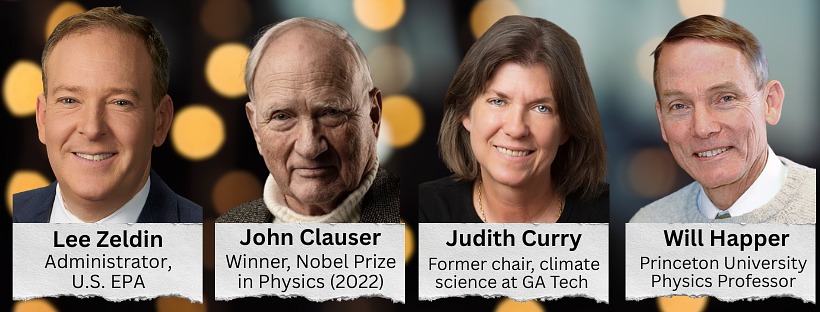
EPA Chief, Nobel Winner to Headline Climate Skeptic Conference
WASHINGTON, DC – March 25, 2026 – A high-profile gathering of figures challenging the scientific consensus on climate change is set to take place in the nation's capital, featuring a sitting EPA Administrator and a Nobel Prize-winning physicist as keynote speakers. The Heartland Institute's 16th International Conference on Climate Change (ICCC16), scheduled for April 8, will provide a prominent stage for a movement that seeks to reframe the global climate debate.
EPA Administrator Lee Zeldin is slated to open the conference, an appearance that underscores the administration's alignment with views skeptical of a 'climate crisis.' He will be joined by John F. Clauser, a co-recipient of the 2022 Nobel Prize in Physics, who has become an outspoken critic of what he calls 'climate alarmism.' The event, co-hosted by a network of free-market and climate-skeptic organizations, aims to present what organizers call "the other side of the climate debate – the side grounded in data rather than dogma," according to a statement from Heartland Institute President James Taylor.
Policy and Controversy from the EPA's Podium
Administrator Zeldin's participation is far more than a ceremonial appearance. It represents a capstone on a tenure defined by an aggressive deregulatory agenda. Since taking office in January 2025, Zeldin has systematically worked to dismantle key environmental regulations, culminating in the recent repeal of the 2009 'Endangerment Finding.' That finding legally classified carbon dioxide as a pollutant threatening public health, providing the legal foundation for a wide range of federal emissions standards under the Clean Air Act.
In announcing its elimination, Zeldin referred to the Endangerment Finding as the "Holy Grail of the climate change religion," claiming its repeal would save taxpayers over a trillion dollars. This action followed a broader initiative Zeldin announced in March 2025, which he called the "largest deregulatory announcement in U.S. history," aimed at shifting the EPA's focus away from climate regulation and toward energy production.
These policies have triggered a significant backlash. In March 2026, a coalition of over 160 environmental and public health organizations called for Zeldin's resignation, accusing him of betraying the agency's mission. The move followed reports of deep dissent within the agency itself, with current and former EPA staff reportedly signing a "Declaration of Dissent" to protest the administration's handling of scientific programs and personnel. Zeldin's keynote address at a conference organized by climate skeptics is poised to intensify this conflict, bringing the administration's environmental policy directly into the heart of the debate it seeks to influence.
A Nobelist's Challenge to Climate Models
Lending the conference significant scientific prestige is the participation of John F. Clauser, who shared the 2022 Nobel Prize in Physics for his pioneering experiments on quantum entanglement. Since receiving the award, however, Clauser has pivoted to a new, more controversial field, publicly declaring himself a "climate change denier" and insisting that "there is no climate crisis."
Clauser's primary argument dismisses the role of CO2 emissions in global warming. Instead, he posits that cloud cover acts as a natural and dominant 'thermostat' for the planet, a feedback mechanism he claims is vastly underestimated by mainstream climate models. In his view, clouds provide a powerful, self-regulating cooling effect that overrides the warming influence of greenhouse gases.
His stance has been widely embraced by climate-skeptic organizations, and in May 2023, he joined the board of the CO2 Coalition, a nonprofit co-hosting the conference. However, the broader scientific community has forcefully rejected his assertions. Climate scientists have labeled his claims 'pseudoscience,' pointing out that Clauser has no peer-reviewed publications in climate science. The overwhelming consensus, as summarized by bodies like the Intergovernmental Panel on Climate Change (IPCC), is that while clouds are a complex variable, their net feedback effect is understood to amplify, not diminish, the warming caused by human greenhouse gas emissions.
The Legal Blueprint for Deregulation
Another marquee speaker, West Virginia Gov. Patrick Morrisey, brings a critical legal and political perspective to the conference. As the former attorney general of his state, Morrisey led the successful lawsuit in West Virginia v. EPA, a landmark 2022 Supreme Court case that fundamentally altered the federal government's ability to regulate climate change.
In its 6-3 decision, the Court invalidated the Obama-era Clean Power Plan, ruling that the EPA lacked the explicit Congressional authority to enforce sweeping, sector-wide shifts in energy production, such as moving from coal to renewable sources. The ruling was based on the 'major questions doctrine,' a legal principle asserting that agencies cannot enact policies with vast economic and political significance without clear authorization from lawmakers.
This decision created the legal landscape that has enabled the current administration's deregulatory push. By constraining the EPA's authority to regulate greenhouse gases on a systemic level, the ruling effectively handed the reins back to Congress, while empowering actions like Zeldin's repeal of the Endangerment Finding. Morrisey's presence at the conference serves as a powerful reminder of how legal strategy has become a central pillar in the effort to reshape American environmental policy.
The Network Amplifying Skepticism
The conference is the flagship event for The Heartland Institute, a think tank The Economist once called "the world’s most prominent think tank promoting skepticism about man-made climate change." Founded in 1984, the Illinois-based organization has a long history of promoting free-market ideology and challenging scientific consensus on issues ranging from secondhand smoke to climate change.
While the institute does not disclose its donors, its funding history has drawn scrutiny. Past contributors have included ExxonMobil and tobacco companies like Philip Morris. More recently, financial records show significant contributions routed through donor-advised funds such as DonorsTrust and Donors Capital Fund, which allow for anonymous giving. Leaked documents in 2012 also revealed a strategy to develop K-12 school curricula questioning the severity of climate change.
The Heartland Institute is not alone. It is joined by co-hosts including CFACT (Committee for a Constructive Tomorrow), the CO2 Coalition, the blog Watts Up With That, and the international group CLINTEL. This network of organizations, often sharing funders and board members, works to amplify a message that challenges the urgency of climate action and promotes the continued use of fossil fuels. For these groups, the 16th International Conference on Climate Change represents a crucial opportunity to demonstrate their growing influence on policy and public discourse.