
- 2,200+ aircraft orders from over 60 customers, valued at nearly $10 billion.
- 150-foot takeoff/landing capability (1.5 basketball courts).
- 2028 target for commercial service entry.
Experts view Electra's EL9 as a pragmatic and disruptive innovation in regional air travel, leveraging hybrid-electric propulsion and ultra-short takeoff/landing to bridge gaps in connectivity, with strong market validation and strategic industry backing.
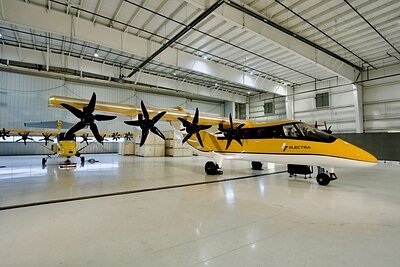
Electra's Ultra Short Aircraft Aims to Remap Regional Air Travel
MANASSAS, Va. – December 10, 2025 – In a move that signals a significant maturation of the advanced air mobility (AAM) market, Electra.aero has officially submitted its application for FAA type certification for its nine-passenger EL9 hybrid-electric aircraft. The filing moves the innovative plane from the realm of emerging technology development into the rigorous, formal process required for commercial passenger and cargo operations, setting the stage for a potential disruption in regional travel.
The EL9 is not another vertical-takeoff air taxi vying for space above crowded city centers. Instead, Electra is pioneering a new category of “Ultra Short” takeoff and landing aircraft. By combining a fixed-wing design with a novel hybrid-electric propulsion system, the company promises the speed, safety, and cost-effectiveness of a conventional airplane with the near-anywhere accessibility of a helicopter. This FAA application, which includes a detailed Project Specific Certification Plan, marks the most critical step yet in turning that promise into a commercial reality.
"This certification application signals that the EL9 is fast becoming a reality and reflects the progress our team and the FAA have made together," said Electra CEO Marc Allen in a recent statement. "The EL9 combines blown-lift with distributed electric propulsion to unlock air travel that takes people directly from where they are to where they want to go."
A Pragmatic Path Through the Regulatory Maze
For an industry filled with futuristic designs, Electra’s strategy is notably pragmatic. The company is pursuing certification under the FAA’s existing Part 23 rules for small aircraft. These regulations were modernized in 2017 to be performance-based rather than prescriptive, a change intended to streamline the approval of innovative technologies. By choosing a fixed-wing eSTOL (electric short takeoff and landing) design, Electra avoids many of the complexities facing eVTOL (electric vertical takeoff and landing) developers, whose aircraft are now being certified under a more complex 'powered-lift' category.
This approach is widely seen as a lower-risk path to market. While the FAA has yet to certify any novel hybrid-electric transport aircraft, Electra’s years of collaboration with the agency's Center for Emerging Concepts and Innovation (CECI) have helped establish a clearer roadmap. With a target for commercial service entry by 2028, the company is now focused on the intensive testing and analysis phase. Challenges remain, particularly in proving the reliability of the hybrid propulsion system and addressing safety standards for high-capacity batteries, but the established framework of Part 23 provides a solid foundation.
Engineering a New Class of Flight
The EL9's remarkable performance stems from a clever synthesis of advanced aerodynamics and hybrid power. The core innovation is its “blown-lift” technology. Eight electric propellers are distributed along the front edge of the wing, continuously forcing a high-speed sheet of air over the wing’s surface and large flaps. This accelerated airflow dramatically increases lift, allowing the aircraft to take off and land in as little as 150 feet—roughly the length of one and a half basketball courts.
This technology, validated on Electra's two-seat EL2 Goldfinch demonstrator, enables the EL9 to fly safely at speeds as low as 25 knots on approach, while still achieving a cruise speed of 175 knots (200 mph). The propulsion system itself is a hybrid-electric architecture, using a small, fuel-efficient turbine to power a generator that drives the electric motors. Crucially, this system can also recharge the aircraft's four battery packs in-flight. This capability is a game-changer, as it eliminates the dependency on ground-based charging infrastructure that limits purely battery-electric aircraft, vastly expanding the EL9’s operational flexibility.
Beyond the Airport: Redrawing the Map with 'Direct Aviation'
Electra’s ultimate vision extends far beyond the aircraft itself. The company is championing a new operational model called 'Direct Aviation,' designed to fill the gap in regional travel for trips between 50 and 500 miles, a distance currently dominated by car travel. The EL9's ultra-short field capability unlocks thousands of potential 'Ultra Short Access Points' (USAPs)—locations like small airfields, helipads, docks, and even reinforced parking areas or industrial lots.
By connecting these points directly, the EL9 can bypass congested airport hubs, creating new, efficient routes between smaller communities, business centers, and remote locations. The operational feasibility of this model is enhanced by the aircraft’s design. With projected noise levels under 75 decibels—quieter than a household vacuum cleaner and significantly less than a helicopter—the EL9 is engineered for community acceptance. However, realizing this vision will require more than just a certified aircraft. It will involve navigating local zoning laws, developing new air traffic management strategies, and gaining public trust.
Market Validation and a Formidable Competitive Edge
While the vision is ambitious, the market has responded with resounding confidence. Electra has amassed a provisional order book of over 2,200 aircraft from more than 60 customers, valued at nearly $10 billion. This backlog, one of the largest in the AAM sector, includes commitments from regional airlines like JSX, helicopter operators such as the Bristow Group, and on-demand charter platforms across the globe.
This commercial interest is bolstered by a roster of powerhouse strategic investors, including aerospace giants Lockheed Martin Ventures, Honeywell, and Safran. Their involvement provides not only capital but also deep technical expertise and supply chain support. Honeywell, for example, is supplying the EL9's flight control systems. Furthermore, contracts with the U.S. Air Force, Army, and NASA for both technology development and military use-case exploration provide further validation of the platform's robustness and versatility.
Compared to its eVTOL competitors, Electra claims the EL9 will deliver 2.5 times the payload and 10 times the range, with 70% lower operating costs than helicopters. By blending the efficiency and safety of a fixed-wing airplane with the operational flexibility of a helicopter, the EL9 is positioned not just as an air taxi, but as a multipurpose workhorse for a new era of regional connectivity. As Electra proceeds through the demanding FAA certification process, the entire aviation industry will be watching to see if this pragmatic yet revolutionary approach can truly get off the ground and remap the future of flight.