
- 32-degree ROADM: The module supports up to 32 different paths for optical signals, enhancing network flexibility and scalability.
- 1.6 Terabit-per-second (Tbps) support: The module enables high-capacity networks with advanced channel profiles, including future 1.6T super-channels.
- Cost and complexity reduction: The 'muxless' design consolidates multiple functions into a single module, reducing physical footprint, power consumption, and operational expenses.
Experts view the PM_ROADM-FLEX-H32M as a transformative advancement in optical networking, offering unprecedented flexibility, scalability, and cost-efficiency, essential for supporting the demands of 5G, cloud computing, and AI-driven data growth.
Ekinops Unveils 32-Degree ROADM to Reshape Optical Networks
PARIS, FRANCE – December 09, 2025 – Ekinops, a leading supplier in optical transport, today announced a significant advancement in network infrastructure with the launch of its 32-degree Reconfigurable Optical Add/Drop Multiplexer (ROADM) module. The new component, named the PM_ROADM-FLEX-H32M, is poised to become a critical building block for the next generation of high-capacity optical networks, designed to handle the explosive growth in data traffic driven by 5G, cloud computing, and artificial intelligence.
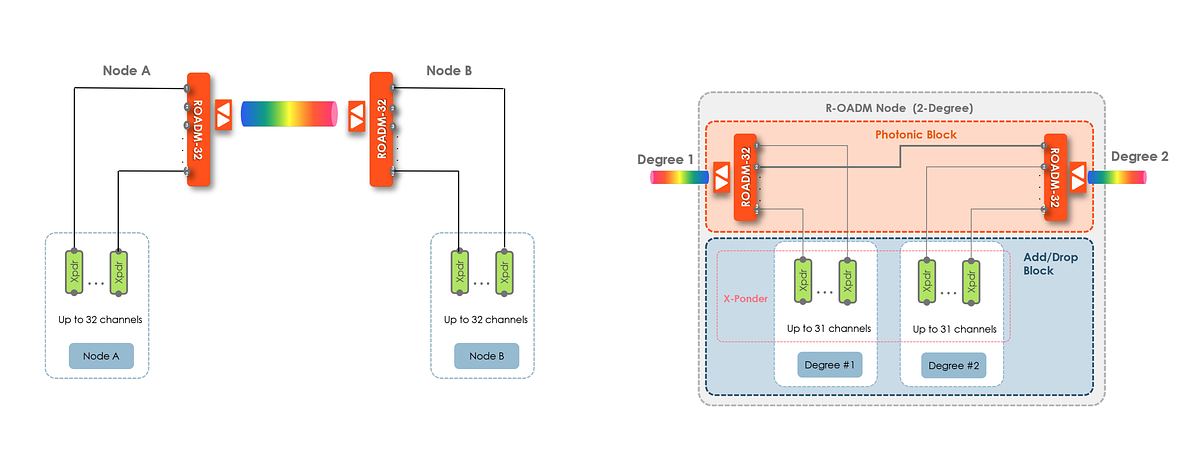
The module, part of the Ekinops360 transport platform, fundamentally rethinks how light-based data is routed. By enabling up to 32 different paths for optical signals to travel, it provides unprecedented flexibility and scalability for network architects designing the sprawling, mesh-like networks that are becoming increasingly necessary to connect cities, data centers, and 5G cell towers.
A Blueprint for Simplicity and Power
At the heart of the new module is an advanced architecture that addresses several long-standing challenges in optical networking. It supports what is known in the industry as a Colorless, Directionless, Contentionless, and Gridless (CDCG) network. In practice, this suite of features transforms network management from a rigid, manual process into a dynamic, software-controlled operation.
- Colorless and Directionless capabilities mean that any wavelength (or 'color' of light) carrying data can be added, dropped, or rerouted to any port or fiber path without physical rewiring. This dramatically simplifies adding new services and enables automated rerouting around fiber cuts, boosting network resilience.
- Contentionless functionality solves a key bottleneck by allowing multiple instances of the same wavelength to be used simultaneously across different paths, a feature absent in many conventional ROADM designs.
- Gridless, or FlexGrid, technology breaks free from the fixed channel spacing of older systems. It allows network operators to allocate just the right amount of spectral width for each data channel, whether it's a 100G service or a future 1.6 Terabit-per-second (Tbps) super-channel. This maximizes the efficiency of the fiber optic cable, akin to fitting more lanes of varying widths onto a highway.
"The PM_ROADM-FLEX-H32M is designed from the ground up to support today's modern channel profile with high bit rates over one terabit per second adding advanced functionality to any optical transport network," said Guillaume Crenn, Product Line and Marketing Director at Ekinops. "It's ideal for high-capacity networks using high baud rate transponders allowing 32 channels at 150GHz spacing to cover full C-band."
Driving Down Costs and Complexity
Beyond its raw technical power, the new ROADM module is engineered to deliver significant economic benefits. Ekinops has implemented a "muxless" design using a sophisticated 'Route-and-Select' architecture. This integrates functions that previously required multiple separate hardware modules and a web of external fiber optic cables.
By consolidating these capabilities - including dual Wavelength Selective Switches (WSS) and an Optical Channel Monitor (OCM) - into a single module, Ekinops directly reduces the physical footprint, power consumption, and capital expenditure (CapEx) for network operators. The design choice to use standard dual LC connectors instead of bulkier MPO connectors further streamlines deployment, eliminating the need for costly and complex shuffle modules. This integrated approach not only lowers initial costs but also slashes operational expenditure (OpEx) by minimizing potential points of failure and simplifying troubleshooting.
For telecommunication providers and data center operators facing relentless pressure to expand capacity while controlling costs, these efficiencies are critical. The ability to remotely provision and reconfigure wavelengths reduces the need for expensive and time-consuming technician visits, or "truck rolls," accelerating service delivery and improving operational agility.
Navigating a Competitive Optical Landscape
The launch positions Ekinops to compete more aggressively in the high-stakes optical transport market against established giants like Ciena, Infinera, and Nokia. While high-degree, CDCG-capable ROADMs are the centerpiece of next-generation network strategies across the industry, Ekinops is betting on its highly integrated, cost-effective design as a key differentiator. The optical networking sector is in a perpetual "arms race" to deliver more bandwidth, greater flexibility, and lower cost-per-bit.
By pushing the degree count to 32 in a compact, muxless form factor, the company is providing network architects with a powerful tool for creating highly resilient, meshed network topologies. This is especially important for data center interconnect (DCI) applications, where massive amounts of data must be reliably exchanged between geographically distributed facilities. The module's introduction signals a clear strategy to provide the foundational photonic layer that can support the industry's rapid migration toward 800G, 1.6T, and future coherent optical technologies.
Enabling the Networks of Tomorrow
The PM_ROADM-FLEX-H32M is more than just an incremental upgrade; it is an enabler for the digital services that will define the coming decade. The massive bandwidth and low latency required by 5G mobile networks, the distributed nature of edge computing, and the insatiable data demands of AI training clusters all depend on an underlying optical network that is not only fast but also intelligent and adaptable.
By providing a scalable and programmable photonic layer, advanced ROADMs like this one form the bedrock of software-defined networking (SDN) and network automation. This allows operators to move from a reactive to a proactive model of network management, using software to optimize data flows, predict congestion, and provision bandwidth on demand. As networks become more complex, this level of automation is no longer a luxury but a necessity for maintaining performance and reliability at scale. The new module, compatible with Ekinops' C600HC and new C700HC chassis and managed through its Celestis NMS software, fits directly into this vision for a smarter, more autonomous network infrastructure.