
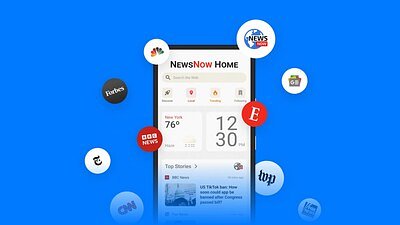
- Eightpoint's NewsNow Home app aims to address information fatigue with hyperlocal relevance and personalized content.
- The app integrates a home screen launcher, which has led to user complaints about intrusive and unexpected UI changes.
- Eightpoint's broader ecosystem includes Closr, Easy Homescreen, and Wave Browser, all leveraging data analytics for personalization.
Experts agree that while Eightpoint's NewsNow Home app addresses a critical need for hyperlocal, personalized news, its intrusive design and lack of transparency risk undermining user trust and the app's core value proposition.
Eightpoint's News App: A Cure for Overload or a New Digital Intrusion?
GEORGETOWN, Cayman Islands – March 06, 2026 – In an era defined by overwhelming digital noise, tech company Eightpoint has unveiled a major upgrade to its Android application, NewsNow Home, positioning it as an antidote to the chaotic, algorithm-driven feeds that dominate modern life. The company's announcement paints a picture of a smarter, calmer news experience, one that prioritizes hyperlocal relevance and personalized content to help users stay informed without feeling inundated.
However, while the vision addresses a widely felt user frustration, the reality of the product on the ground reveals a complex and sometimes contentious relationship between a company's strategic goals and the end-user experience.
The Promise of a Calmer News Feed
According to Eightpoint, the new version of NewsNow Home is a direct response to information fatigue. The platform aims to transform the user's home screen into an intelligent, curated information layer. Instead of prioritizing viral headlines or generic national stories, the app focuses on delivering news that is geographically and personally meaningful to the user.
Powered by the company's business intelligence and data analytics capabilities, the app promises a suite of enhancements designed for clarity and focus. These include real-time breaking news alerts for immediate local awareness, expanded hyperlocal coverage tailored to specific neighborhoods, and personalized daily digests that adapt and evolve based on a user's reading habits. A cleaner, faster, and distraction-free interface is intended to round out the experience, making daily engagement smoother and more focused.
This initiative is a cornerstone of Eightpoint's broader philosophy. "Information today is abundant, but relevance is increasingly rare," said Deniz Gezgin, Eightpoint's CEO, in the press release. "Our vision is to build products that understand what matters to each user and deliver it at the right moment." Gezgin frames personalization not merely as a feature but as a "long-term platform strategy," suggesting that NewsNow Home is a key piece in a much larger puzzle.
Revitalizing the Local News Landscape
The problem Eightpoint aims to solve is undeniably significant. The decline of traditional local media has created "news deserts" in many communities, leaving a vacuum where reliable, community-focused information once existed. Tech companies have increasingly stepped into this void, leveraging technology to aggregate and distribute local content. Platforms like Google News and NewsBreak have already captured significant market share by offering personalized local news feeds.
NewsNow Home enters this competitive arena with a specific focus on being an antidote to the very algorithms its competitors often rely on. The challenge is immense. Sustaining local news is not just a technological problem but an economic and social one. Experts in media have long argued that for such platforms to be successful, they must not only deliver relevant content but also build trust and foster a sense of community engagement. The potential impact is huge; a successful hyperlocal platform could make residents more aware of local government, community events, and public safety issues, thereby strengthening civic bonds.
Eightpoint's approach, which emphasizes its proprietary data analytics, suggests a belief that technology can create a more sustainable model for local information delivery. "When something important happens in your neighborhood, you shouldn't need to hunt for it," Gezgin stated. The goal is to make the home screen a "trusted, personalized source of information," reducing the effort required for users to stay confidently informed about their immediate surroundings.
A Troubling User Experience Disconnect
Despite the polished vision and the clear market need, the reception of NewsNow Home among some users tells a different story. A significant volume of user feedback on public app distribution platforms paints a picture that starkly contrasts with the company's marketing. The most common and serious criticism is that the app functions not just as a news service but as a complete home screen launcher that fundamentally alters the phone's user interface.
Many users have expressed frustration and surprise, describing the app as "intrusive" and "misleading." They report that upon installation, their home screens were completely reorganized, with new app groupings and layouts they did not request. This experience stands in direct opposition to the promise of a "calmer" and more user-controlled environment. Furthermore, some users have noted difficulties in uninstalling the application and reverting their device to its previous state, fueling feelings of distrust.
This launcher functionality, which also integrates Yahoo search into the home screen, appears to be a deliberate strategic choice, aligning with the company's goal of turning the "home screen into a smarter information layer." However, the lack of clear communication about this core function has led to a significant disconnect. For a product aiming to solve information overload and build trust, forcing a disruptive and unexpected user interface change is a major misstep that undermines its core value proposition.
Part of a Larger Digital Ecosystem
To fully understand NewsNow Home, it must be viewed within the context of Eightpoint's wider corporate strategy. The company is not just an app developer; it is building an ecosystem of interconnected, data-driven products. Its portfolio includes Closr, a GPS location-sharing app for families; Easy Homescreen, another Android launcher designed for simplicity; and Wave Browser, a web browser linked to ocean cleanup initiatives.
This collection of products reveals a long-term vision centered on leveraging user data and personalization across multiple touchpoints of a person's digital life. The business intelligence and analytics engine that powers NewsNow Home's news recommendations is likely the same one that informs features across its other applications. In this light, the app is more than a news service; it is a data-gathering and user-engagement tool that strengthens the entire Eightpoint ecosystem.
This strategy presents both opportunities and risks. A well-integrated ecosystem can offer users seamless and highly personalized experiences. However, it also raises questions about data privacy and the extent to which users are aware of how their behavior on one app influences their experience on another. Eightpoint's success will ultimately depend on its ability to balance its ambitious data strategy with a transparent and respectful user relationship. For now, the company faces the challenge of aligning its powerful technological capabilities with the practical expectations of users, who are seeking not just relevant information, but also control over their own devices.
Topics & Related
Software & SaaS
AI & Machine Learning
Fintech
ESG
Geopolitics & Trade
AI & Emerging Technology
Cloud Migration
Product Launch
Revenue
Related Company Pulse