
- 3,500+ industrial implementations of Eforthink's UWB technology in high-stakes environments like automotive manufacturing
- 10 cm spatial sensing precision in consumer products, enabling secure and intuitive interactions
- Over half of all new smartphones expected to feature UWB by 2030, per ABI Research
Experts view Eforthink's expansion into the smart home market as a strategic but challenging move, leveraging its industrial UWB precision to compete in a consumer space dominated by tech giants like Apple and Samsung.
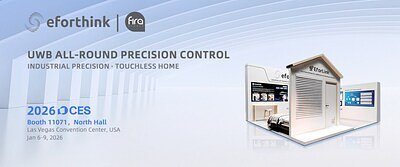
Eforthink's UWB Leap: From Factory Floors to the Smart Living Room
LAS VEGAS, NV – December 29, 2025 – A technology long honed in the demanding environments of factory floors and sprawling warehouses is set to make a bold leap into living rooms, home offices, and even pet doors. Eforthink, a company with deep roots in industrial location services, is preparing to unveil a new suite of consumer-focused products at CES 2026, signaling a strategic and ambitious expansion from its enterprise stronghold into the burgeoning smart home market.
The announcement outlines a dual-track strategy: continue to refine its industrial-grade Real-Time Location Systems (RTLS) while simultaneously introducing a line of consumer devices that leverage the same core Ultra-Wideband (UWB) technology. This move aims to translate the centimeter-level precision that optimizes automotive assembly lines into intuitive, seamless experiences for everyday life, potentially heralding a new era of proactive, spatially intelligent homes.
An Industrial Bedrock of Precision
Eforthink's credibility in the high-stakes world of industrial IoT is well-established. The company has spent over a decade developing and deploying UWB-powered solutions for a client roster that includes manufacturing giants like Mercedes-Benz, BYD, and FAW-Volkswagen. Its claim to leadership stems from this extensive portfolio of over 3,500 industrial implementations, where its technology is used to track assets, vehicles, and personnel with pinpoint accuracy.
The company’s industrial platform utilizes a sophisticated hybrid positioning system, fusing UWB with Bluetooth Angle-of-Arrival (AoA) to deliver reliable, centimeter-level location data in complex indoor and outdoor environments. This capability is critical for applications like forklift tracking in busy warehouses, managing tools and components on a production line, and streamlining yard management at logistics hubs. By providing a real-time digital twin of physical operations, Eforthink helps enterprises enhance lean production, improve worker safety, and build more resilient supply chains.
This deep expertise in creating robust, high-precision tracking systems forms the foundation of its new consumer-facing ambitions. As a company spokesperson noted in the official announcement, "UWB technology has long been the backbone of industrial automation. Now, Eforthink is bringing that same precision and reliability into consumers' daily lives."
A Leap into the Smart Home
The centerpiece of the CES 2026 debut is a trio of consumer products under the 'Eforlink' brand, each designed to make our interaction with technology more intuitive and less intrusive.
First is the Eforlink ScreenLock, a smart key for computers. While proximity-based unlocking isn't new, Eforthink promises a higher degree of security and convenience by leveraging UWB's 10 cm spatial sensing precision. The system recognizes an authorized user's smartphone, unlocking the computer as they approach and instantly locking it the moment they walk away. This eliminates the risk of accidental unlocks associated with less precise Bluetooth-based solutions and removes the friction of passwords or fingerprint scans.
Perhaps most ambitious is the Eforlink UWB Identity Presence Sensor. This device aims to elevate the smart home beyond simple voice commands or motion-triggered routines. By identifying who is in a room, not just that someone is present, it can trigger truly personalized automations—adjusting lighting, temperature, and entertainment settings to pre-configured individual preferences. This moves the smart home from a reactive model to a proactive one. While competitors like Aqara have gained traction with millimeter-wave (mmWave) sensors that can detect stationary human presence, UWB’s potential for even finer-grained location and identity tracking could enable hyper-localized experiences, where a room adjusts based on a person's exact position within it.
Finally, the Eforlink UWB Pet Tag offers a clever solution for pet owners. The tag allows authorized pets to trigger automatic doors, granting them freedom to move in and out while keeping strays or wild animals out. It’s a small innovation that solves a common frustration, showcasing how high-precision location awareness can deliver practical benefits.
Navigating a Crowded and Evolving Market
Eforthink's dual-track strategy is a logical extension of UWB's growing ubiquity, but it enters a competitive landscape. In the industrial RTLS space, it contends with established players like Zebra Technologies, Pozyx, and Siemens. However, its most significant challenge may lie in the consumer arena, which is increasingly dominated by tech giants.
Apple, with its U1 chip in iPhones and AirTags, has been the primary catalyst for consumer awareness of UWB, using it for its 'Precision Finding' feature. Samsung and Google have followed suit, integrating the technology into their flagship smartphones. This widespread adoption is a double-edged sword for Eforthink. On one hand, it creates a massive, pre-existing ecosystem of UWB-enabled devices that third-party products can interact with. On the other, it means competing with companies that control the entire hardware and software stack.
Analysts note that while Eforthink's claim as a 'global leader' is substantiated by its deep industrial project history, it does not hold a dominant share of the overall UWB chip or device market, where silicon vendors like Qorvo and NXP Semiconductors are key players. Success in the consumer space will require not only technological superiority but also savvy marketing, competitive pricing, and seamless integration with popular smart home platforms.
The Dawn of Mainstream Spatial Intelligence
The broader trend underpinning Eforthink's strategy is the shift toward 'spatial intelligence'—the ability for our devices and environments to understand and react to our physical presence and context. Market research firm ABI Research forecasts that UWB device shipments will grow significantly, with over half of all new smartphones expected to feature the technology by 2030. This proliferation is set to unlock a wave of innovation in smart homes, augmented reality, and secure access.
UWB's inherent characteristics make it well-suited for this future. Unlike camera-based systems, its radar-like sensing is generally considered more privacy-preserving, as it tracks presence and location without capturing identifiable visual data. This could be a key selling point for consumers wary of putting more cameras in their homes.
Eforthink's CES showcase will serve as a crucial test of whether a company steeped in the logic of industrial efficiency can capture the imagination of the consumer. By attempting to bridge these two worlds, the company is placing a significant bet that the precision once used to track a car chassis can bring a similar degree of order, convenience, and even a little bit of magic to the chaos of daily life. As the industry gathers in Las Vegas, all eyes will be on Booth #11071 to see if this vision of a spatially aware future is ready for the mainstream.