
- After-tax NPV: $488 million (at 8% discount rate) with a base-case copper price of $4.60/lb
- Projected Copper Production: 784 million pounds over a 10-year mine life
- IRR: 23.4% under base-case scenario, rising to 40.9% at current spot copper price ($5.98/lb)
Experts would likely conclude that Edge Copper’s Zonia Project represents a strategically valuable and economically robust near-term copper development, particularly amid looming global supply deficits and rising demand for the metal in critical industries.
Edge Copper's Arizona Project Shows Billion-Dollar Potential
VANCOUVER, BC – March 12, 2026 – Edge Copper Corporation (TSXV: EDCU) today unveiled a Preliminary Economic Assessment (PEA) for its Zonia Copper Project in Arizona, revealing a potentially highly profitable mining operation that could tap into a domestic supply chain hungry for the critical metal. The study outlines a project with an after-tax net present value (NPV) of nearly half a billion dollars and the potential to generate over a billion dollars in value at current copper prices.
The announcement positions the past-producing Zonia mine as a significant near-term development asset in the United States at a time when global supply deficits for copper are looming. The study projects a 10-year mine life capable of producing 784 million pounds of high-grade copper cathodes, a crucial component for everything from electric vehicles to the rapidly expanding AI data center industry.
A High-Return Economic Profile
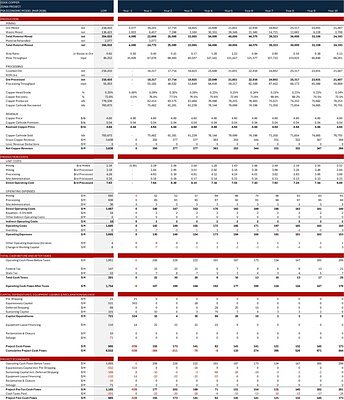
The PEA, prepared in accordance with National Instrument 43-101 standards, paints a robust financial picture for the Zonia project. Using a base-case copper price of $4.60 per pound, the study estimates an after-tax NPV of $488 million (at an 8% discount rate) and a strong internal rate of return (IRR) of 23.4%. Under this scenario, the project would generate nearly $1 billion in free cash flow and pay back its initial investment in just four years.
The economics become even more compelling when considering the current spot market for copper. At a price of $5.98 per pound, Zonia's after-tax NPV more than doubles to an impressive $1.07 billion, with the IRR soaring to 40.9%. The payback period shortens dramatically to just over two years, highlighting the project's significant leverage to rising copper prices.
This profitability is underpinned by a manageable cost structure. The total initial capital required to build the mine is estimated at $524.5 million, which includes a contingency of $81.2 million. Once operational, the all-in sustaining costs (AISC)—a comprehensive measure of production expenses—are projected to be a competitive $2.38 per pound of copper produced.
A Strategic Asset in a Copper-Starved World
The Zonia project emerges at a critical juncture for global industry. Forecasts from market analysts like S&P Global and Wood Mackenzie predict a massive structural deficit in the copper market within the next decade, with demand potentially outstripping supply by as much as 10 million metric tons. This surge is fueled by the accelerating global energy transition.
Electric vehicles, which use up to four times more copper than conventional cars, and the build-out of renewable energy infrastructure are primary drivers. More recently, the explosive growth of artificial intelligence has created a new, power-intensive demand center, as data centers require vast amounts of copper for grid connections and internal wiring.
Against this backdrop, Zonia's location on private land in Arizona—a state with a long and established history of copper mining—positions it as a strategic asset for U.S. industrial and national security. The project is designed to produce London Metal Exchange (LME) grade A copper cathodes on-site, providing a direct source of refined, high-purity copper for the domestic market and reducing reliance on complex international supply chains.
The Path Forward: Unlocking Zonia's Full Potential
While the PEA establishes a strong economic foundation, Edge Copper's leadership emphasizes that this is just the beginning. "These results highlight a solid economic foundation and represent only an initial indication of Zonia's potential as they are based on historical data," commented Edge Copper's Chair and CEO, Gil Clausen, in a press release.
The company sees significant opportunities to enhance the project's value. An inaugural 54,000-foot drill program, which began in January, is currently underway. Its primary goals are to expand the known mineral resource, potentially extending the mine's 10-year life, and to upgrade existing inferred resources to higher-confidence categories. The results of this program will be incorporated into an updated Mineral Resource Estimate in the fourth quarter of 2026.
To execute this, Edge Copper is deploying advanced technology through a partnership with Resource Exploration Strategies (RXS). By using high-resolution core scanning and AI-powered geological analysis, the company aims to improve data quality, refine its geological model, and optimize drill targeting, thereby de-risking and accelerating the expansion process. Further metallurgical test work is also planned to explore methods, such as finer crushing, that could improve the 72.8% copper recovery rate assumed in the PEA.
The most significant hurdle for the junior exploration company will be securing the $524.5 million in initial capital. With a current cash position of around $10 million, Edge Copper will need to pursue a combination of equity financing, debt, or strategic partnerships to fund the mine's construction. The robust economics detailed in the PEA will be central to attracting that investment.
Anatomy of a Modern Copper Mine
The Zonia project is envisioned as a conventional open-pit mining operation coupled with a modern and efficient processing circuit. Over its life, the mine is expected to move 354 million tons of material, with a very low strip ratio of 0.6 tons of waste for every ton of resource, which helps keep mining costs down.
The mined ore, with an average grade of 0.25% copper, will be processed using a heap leach and solvent extraction-electrowinning (SX-EW) method. This well-established technology is particularly effective for the type of oxide-dominant copper resource found at Zonia. The company has also noted the processing facility is designed as a closed-circuit, zero-discharge system, a key consideration for operations in an arid environment like Arizona.
The project benefits from existing infrastructure, including road access and an upgradeable power line at the site, which helps contain capital costs. With a clear roadmap that includes an updated resource estimate this year and a more detailed pre-feasibility study slated for 2027, Edge Copper is systematically advancing Zonia towards becoming a key new source of American copper.