
- 950 MW capacity: The world's largest single-site Concentrated Solar Power and Photovoltaic (CSP-PV) project.
- $2.5 billion in syndicated loans secured for the project, with $400 million committed by the Agricultural Bank of China.
- 1.6 million tonnes of CO2 emissions reduced annually, powering 320,000 households in Dubai.
Experts view this project as a groundbreaking model for green finance and renewable energy, demonstrating how international collaboration and innovative financial structures can accelerate the global transition to sustainable energy.
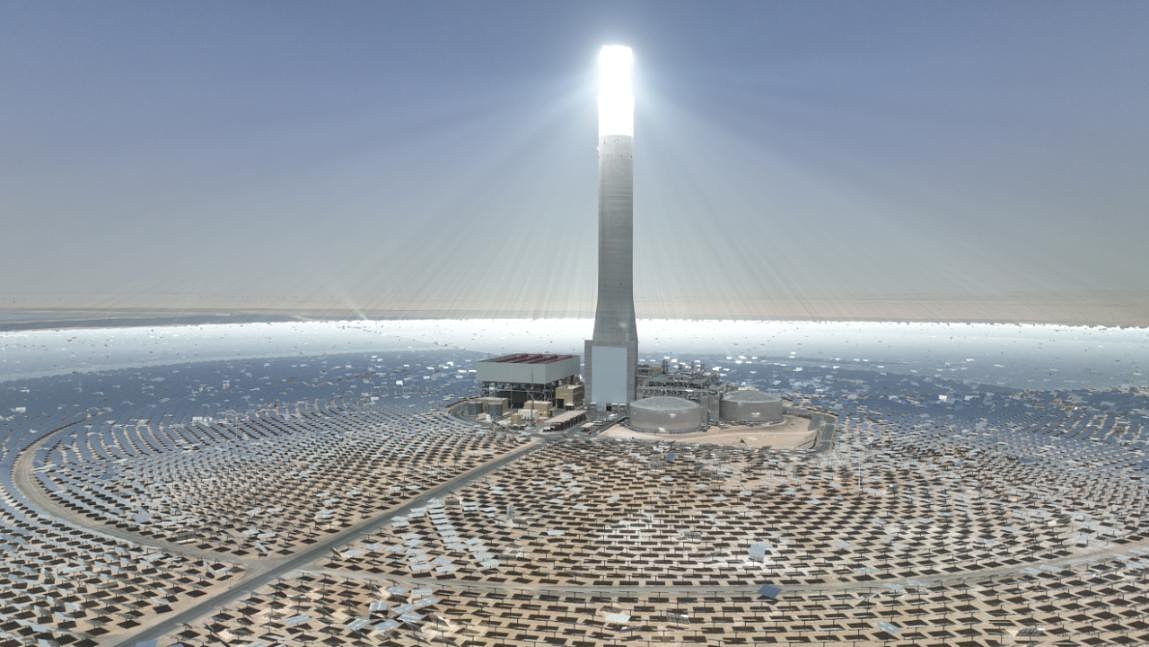
Dubai's Solar Titan: A New Blueprint for Global Green Finance
DUBAI, UAE – March 27, 2026 – By Sharon Kelly
Rising from the sun-scorched sands of the Dubai desert, a sprawling network of mirrors and panels now stands as a testament to a new era of energy. The Mohammed bin Rashid Al Maktoum Solar Park's 950-megawatt (MW) fourth phase, the largest single-site Concentrated Solar Power and Photovoltaic (CSP-PV) project in the world, is now fully operational. More than just a power plant, this colossal undertaking represents a confluence of technological ambition, international cooperation, and a groundbreaking financial strategy that could reshape how the world funds its transition to green energy.
Spanning an area of 4,300 hectares, the project is a cornerstone of the UAE's bold vision to achieve net-zero emissions by 2050. Its completion marks a critical milestone, not only for Dubai's energy independence but also as a flagship achievement for China's Belt and Road Initiative (BRI), demonstrating a significant pivot towards sustainable development.
A New Dawn for Green Finance
Large-scale renewable energy projects in emerging markets have historically faced a treacherous financial landscape, often hampered by massive upfront costs, uncertain revenue streams, and the complexities of cross-border investment. The Dubai solar project was no different, requiring a staggering $2.5 billion in syndicated loans to move from blueprint to reality.
The solution came through an innovative financing architecture pioneered by the Agricultural Bank of China (ABC)'s Dubai branch. Acting as a joint mandated lead arranger and committing $400 million of its own funds, ABC orchestrated a syndicate of international lenders. The model's key innovation was to create a close partnership between the financiers and the project's Engineering, Procurement, and Construction (EPC) contractor, Shanghai Electric.
This integrated approach tackled several critical challenges head-on. To manage risks associated with a high debt-to-equity ratio, the financing structure incorporated a "cash sweep mechanism." This financial tool mandates that any surplus cash flow generated by the plant in its early years is used to prepay debt, providing an extra layer of security for lenders and accelerating their return on investment. Furthermore, the disbursement of funds was meticulously synchronized with construction milestones under rigorous drawdown conditions, ensuring capital was deployed efficiently and effectively, with emergency mechanisms in place to prevent delays.
This financial model is being heralded as a replicable template for the "Green Belt and Road," offering a pathway to de-risk and unlock capital for vital infrastructure projects across the Middle East, Central Asia, and beyond. It signals a strategic evolution of the BRI, emphasizing sustainable investments and showcasing China's capacity to provide sophisticated green finance solutions on the global stage.
Engineering an Energy Revolution
The project's financial innovation is matched only by its engineering prowess. The 950MW plant is a hybrid marvel, combining three distinct technologies to optimize power generation: 600MW from a parabolic basin complex, 250MW from traditional photovoltaic panels, and a groundbreaking 100MW from the world's tallest CSP tower, which soars to a height of 263 meters.
This CSP tower is the heart of the project's most revolutionary feature: the ability to generate power 24/7. A vast field of heliostats—computer-controlled mirrors—tracks the sun and focuses its energy onto a receiver at the top of the tower. This intense heat is used to melt salt, which is then stored in a massive thermal tank. The molten salt, acting as a giant thermal battery, retains its heat for up to 15 hours, allowing the plant to drive steam turbines and generate electricity long after the sun has set.
This massive energy storage capacity overcomes the primary drawback of traditional solar power—its intermittency. By providing a stable and continuous supply of clean energy, the plant functions more like a conventional baseload power station, a critical requirement for grid stability. The successful deployment of this technology at such a scale provides a viable path for regions heavily dependent on sunshine to achieve true energy independence from fossil fuels.
A Partnership Forging the Future
The successful delivery of this megaproject is a story of powerful international collaboration. The vision was driven by the Dubai Electricity and Water Authority (DEWA), the state utility at the forefront of the UAE's clean energy transition. The project was co-developed by Saudi Arabia's ACWA Power, a global leader in power generation and a major equity stakeholder in the operating company, Noor Energy 1.
The immense task of construction fell to Shanghai Electric Group, a Chinese industrial giant that served as the EPC contractor. Their ability to execute the complex engineering and navigate logistical challenges was crucial. Together, this consortium of entities from the UAE, Saudi Arabia, and China created a powerful synergy of vision, capital, development expertise, and technical execution.
This multi-national partnership demonstrates a successful model for BRI projects, integrating the strategic goals of the host nation with the financial and industrial capabilities of Chinese firms and the expertise of regional power players. The project's success serves as a powerful demonstration for other nations seeking to attract large-scale investment for their own national infrastructure priorities.
Powering Progress Beyond the Grid
The impact of the Mohammed bin Rashid Al Maktoum Solar Park's fourth phase extends far beyond its physical footprint. The clean electricity it generates will power over 320,000 households in Dubai and slash the emirate's carbon dioxide emissions by more than 1.6 million tonnes annually—a significant step towards its climate goals.
Economically, the project has been a powerful engine for growth. During its construction and operational phases, it created an estimated 4,000 direct and over 10,000 indirect jobs, fostering a new skilled workforce in the green energy sector. It significantly enhances the UAE's energy security by diversifying the power grid away from a heavy reliance on natural gas, insulating the economy from volatile global energy markets.
Ultimately, the project helps solidify Dubai's position as a global hub for innovation and sustainability. By investing in a future powered by clean energy, the emirate is not only safeguarding its environment but also building a diversified, knowledge-based economy. The light radiating from this solar titan in the desert illuminates a path for sustainable development that other nations around the world will be watching closely.