
- 4.8 km: Length of the autonomous bus route in Sälen, Sweden
- Level 4 autonomy: The bus operates without human intervention on its predefined route
- 20 times per second: The AI system analyzes the vehicle's surroundings to react to dynamic challenges
Experts view this deployment as a major milestone proving that autonomous public transport can operate safely and efficiently even in extreme winter conditions, marking a shift from pilot projects to real-world commercial viability.
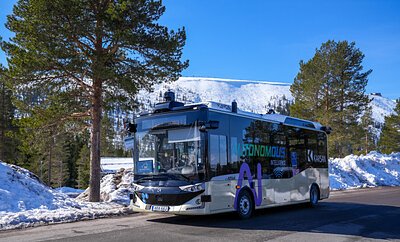
Driverless Bus Conquers Swedish Alps in World-First Service
SÄLEN, SWEDEN – April 20, 2026 – In a landmark achievement for autonomous transportation, a self-driving electric bus has successfully completed a month of commercial passenger service in the heart of a Swedish ski resort, navigating heavy snowfall, icy roads, and crowds of skiers. The Karsan Autonomous e-ATAK, operating in the mountainous region of Sälen, has proven that driverless technology is no longer confined to sunny test tracks, marking a pivotal shift from pilot projects to real-world viability.
The deployment is part of the Sälen–Idre Autonomous Public Transportation Project (SIKTA), a forward-thinking collaboration between Turkish manufacturer Karsan, the municipalities of Malung-Sälen and Älvdalen, local businesses, and Dalarna University. After rigorous testing that began in January 2026, the vehicle earned its operational permit from the Swedish Transport Agency (Transportstyrelsen) on March 9, 2026, and immediately began ferrying tourists and locals along a 4.8-kilometer route connecting ski areas with accommodation points during the busiest part of the winter season.
A Technological Triumph Over Winter's Fury
The success in Sälen represents a significant engineering milestone, conquering what is widely considered one of the most hostile environments for autonomous systems. The Karsan e-ATAK operates at Level 4 autonomy, meaning it can perform all driving functions on its predefined route without any human intervention.
To navigate the treacherous conditions, the bus is equipped with a sophisticated array of sensors. Multiple LiDAR units scan the environment with lasers to create a 3D map, high-resolution radar penetrates snow and fog to detect obstacles, and a suite of RGB cameras provides visual data. This information is fused and processed by an advanced AI system that analyzes the vehicle's surroundings approximately 20 times per second, allowing it to react instantly to dynamic challenges like skiers crossing the road, sudden whiteouts, or other vehicles.
This constant data feed, supported by a high-precision GNSS navigation system, allowed the e-ATAK to maintain its route and schedule with unwavering safety and reliability. The approval from Transportstyrelsen was not granted lightly; it came only after the vehicle demonstrated its capability to handle the complex interactions and unpredictable weather that define a bustling ski resort, setting a new global benchmark for autonomous safety validation.
"With this project we have launched in Sälen, we have demonstrated that autonomous mobility can operate safely and seamlessly even in winter tourism regions one of the most challenging use cases for autonomous mobility," said Karsan CEO Okan Baş. "This application is strong evidence that autonomous public transportation has moved beyond being a pilot technology and has become an integral part of real life."
Redefining Sustainable Slopes and Smart Tourism
Beyond the technological feat, the SIKTA project serves as a powerful model for the future of sustainable tourism. By deploying a zero-emission electric bus, the initiative directly addresses the environmental impact of transportation in pristine natural areas. The quiet operation of the e-ATAK reduces noise pollution, enhancing the tranquil atmosphere of the mountain resort.
Furthermore, autonomous driving technology itself can contribute to greater efficiency. Studies on similar electric buses have shown that the smooth, calculated acceleration and braking performed by an AI can reduce energy consumption by 10-15% compared to manual driving, extending vehicle range and lowering operational costs.
The project is more than just a bus route; it's an integrated mobility solution designed to improve the visitor experience. By providing reliable, on-demand transport between key points, it reduces dependence on private cars, easing traffic congestion and parking shortages during peak season. This successful implementation in Sälen is now being viewed by other tourism-dependent regions as a blueprint for creating smarter, greener, and more accessible infrastructure.
Navigating a Competitive and Evolving Market
Karsan's achievement in Sweden places it at the forefront of a competitive race to commercialize autonomous public transport. While major players like Volvo Buses and Mercedes-Benz have made significant strides, their progress has often been in more controlled settings. Volvo has focused on depot automation and conducted trials in partnership with universities, while Mercedes-Benz's notable "Future Bus" demonstration in 2016 involved a lower level of semi-autonomous technology.
The Sälen deployment is distinct in that it represents the world's first instance of a Level 4 autonomous bus carrying ticketed passengers on open public roads in such extreme weather. This real-world commercial operation moves the company past the pilot-project stage that has defined the industry for years. It builds on Karsan's existing autonomous deployments in a dozen countries, including the USA, Norway, and France, but the harshness of the Swedish winter provides a unique and powerful validation of its technology's robustness.
This success is expected to pave the way for broader-scale operations. The SIKTA project is already planning a second phase to bring the autonomous service to Idre, another major Swedish winter tourism hub. Karsan also has plans for further expansion in Europe, with a passenger service scheduled to begin in Gothenburg, Sweden, in August 2025.
The Road Ahead: Regulation and Global Scalability
The successful operation in Sälen arrives at a critical moment as regulators worldwide grapple with creating a legal framework for self-driving vehicles. The European Union is working towards a unified regulatory system by 2026, while the UN Economic Commission for Europe (UNECE) is poised to adopt a global regulation on Automated Driving Systems in June 2026. This landmark UN regulation aims to harmonize safety standards and validation methods, preventing a patchwork of national laws and accelerating market access.
Projects like SIKTA provide regulators with invaluable real-world data, demonstrating that the technology can be deployed safely and responsibly. As Karsan and its partners look to expand the service, their operational success will serve as a crucial case study, influencing policy and public acceptance. The lessons learned on the snowy roads of Sälen are not just about a single bus route; they are helping to chart the course for a future where autonomous, sustainable public transportation becomes a common feature of cities and remote destinations alike.