
- 3.5 million gallons: The DoD mandate requires destruction of this amount of PFAS-contaminated firefighting foam and wastewater from military bases.
- $9.3 billion: The estimated future cleanup costs for PFAS contamination at military sites, as reported by the GAO in early 2025.
- 99.99%: The destruction efficiency of Supercritical Water Oxidation (SCWO) technology in breaking down PFAS molecules.
Experts agree that the DoD's mandate for verified destruction of PFAS represents a critical policy shift, favoring permanent elimination over disposal, and positioning advanced technologies like SCWO as essential solutions for addressing widespread environmental contamination.
DoD Mandate Ignites Market for 'Forever Chemical' Destruction Tech
COLUMBUS, OH – March 11, 2026 – A landmark federal directive issued in February is reshaping the multi-billion-dollar challenge of cleaning up military contamination, creating an urgent demand for technologies that can permanently destroy toxic “forever chemicals.” The new guidance from the Department of Defense (DoD) effectively greenlights a new phase in the war on Per- and Polyfluoroalkyl Substances (PFAS), prioritizing verifiable destruction over simple disposal and positioning a handful of specialized companies to tackle one of the nation's most widespread environmental crises.
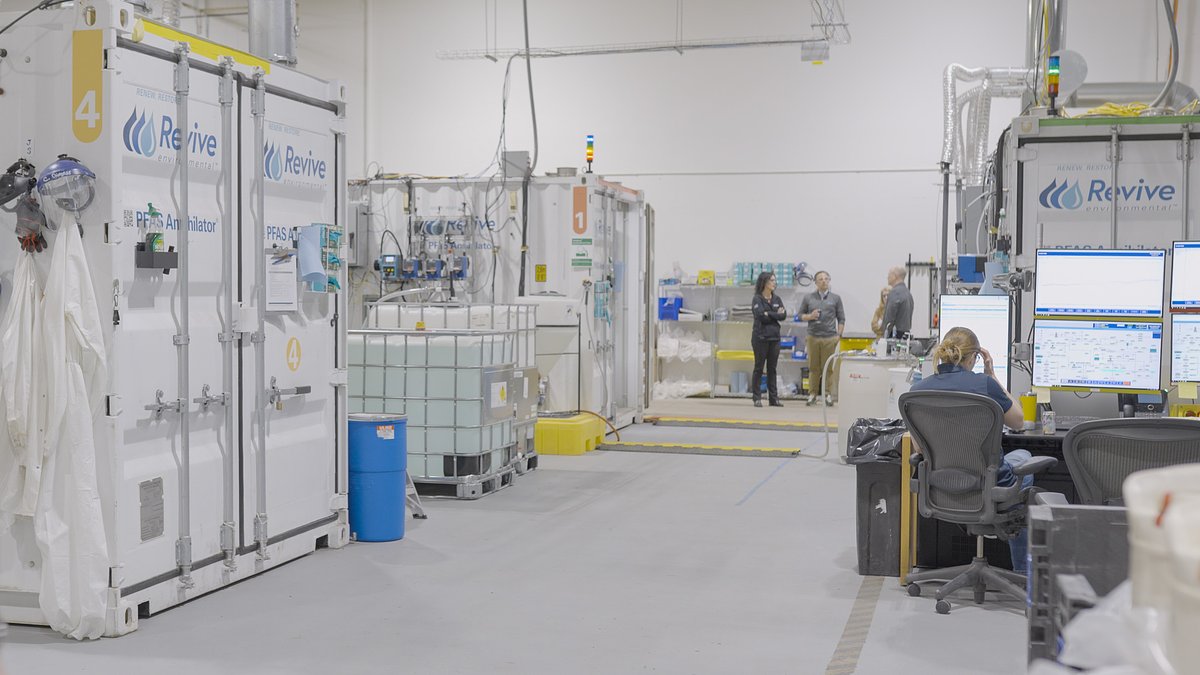
Among those poised to answer the call is Revive Environmental, an Ohio-based firm that claims to operate the nation's only commercially permitted, large-scale facility using a high-tech method called Supercritical Water Oxidation (SCWO). The DoD’s mandate requires that over 3.5 million gallons of concentrated firefighting foam and related wastewater from military bases be destroyed by companies holding specific environmental permits and providing documented proof of destruction. With the military ordered to cease using PFAS-laden Aqueous Film-Forming Foam (AFFF) by October 2026, the race for compliant solutions is on.
“Regulators and base commanders have consistently looked for the same thing, verified destruction at a permitted facility,” said Rick Gillespie, Chief Executive Officer of Revive Environmental, in a statement. “That is how we have operated since we opened our first permitted facility in 2023.”
A New Directive in the War on 'Forever Chemicals'
The DoD's updated guidance, “Updated Interim Guidance on Destruction or Disposal of Materials Containing Per- and Polyfluoroalkyl Substances,” represents a significant policy shift. For decades, the extensive use of AFFF in training exercises and emergencies has led to severe PFAS contamination of soil and groundwater at over 700 military sites. These chemicals, which do not break down naturally, have been linked to serious health problems, including cancer, immune system dysfunction, and developmental issues, creating a public health crisis for service members, their families, and surrounding communities.
The financial burden is staggering. The Government Accountability Office (GAO) reported in early 2025 that the DoD’s estimated future cleanup costs had surged to over $9.3 billion, a figure that many analysts believe is still conservative. The new guidance aims to stop the cycle of merely moving these persistent chemicals from one place to another—such as to landfills, from which they can leach back into the environment. By mandating permitted and verified destruction, the DoD is creating a clear standard that favors permanent elimination, a move applauded by environmental advocates and technology providers alike.
The Technology Tearing Apart PFAS
At the heart of this new chapter in environmental remediation is the technology itself. Revive Environmental's patented PFAS Annihilator® system employs Supercritical Water Oxidation (SCWO), a process that uses water in a unique state to achieve what was once thought impossible: breaking the famously strong carbon-fluorine bond that makes PFAS so persistent.
SCWO works by subjecting PFAS-contaminated water to extreme temperatures and pressures, bringing the water beyond its critical point (374°C and 22.1 MPa). In this supercritical state, water acts as a powerful solvent for organic compounds, and when an oxidant is introduced, it rapidly and completely breaks down the PFAS molecules. The end products are simple, non-hazardous substances: carbon dioxide, water, and inorganic fluoride salts.
Scientific studies have consistently validated the efficacy of SCWO, with multiple research initiatives demonstrating destruction efficiencies greater than 99.99%. Unlike incineration, which has faced public backlash and regulatory bans over concerns about releasing partially combusted toxic byproducts into the air, SCWO is a closed-loop system with manageable, treated emissions. While the technology is energy-intensive and presents engineering challenges related to corrosion and salt precipitation, its proponents argue these are solvable issues that are far outweighed by the benefit of permanent, verifiable destruction.
A Market in Motion: The Race to Remediate
Revive Environmental’s readiness is no accident. The company was spun out in 2022 as a partnership between Battelle, the world’s largest nonprofit applied science organization, and investment firm Viking Global Investors. This combination of deep scientific expertise and significant financial backing allowed the company to scale its PFAS Annihilator® technology and navigate the complex regulatory landscape to secure commercial permits, giving it a crucial head start.
The DoD’s directive has effectively fired the starting pistol for a competitive market. While Revive highlights its unique position with a permitted, at-scale SCWO facility, other companies are deploying a range of technologies. Competitors like 374Water are also advancing SCWO systems, while others are championing different methods. Clean Harbors continues to offer high-temperature incineration, and emerging players are promoting solutions like hydrothermal processing, electrochemical oxidation, and plasma vortex technology. The key differentiator, however, will be the ability to meet the DoD's stringent requirements for permitting, regulatory acceptance, and documented performance on a commercial scale.
This new policy landscape is forcing a critical evaluation of risk and liability. The military, like many industries, is shifting its focus from short-term disposal to long-term elimination to avoid future legal and environmental consequences. “As activity continues to accelerate at sites across the country, it is more important than ever to choose solutions that do not simply postpone PFAS liability, but eliminate it,” Gillespie stated. He affirmed that his company has commercially available solutions ready to meet the DoD’s immediate needs, a capability that will be vital in the coming months as the October deadline approaches.